
Show summary Hide summary
Halting two luxury cars to build a million robots a year. Funding an AI lab with $2 billion, then quietly preparing a space company for Wall Street. Elon Musk’s latest moves feel less like routine restructuring and more like a single, audacious bet on the future.
Seen together, Tesla, SpaceX and xAI now look like one giant project: an integrated platform of technology, innovation and compute designed to redefine work, cities and even Earth orbit.
Elon Musk presses pause on cars to chase robots
The decision surprised fans of electric vehicles. Tesla announced it is halting production of the Model S and Model X to convert their lines into a factory dedicated to Optimus humanoid robots. These iconic vehicles are making way for an army of machines designed to work alongside humans.
Satellites Reveal Hidden Flaws in Bridges Across America and Beyond
New Study Reveals AI Enthusiasm Amidst Poor Preparation
Elon Musk’s stated goal: 1 million third-generation Optimus robots per year once the new factory reaches full speed. For a company that symbolized the rise of the electric car, this pivot to robotics marks a new stage in its visionary strategy, already outlined in presentations dedicated to self-driving cars and AI, as explained by analyses of Musk’s 2025 vision for autonomy and human enhancement.
A factory turning into a robot foundry
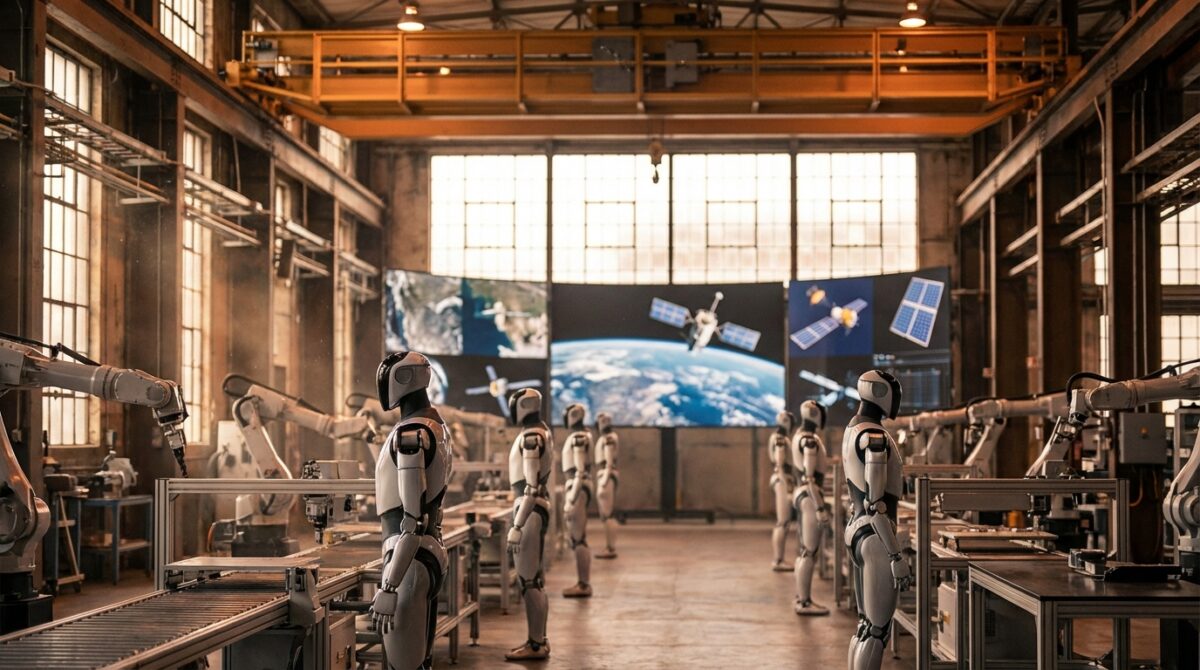
In the new setup, each former car-assembly cell becomes a station to build and test bipedal robots. These machines will need to operate in warehouses, factories and, eventually, public buildings. They will make real Musk’s promise of a future economy where physical work is largely automated.
To get there, Tesla is relying on its expertise in batteries, sensors and electric motors. The legacy of electric vehicles doesn’t disappear; it migrates into mechanical bodies that can walk, carry, handle—and perhaps one day assist in hospitals or farms. This shift illustrates a form of entrepreneurship where the factory becomes a living lab for large-scale robotics.
Why AI and space are suddenly in the same sentence
At the same time, Tesla has committed to investing $2 billion in xAI, the company behind the Grok chatbot and the social platform X. That money will fund more powerful AI models capable of orchestrating fleets of robots, autonomous vehicles and, potentially, orbital infrastructure.
According to reports relayed by Bloomberg and Reuters, Elon Musk is now exploring a capital tie-up between SpaceX and Tesla or xAI—or even a combination of all three. The aim would be to prepare SpaceX for an IPO, while creating an industrial block in which AI, space exploration and terrestrial hardware reinforce one another.
Data, rockets and an orbital nervous system
For Merve Hickok, an AI specialist at the University of Michigan, the idea would be to pool data, energy and computing power. Tesla would bring a global network of vehicles—and soon robots—that could serve as distributed computing endpoints. SpaceX, with Starlink and its thousands of satellites, would provide orbital connectivity.
xAI, for its part, would develop the digital brains that orchestrate the whole system. In this logic, space becomes an extension of the cloud. Low Earth orbit, already used by Starlink, turns into an additional layer of digital infrastructure—similar to projects describing lunar travel in articles about future NASA missions around the Moon, but applied this time to data centers rather than human crews.
Inside the tech: AI, power and orbital data centers
Training a humanoid robot to walk in a factory, avoid humans, manipulate fragile objects and understand natural instructions requires giant AI models. These systems consume massive volumes of data and considerable electrical energy—already at the heart of debates on digital sustainability.
xAI’s Colossus data center in Memphis has also been called out by the U.S. Environmental Protection Agency for exceeding permitted electricity-generation capacity. This warning highlights the dilemma: AI innovation is moving faster than energy infrastructure, even in a context of rapidly growing renewable energy.
Why Musk talks about putting data centers in orbit
At the World Economic Forum in Davos, Elon Musk described space-based data centers as a “no-brainer,” suggesting deployment within two to three years. Sending servers into orbit could ease some terrestrial networks and tap energy production in space—a theme echoed in debates about technology aimed at abundance.
However, this vision runs into concrete obstacles: cooling in a vacuum, protection against radiation, and maintenance hundreds of kilometers above Earth. SpaceX nevertheless has unique experience in commercial space exploration, with thousands of Starlink satellites already in orbit. That fleet could serve as a testbed for onboard computing modules designed to operate for years in the cold of space.
Money, risk and the real motive behind the mega-merger
Behind the futuristic storytelling, some analysts see another narrative. Edward Niedermeyer, author of an in-depth investigation into Tesla, views this potential merger as a defensive move. In his view, Tesla remains the only entity in the group generating sufficient cash flows to fuel the AI and space dreams.
The training and operating costs of the latest-generation models have become staggering. Each new model brings a massive bill for servers, specialized chips and energy. To attract public capital, consolidating SpaceX, Tesla and xAI into a package that Wall Street can easily read could make the bet more appealing to investors willing to back a visionary leader.
What this means for everyday life on Earth
For an urban planner like Sofia, these moves aren’t science fiction. Fleets of robots and autonomous vehicles could transform logistics, reduce certain accidents and smooth traffic—much like the scenarios described in studies on autonomous vehicles in the cities of the future. Starlink networks can already connect rural regions where fiber will never reach.
The question is whether this transformation will strengthen sustainability or amplify energy and digital inequalities. Factory robots can reduce some dangerous work, but they also raise questions about jobs and the future organization of work—at the heart of debates on AI and the human role in the economy to come.
Why Musk’s bet matters for our shared future
Beyond the man himself, Elon Musk’s initiative highlights a historic turning point: the convergence of electric vehicles, humanoid robots, satellites and large-scale AI. What yesterday belonged to separate industries is becoming a single ecosystem, driven by a handful of global platforms.
For readers already following his positions—whether his influential reading list described in the books that shaped his vision or his future predictions covered in many profiles—this potential merger looks like a logical next step. It still raises a question: who will control the cognitive and energy infrastructure that cities, transport and communications will depend on in a few decades?
- For scientific research: AI-equipped satellite constellations can improve climate observation, water management and disaster forecasting.
- For energy: rising demand for computing power pushes faster investment in solar, wind and storage, with potential benefits for households.
- For citizens: the promise of technological abundance comes with debates on privacy, regulation and how benefits are shared.
The potential deployment of orbital data centers, the mass production of robots and the merger of tech giants are not just company news. They reshape the tools through which humanity will measure climate, organize cities and explore space—tightly linking space exploration, sustainability and the future of society.
What is Elon Musk trying to achieve by merging Tesla, SpaceX and xAI?
The consolidation aims to create a tightly integrated platform combining rockets, satellites, electric vehicles, humanoid robots and advanced AI. SpaceX would provide launch capacity and orbital infrastructure, Tesla would supply hardware, energy and manufacturing, while xAI would deliver the intelligence to coordinate everything. Together, they could form a powerful ecosystem that shapes transportation, automation and digital services for decades.
How does this strategy affect electric vehicle owners today?
Current Tesla owners will still receive software updates, maintenance and support. The shift away from Model S and X production mainly impacts future product lines, not existing cars. However, AI and robotics work may accelerate improvements in autonomous driving, energy management and safety features that eventually benefit vehicles on the road.
Are space-based data centers realistic in the near future?
The concept faces serious engineering and cost challenges, such as cooling, radiation protection and in-orbit maintenance. Yet SpaceX’s experience with reusable rockets and large satellite constellations gives Musk an advantage to experiment. In the short term, we are more likely to see incremental steps, such as satellites with enhanced onboard processing, rather than full-scale orbital data centers.
What are the main risks of this mega-bet on AI and space?
How One City Boosted Bus Speeds by 20% with AI
Kansas City Missouri Leads with New Data Center Ordinance
Key risks include enormous capital requirements, regulatory scrutiny over energy use and data, and technical uncertainties around large-scale robotics and orbital infrastructure. There is also a social risk: rapid automation could disrupt jobs and deepen inequalities if policies, education systems and safety nets do not evolve alongside technological progress.
Why does this matter for climate and sustainability?
Satellite networks and advanced AI can improve climate monitoring, optimize renewable energy grids and reduce waste in logistics. At the same time, training massive AI models and launching hardware into space consumes significant energy and materials. The overall impact on sustainability will depend on how quickly clean energy scales and how responsibly these technologies are deployed.