Show summary Hide summary
- How humpback whale bubble feeding actually works
- New evidence of social learning in whale communities
- Climate stress, heatwaves and behavioral spread
- How scientists decode communication and coordination
- What this whale culture teaches about our own future
- Lessons for science, policy and everyday life
- What is clever bubble feeding in humpback whales?
- How do humpback whale communities learn the feeding technique?
- Why did bubble-net feeding spread faster after the marine heatwave?
- Are humpbacks the only whales capable of bubble-net feeding?
- How does this research on humpback culture help protect oceans?
When food in the North Pacific suddenly became scarce, humpback whales did not only swim farther. They changed culture. A single Clever Bubble Feeding trick began to ripple through whale communities, turning scattered individuals into coordinated hunting teams able to survive a stressed ocean.
This story of shared knowledge in marine mammals is reshaping how researchers think about animal societies, resilience, and even conservation strategies for a warming planet.
How humpback whale bubble feeding actually works
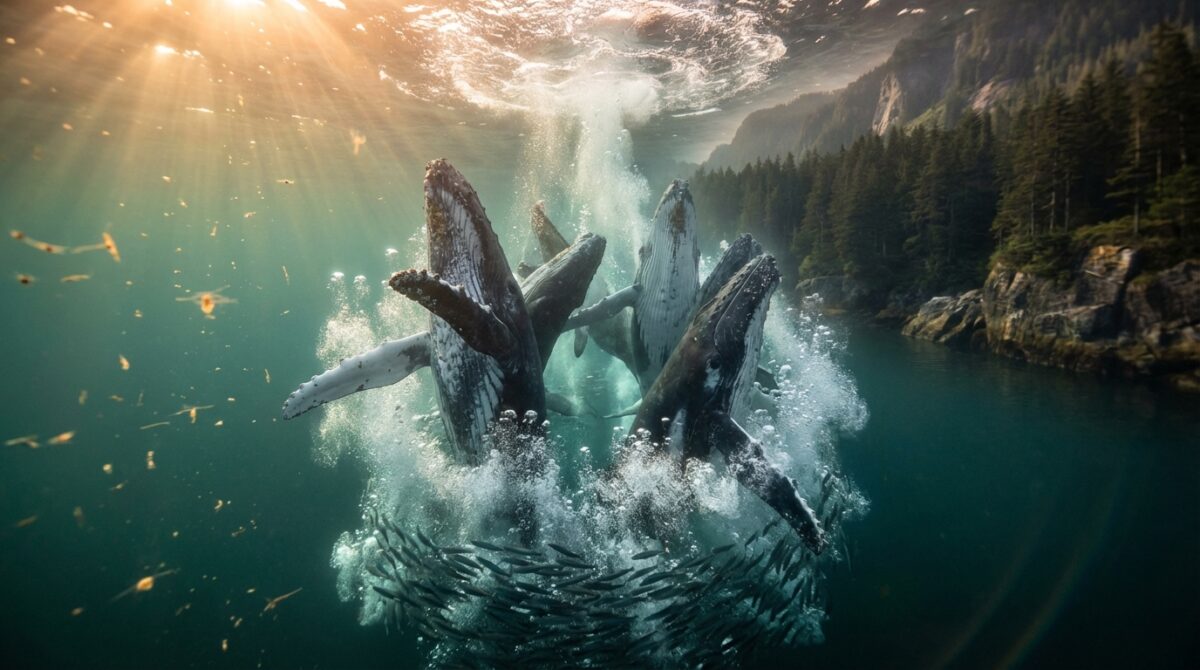
To understand the spread of this feeding technique, it helps to picture what happens beneath the surface. In British Columbia’s Kitimat Fjord System, groups of humpbacks dive below schools of herring, then one or more whales start blowing rising curtains of bubbles in a spiral.
Researchers Develop Slippery Nanopores to Boost Blue Energy Harvesting
Is Geothermal Energy Poised to Spark a Global Revival?
These bubbles form a moving cage that fish instinctively avoid, concentrating the prey into a dense column. At a precise moment, the whales coordinate and rush upward through the bubble cylinder, mouths agape, in a dramatic, synchronized strike that can capture thousands of fish at once. Analyses of this behaviour echo what has been long documented in Alaska and detailed in resources like how whales use bubbles to catch thousands of fish at once.
Only humpbacks have the right body for the job
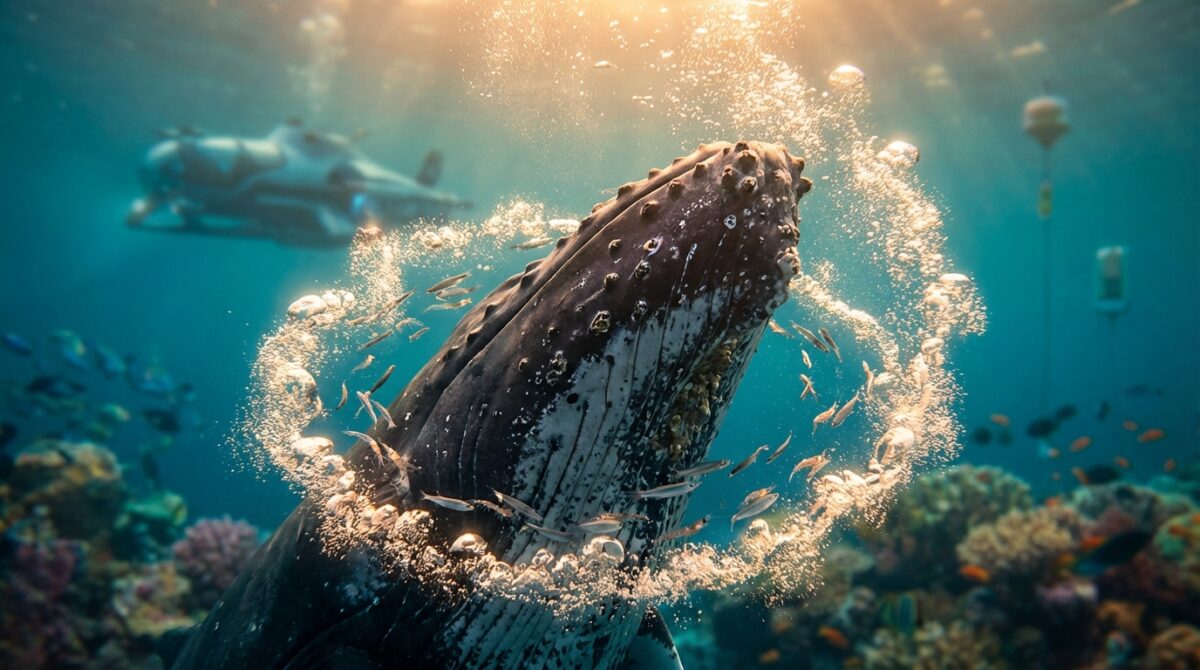
Not every baleen whale could pull this off. A University of Hawaiʻi at Mānoa project, covered in reports such as the UH study on humpbacks’ unique feeding skill, tested hydrodynamic models for seven species. The work showed that humpback whales alone can perform the tight, high-energy turns needed to lay down a neat bubble net.
Their long, manoeuvrable pectoral flippers act almost like underwater wings, creating agile banking motions while retaining speed. According to further coverage in analyses of bubble-net feeding capability, this anatomy sets humpbacks apart from other baleen whales that rely on more straightforward lunges.
New evidence of social learning in whale communities
The latest insight does not come from the physics of turning but from who learns from whom. A long-term study led by researchers at the University of St Andrews tracked 526 individually identified humpbacks in the Kitimat Fjord System between 2004 and 2023.
Each tail fluke acts like a fingerprint, enabling scientists to follow individuals over many seasons. Out of these whales, 254 were observed performing bubble-net feeding at least once, and around 90 percent of those events involved groups, revealing a strong cooperative pattern rather than isolated experimentation.
Immigrant whales as cultural carriers
One intriguing pattern emerged when the team matched behaviour with social associations. Whales were more likely to adopt the foraging strategy if they regularly swam with individuals that already used it, a signature of social learning rather than random discovery.
Analyses described in outlets such as reports on immigrant humpbacks sharing netting knowledge and coverage of cultural spread among immigrant humpbacks highlight how migrants from other North Pacific feeding grounds appear to introduce the technique, which then diffuses along stable social networks.
Climate stress, heatwaves and behavioral spread
The timing of this behavioral spread is not random. Researchers noticed a sharp rise in group bubble-net feeding after 2014, coinciding with a major North-East Pacific marine heatwave sometimes referred to as “the Blob.” Warmer waters disrupted plankton dynamics and reduced prey availability for many predators.
Under those conditions, whales that depended on scattered fish schools faced an energy deficit. Switching to a more efficient cooperative hunt could mean the difference between gaining or losing weight over a feeding season, making flexible culture a survival tool rather than a curiosity.
Why cultural transmission matters for conservation
This is where humpback culture intersects directly with human decisions. Conservation programmes typically track population size, migration routes, or bycatch risk, but they rarely examine whether key behaviours are rebuilding alongside numbers.
As commentators in pieces like reports on bubble feeding spreading through humpback groups and analyses of feeding trick diffusion point out, a humpback population that has lost its cooperative feeding culture may be numerically “recovered” yet still functionally fragile.
How scientists decode communication and coordination
Coordinating a precise spiral of bubbles in dark, turbulent water requires more than instinct. Acoustic recordings reveal calls exchanged during hunts, suggesting a sophisticated layer of communication that guides each whale’s role.
Research teams combine hydrophone arrays, drone footage and photo-identification to link specific calls with positions in the net. Enthusiasts can see the visual side in resources such as explanations of how humpbacks use bubble-net feeding and field descriptions from Alaska, where large groups sometimes include well over ten individuals.
Roles inside a clever bubble feeding team
Field observations suggest that not every participant behaves identically. Some whales appear to specialize in producing the bubble curtain, others deliver loud “feeding calls,” and some focus on the final upward lunge through the prey cloud.
This division of labour mirrors human teams under pressure: different roles, shared payoff. It also underlines why losing experienced “teachers” could damage group performance even if total whale numbers stay stable.
What this whale culture teaches about our own future
A guiding thread through this research is flexibility. When the ecosystem shifted, humpbacks from other regions brought a more efficient method, and local whales absorbed it through cultural transmission. That adaptability may help them cope with future disruptions.
For humans managing fisheries, shipping, and noise in the same fjords, understanding these cultural landscapes becomes part of responsible ocean planning. If bubble-net feeding hotspots overlap with coastal industry, measures such as seasonal slow zones or noise reduction can protect both animals and ecotourism livelihoods.
Lessons for science, policy and everyday life
Many readers will never see a bubble-net hunt in person, but the underlying principle is surprisingly close to everyday choices on Earth. Groups that share knowledge and adjust social norms faster tend to handle crises better than those that do not.
By tracking how whale communities exchange a complex hunting method, scientists gain a living model of resilience that can inform ecosystem-based management and inspire new ways of thinking about culture in non-human societies.
- For researchers: Bubble-net feeding offers a natural laboratory for testing theories of learning, cooperation and innovation in wild animals.
- For policymakers: Protecting behaviours, not only bodies, reframes marine reserves, shipping rules and climate adaptation plans.
- For the public: Following detailed explainers such as analyses of humpbacks’ exclusive bubble-net ability connects individual choices on emissions or seafood to the survival of these intricate cultures at sea.
What is clever bubble feeding in humpback whales?
Clever Bubble Feeding refers to a cooperative hunting strategy where humpback whales create spirals of bubbles to corral fish into a dense column. Once the prey is trapped inside this temporary barrier, the whales surge upward together with mouths wide open, capturing large quantities of fish in a single, coordinated strike. The behaviour combines precise movement, acoustic communication and social coordination within whale communities.
How do humpback whale communities learn the feeding technique?
Evidence from long-term studies in the Kitimat Fjord System shows that humpback whales learn this feeding technique through social learning. Individuals that frequently associate with experienced bubble-net feeders are much more likely to adopt the behaviour themselves. Migrant whales from other regions appear to introduce the method, and then it spreads along local social networks, illustrating a clear case of cultural transmission in marine mammals.
Why did bubble-net feeding spread faster after the marine heatwave?
After a major North-East Pacific marine heatwave around 2014, prey became less predictable and more dispersed. Under these tougher conditions, group bubble-net feeding offered a more efficient foraging strategy, helping whales maintain their energy intake. As a result, whales that could switch to this cooperative method had an advantage, which likely accelerated the behavioural spread through the population facing climate-related stress.
Are humpbacks the only whales capable of bubble-net feeding?
Scientists Transform Light into a Remote Control to Manipulate Crystals
5 Astonishing Facts Unveiling world’s largest hydroelectric dam
Hydrodynamic studies comparing several baleen whale species indicate that only humpbacks have the turning ability and flipper design required for classic bubble-net feeding. Their long, wing-like pectoral fins allow tight, controlled manoeuvres while generating spiral curtains of bubbles. Other baleen whales may use different lunge-feeding tactics, but the specific circular bubble-net structure appears to be unique to humpback whales.
How does this research on humpback culture help protect oceans?
By showing that survival can depend on shared knowledge as well as numbers, the research encourages conservation policies that protect key behaviours and social networks. Managers can prioritize safeguarding feeding hotspots, limiting disturbance where bubble-net hunts occur, and integrating cultural behaviour into assessments of population health. This approach links whale conservation with broader ecosystem management and highlights how cultural flexibility supports resilience in a changing ocean.