
Show summary Hide summary
- Water stress hotspots in the world’s largest cities
- From global water bankruptcy to local tap failures
- Floods, droughts and the paradox of too much or too little
- Engineering and nature-based solutions to urban water stress
- What cities and citizens can do now
- What does water stress mean for a large city?
- Why are so many of the world’s biggest cities facing water scarcity now?
- How does climate change influence urban water crises?
- Can technology alone solve global water shortage in cities?
- What practical steps can residents take to support sustainable water use?
When a city of 10 million people is days away from turning off the taps, water scarcity stops being a distant scenario and becomes a calendar date. Recent analysis shows that half of the world’s 100 largest cities now face high water stress, with 39 of them in zones of “extremely high water stress” where demand is already brushing against the limits of what nature can supply.
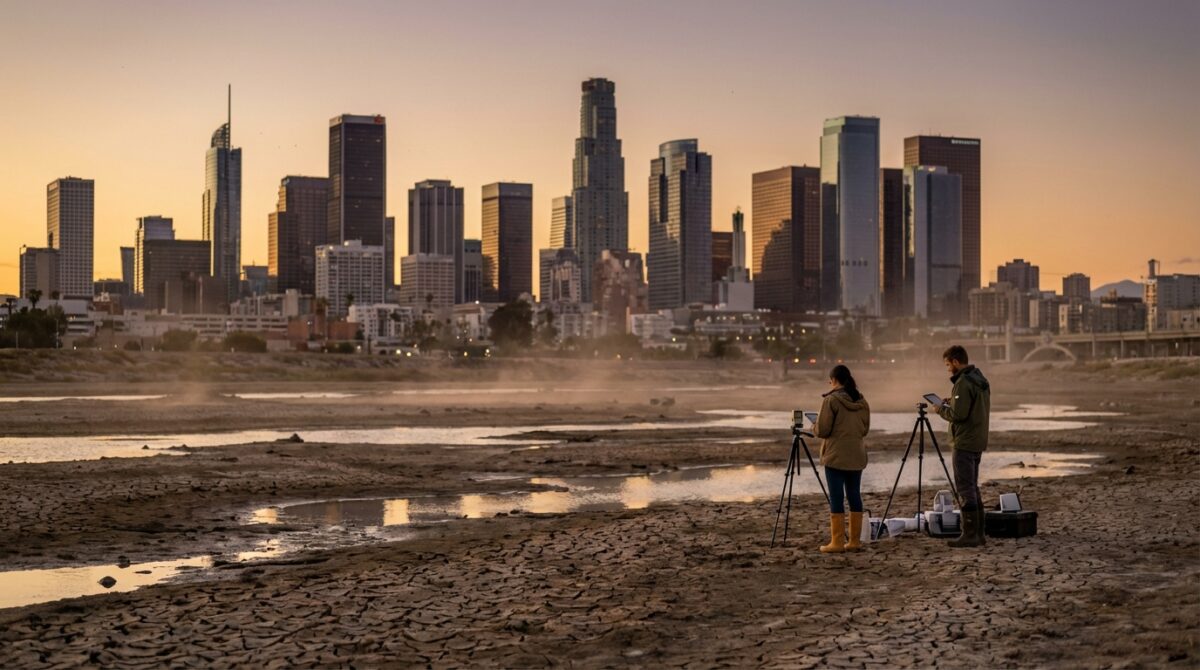
This urban water crisis is not confined to arid regions. Mapping by Watershed Investigations and independent media partners reveals that cities as different as Beijing, New York, Los Angeles, Rio de Janeiro and Delhi now sit in basins under extreme pressure. London, Bangkok and Jakarta fall into the “high water stress” category, where city water demand is already uncomfortably close to long‑term sustainable supply.
Water stress hotspots in the world’s largest cities
The picture becomes starker when city locations are overlaid on global water stress maps. In these 100 large cities, water withdrawals for households and industry are nearing, or sometimes overshooting, renewable supplies. This is what scientists mean by water stress: a chronic imbalance where the taps still run but the underlying system is stretched thin.
Six Decades of Data Reveal How Extreme Weather Severely Impacts Baby Birds
Researchers Unveil Seven Mysterious Frog-Inspired Insect Species Concealed within Uganda’s Rainforest
Researchers at University College London used NASA’s GRACE satellite mission to track changes in total water storage over two decades. Their analysis, echoed in work on global water security in Nature, separates cities into long‑term “drying” and “wetting” trends. About 1.1 billion people now live around cities in strong drying zones, while only about 96 million inhabit rapidly wetting regions, highlighting a deep geographic asymmetry.
Drying megacities and the rise of ‘Day Zero’ risk
Most of the urban centres in pronounced drying zones cluster across Asia, especially northern India, Pakistan and the Middle East. Cities such as Chennai, Tehran and Zhengzhou show steep declines in stored water. Tehran is entering its sixth consecutive year of drought, with national leaders warning that, without relief, the capital could eventually face evacuation to avoid an outright breakdown of supply.
By contrast, only a handful of large cities outside sub‑Saharan Africa appear in zones where water storage is increasing, including Tokyo and Santo Domingo. Yet “wetter” does not always mean safer. As mapped in a recent assessment of cities most at risk from water extremes, many fast‑growing African cities such as Lagos and Kampala face higher flood and stormwater risks as rainfall intensifies.
From global water bankruptcy to local tap failures
In 2025, UN scientists described the world as entering a state of “water bankruptcy”, a term unpacked in detail by researchers in a recent explainer on global water bankruptcy. The phrase does not mean all water is gone; it means that the long‑term “accounts” are in the red because over‑extraction and pollution have damaged rivers, aquifers and wetlands faster than they can recover.
According to the World Bank Group, global freshwater reserves are shrinking by about 324 billion cubic metres every year. That is roughly enough to meet the annual needs of 280 million people. These losses are spread across major river basins on every continent, intensifying global water shortage risks and leaving large cities exposed when droughts, heatwaves or infrastructure failures arrive together.
Climate impact, population growth and fragile infrastructure
Scientists emphasise that climate impact is an accelerant rather than the only driver. As Prof Kaveh Madani from the UN University Institute for Water, Environment and Health puts it, climate change is like “a recession on top of bad management”. Rapid population growth and urbanisation push city water demand higher, while ageing pipes leak treated water and polluted rivers undermine supplies.
Research on urbanisation and water stress shows that more than half of humanity now lives in cities, heading towards about 68% by 2050. Without smarter water management, this growth risks locking in an urban water crisis where both floods and shortages become more frequent. The phrase “no city is an island”, developed in analysis by the Center for Strategic and International Studies, captures this dependence on regional watersheds that stretch far beyond city boundaries.
Floods, droughts and the paradox of too much or too little
New international work with the charity WaterAid, UCL and Cardiff University, presented in a 2025 report on cities vulnerable to extreme climate shifts, highlights a paradox. Many of the world’s biggest cities are now exposed to both severe flooding and deep drought within the same decade. Colombo, Faisalabad and Surat, for example, are seeing more frequent “very wet” periods that heighten flood risk while still living with seasonal scarcity.
These dual threats show how climate impact disrupts the old assumption of stable averages. For planners, the challenge is not just supplying enough water in a dry year, but also safely moving it away when rivers burst their banks. Features from outlets tracking how cities are adapting to more flooding and drought underline that resilience means planning for both extremes together rather than treating them as separate problems.
England’s tight future: a local example of global stress
England provides a striking case study of a temperate country flirting with water stress. The national Environment Agency warns that by 2055 the country may need an extra 5 billion litres per day just for public supply, on top of today’s roughly 14 billion litres. Agriculture and energy generation together may need a further 1 billion litres daily, tightening the margins between demand and available resources.
Parts of southern England have already experienced localised water outages, which utilities blamed on winter storms. Regulators, however, had previously raised “serious concerns” about the resilience of those systems. In response, the government has outlined reforms in a new water white paper, proposing a chief water engineer role, infrastructure “MOT checks” and stronger regulatory powers to push companies toward sustainable water use.
Engineering and nature-based solutions to urban water stress
Despite the gravity of global water shortage trends, researchers are keen to stress that cities still have options. Case studies compiled in a global atlas of urban water security strategies show how investment, collaboration and innovation can gradually pull systems back from the brink. The most successful cities combine demand reduction, new supply sources and ecosystem restoration.
For example, some utilities are expanding groundwater recharge, storing excess winter rain in aquifers for dry months, an idea that UCL’s Mohammad Shamsudduha describes as unlocking a “hidden resource”. Others are investing in wastewater recycling, smart leak detection and green infrastructure such as wetlands or permeable pavements that both reduce flood peaks and improve water quality.
What cities and citizens can do now
To move from warning to action, experts consistently highlight a handful of priorities that both decision‑makers and residents can influence. Urban water stress is not inevitable; it is shaped by choices about consumption, planning and technology. A fictional homeowner in fast‑growing Lagos or a business manager in Los Angeles faces different constraints, yet both are part of the same bigger story.
- Cut demand intelligently: Cities can promote efficient appliances, district‑scale leak repairs and tariff structures that reward lower use without pricing out vulnerable households.
- Protect and restore watersheds: Reforesting upstream catchments, protecting wetlands and cleaning polluted rivers stabilise supplies and reduce treatment costs.
- Diversify water sources: Managed aquifer recharge, rainwater harvesting and reuse of treated wastewater reduce dependence on a single river or reservoir.
- Plan for extremes: Integrating flood defences, drought plans and early‑warning systems helps cities navigate both intense storms and multi‑year dry spells.
- Engage communities: Public awareness campaigns, citizen science and clear communication around risks build support for sometimes uncomfortable reforms.
Individual choices sit inside this larger frame. Exploring content on UN global water bankruptcy makes the scale of the challenge visible, yet everyday actions still matter. Simple steps such as fixing leaks, installing efficient fixtures or supporting policies for sustainable water use align household behaviour with long‑term urban resilience, just as investing in low‑carbon heating aligns home energy choices with climate goals.
What does water stress mean for a large city?
For a large city, water stress means that demand for water from households, industry and agriculture is close to or exceeding the amount that can be sustainably supplied from rivers, reservoirs and aquifers. The taps may still run, but the safety margin has eroded, making the city more vulnerable to droughts, pollution incidents or infrastructure failures. High water stress also signals growing competition between sectors and ecosystems for the same limited resource.
Why are so many of the world’s biggest cities facing water scarcity now?
Several forces are converging. Population growth and urbanisation drive up city water demand, while ageing infrastructure leaks large volumes of treated water before it reaches users. At the same time, climate change alters rainfall patterns, reduces snowpack in some basins and intensifies both droughts and floods. Poor planning, over‑extraction of groundwater and pollution of rivers and lakes compound these pressures, turning what could be manageable variability into structural water scarcity for many megacities.
How does climate change influence urban water crises?
Climate change influences urban water crises by shifting when and where rain and snow fall, raising temperatures and increasing evaporation. Many regions are seeing longer dry spells punctuated by more intense downpours. This combination can leave reservoirs empty at the end of the dry season, then overwhelm drainage systems when storms arrive. Higher temperatures also increase water use for cooling and irrigation. Together, these effects magnify existing weaknesses in water management rather than creating problems entirely on their own.
Can technology alone solve global water shortage in cities?
London, San Francisco, and Beijing Make Significant Strides in Slashing Air Pollution Levels
The Reappearance of a ‘Ghost’ Great White Shark Sparks New Questions in the Mediterranean
Technology can greatly reduce pressure on supplies, but it cannot solve global water shortage on its own. Desalination, wastewater recycling, smart meters and leak detection all help close the gap between demand and sustainable supply. Yet without governance reforms, ecosystem protection and fair pricing structures, these tools risk shifting problems elsewhere or benefiting only certain groups. Successful cities combine technology with transparent institutions, public engagement and long‑term investment in both infrastructure and natural systems.
What practical steps can residents take to support sustainable water use?
Residents can support sustainable water use by installing efficient taps, toilets and appliances, fixing household leaks promptly and reusing greywater where regulations permit. People can choose drought‑tolerant gardens instead of thirsty lawns, and avoid polluting drains with chemicals or oils that complicate treatment. Beyond the home, citizens can back local initiatives that protect rivers and wetlands, and support policies that improve water management rather than only expanding supply. These actions are modest individually but significant when adopted at scale.