Show summary Hide summary
- Global water bankruptcy: what the UN scientists mean
- How climate change and overuse destabilise global water resources
- Who is already living the water bankruptcy reality
- Managing water within new planetary limits
- Transforming agriculture, cities and industry
- What does “Global Water Bankruptcy” actually mean?
- How is climate change linked to the current water crisis?
- Which regions are most affected by water scarcity today?
- Can technology alone solve global water shortages?
- What actions can individuals take to support sustainable water management?
Rivers that once seemed eternal now stop short of the sea. Lakes that anchored communities for generations are shrinking in a single human lifetime. Behind these visible scars lies a stark verdict from a new UN Report: the planet has entered an era of Global Water Bankruptcy.
Global water bankruptcy: what the UN scientists mean
The term Global Water Bankruptcy is more than a metaphor. Researchers from the UN University Institute for Water, Environment and Health describe a world “living beyond its hydrological means,” using water faster than nature can replace it.
According to the flagship environmental report, about 75% of the global population now lives in countries classified as water-insecure or critically water-insecure. Long-term stores such as aquifers, wetlands and glaciers have been depleted or damaged, meaning many water systems can no longer be restored to former levels.
Six Decades of Data Reveal How Extreme Weather Severely Impacts Baby Birds
Researchers Unveil Seven Mysterious Frog-Inspired Insect Species Concealed within Uganda’s Rainforest
From “water crisis” to permanent hydrological deficit
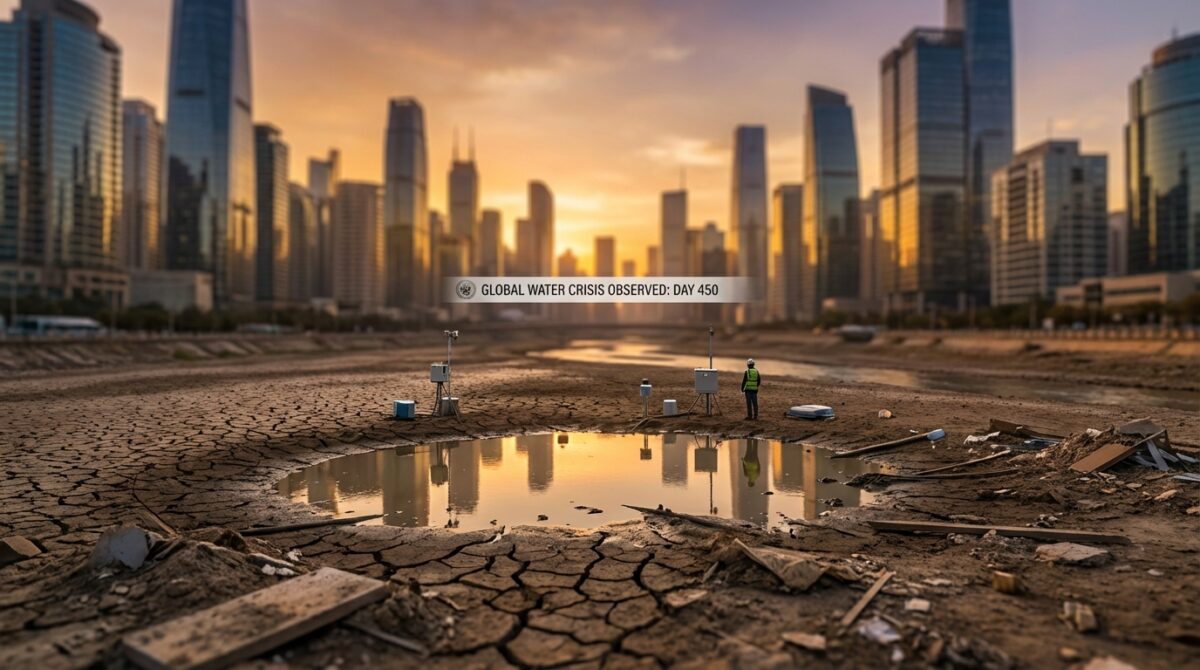
Earlier debates framed the Water Crisis as a temporary shock followed by recovery. The new assessment, echoed by coverage in outlets like CBS News and The Washington Post, argues that humanity has pushed vital systems beyond a tipping point.
Rivers such as the Colorado in North America and the Murray–Darling in Australia now often fail to reach the ocean. In densely populated basins like the Indus or the Yellow River, channels periodically run dry before the sea. For many regions, the “normal” conditions that planners hope to restore no longer exist.
How climate change and overuse destabilise global water resources
Behind this hydrological deficit lies a simple cause-effect chain. Climate Change is heating the atmosphere, altering where and when rain falls, while human activity withdraws and pollutes water at unprecedented rates. The combination leaves societies exposed to both Water Shortage and sudden floods.
Studies cited in the Phys.org analysis of the UN findings show that about 70% of freshwater withdrawals go to agriculture. Many of the world’s major food-producing regions now depend on groundwater that is declining year after year, turning farming into a race against disappearing reserves.
Whiplash between droughts and deluges
Scientists such as Prof. Albert Van Dijk highlight that the problem is not only scarcity but volatility. In many basins, there may be similar annual rainfall, yet it arrives in shorter, more intense bursts, separated by longer dry spells.
This volatility complicates Sustainable Water Management. Reservoirs must be low enough to catch extreme rainfall and prevent downstream disasters, yet high enough to provide reliable supply in drought. The result is a growing risk that even well-managed systems can be overwhelmed in both directions.
Who is already living the water bankruptcy reality
The UN researchers estimate that 2 billion people now live above sinking ground, as aquifers collapse beneath cities and farmlands. Land subsidence of 20–30 cm per year has been measured in places such as Mexico City, parts of California’s Central Valley, and Rafsanjan in Iran.
High-profile urban “day zero” emergencies, when taps nearly ran dry in Cape Town, São Paulo and Chennai, have become warning signals for any metropolis that relies on overdrawn rivers or groundwater. A detailed overview on UN News underlines how such crises now form part of a global pattern rather than isolated accidents.
From shrinking lakes to growing conflicts
Half of the world’s large lakes have shrunk since the early 1990s, according to studies referenced in the UNU-INWEH synthesis. From Lake Urmia in Iran to the Salton Sea in the United States, evaporation, diversions and overuse of inflowing rivers have cut surface areas dramatically.
As supply tightens, tensions rise. Recorded water-related conflicts have increased from around 20 incidents in 2010 to more than 400 by 2024. UN officials now describe water bankruptcy as a driver of fragility, displacement and social unrest, particularly where political institutions struggle to manage scarcity fairly.
Managing water within new planetary limits
Scientists behind the UN Report insist on one uncomfortable truth: lost glaciers and severely compacted aquifers cannot simply be restored. The only realistic path is to prevent further damage while redesigning how societies use and share remaining Global Water Resources.
That redesign starts with accepting lower withdrawal rights in many basins. Over-allocated rivers must be brought back into balance with today’s reduced flows, not the wetter conditions of decades past. This reset requires legal reforms, transparent data and strong institutions at national and basin level.
Transforming agriculture, cities and industry
Because food production consumes most freshwater, Sustainable Water Management in agriculture carries outsized impact. Shifts to less thirsty crops, deficit irrigation, soil-moisture conservation and precision application can sharply reduce withdrawals without sacrificing yields.
Cities can similarly cut demand through leak reduction, efficient appliances and smarter pricing, while industries adopt circular systems that recycle process water. As covered by outlets such as Scientific American and CTV News, these measures are not theoretical: they are already reshaping water use in regions from northern Europe to East Asia.
- Rebalancing withdrawals: aligning legal water rights with reduced river flows and depleted aquifers.
- Climate-smart farming: switching crops, improving irrigation and restoring soil health to hold more moisture.
- Urban efficiency: fixing leaks, reducing wastage and promoting water-wise buildings and households.
- Protecting ecosystems: safeguarding wetlands, floodplains and headwaters that buffer both droughts and floods.
- Cooperative governance: sharing data and negotiating fairly across borders and sectors.
For a fictional farmer in the Indus basin, this transition might mean planting fewer water-hungry rice varieties and investing in drip systems supported by public funds. For a coastal city manager, it could involve combining conservation, rainwater harvesting and modest desalination rather than relying on a single overstressed river.
The underlying message running through analyses from ABC News to UN Geneva is consistent: Water Security will depend less on chasing ever more supply and more on learning to live within new hydrological limits.
What does “Global Water Bankruptcy” actually mean?
The term describes a situation where human societies consistently use and pollute more water than natural systems can regenerate. Short-term crises turn into a permanent deficit, because rivers, aquifers, wetlands and glaciers have been so heavily depleted that many cannot return to previous levels.
How is climate change linked to the current water crisis?
Climate change alters rainfall patterns, accelerates glacier melt and raises evaporation rates. These shifts intensify droughts and floods, creating unstable water supplies. Even where annual rainfall has not dropped significantly, it often arrives in shorter, more intense bursts, which is harder to manage for drinking water, farming and ecosystems.
Which regions are most affected by water scarcity today?
Highly populated and heavily farmed basins such as the Indus, Yellow, Tigris–Euphrates, Colorado and Murray–Darling already face severe stress. Many cities that rely on overdrawn rivers or groundwater—such as parts of India, South Africa, Brazil and the Middle East—are at growing risk of day zero type emergencies.
Can technology alone solve global water shortages?
London, San Francisco, and Beijing Make Significant Strides in Slashing Air Pollution Levels
The Reappearance of a ‘Ghost’ Great White Shark Sparks New Questions in the Mediterranean
Technology can ease pressure through efficient irrigation, leak detection, reuse and selective desalination, but it cannot replace lost glaciers or fully restore compacted aquifers. Long-term security depends on reducing demand, improving governance and protecting ecosystems alongside technical solutions.
What actions can individuals take to support sustainable water management?
Individuals can reduce waste at home, favour food with lower water footprints, support local conservation initiatives and push for transparent, science-based water policies. While personal savings are modest compared with agriculture or industry, they help build social pressure for broader change and protect local supplies.