Show summary Hide summary
- Toby Carvery eviction threat after ancient oak removal
- Why a single ancient oak matters for urban climate resilience
- Legal action, life support for the stump and who pays
- What this dispute reveals about heritage and conservation
- What can be done now: from outrage to action
- How you can support urban trees and local heritage
- Why is the Whitewebbs oak considered so important?
- Is Toby Carvery definitely being evicted from the site?
- Can the ancient oak tree still be saved?
- Who is responsible for protecting ancient trees on commercial sites?
- What broader lessons does this dispute offer for other cities?
In North London, a single chainsaw cut has turned a Sunday roast landmark into the centre of a legal storm. The Toby Carvery owner at Whitewebbs Park now stands threatened with eviction after the removal of an ancient oak tree that had watched over Enfield for roughly 500 years.
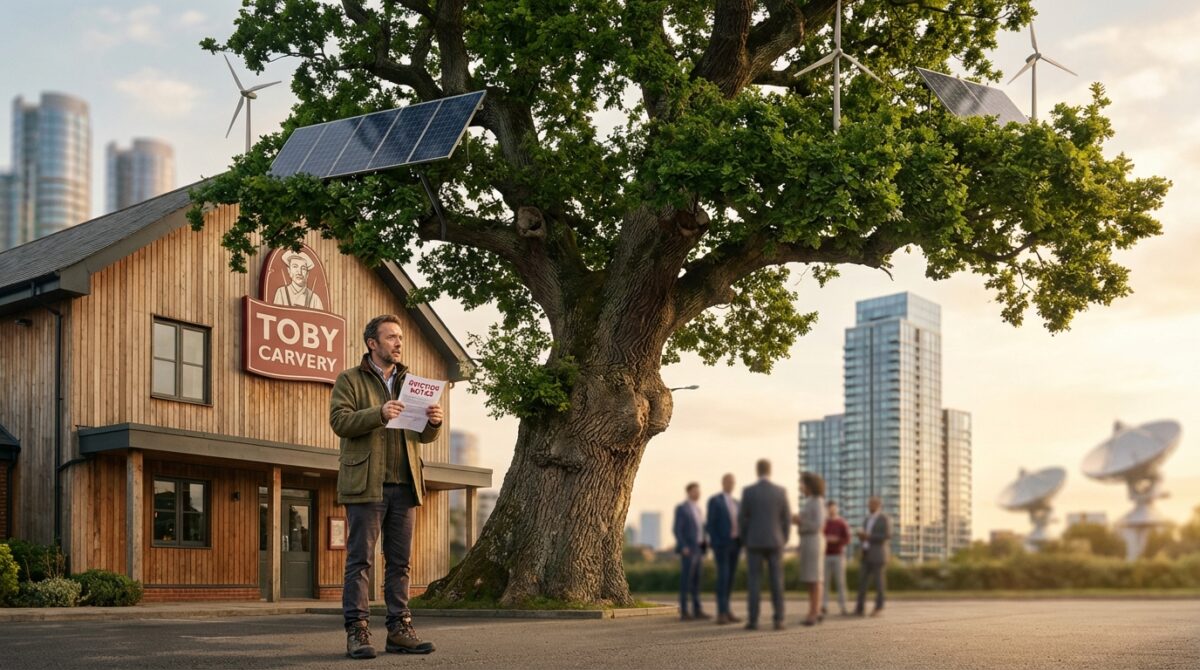
The tree, known locally as the Whitewebbs or “Guy Fawkes” oak, stood on the edge of a car park beside the restaurant, anchoring community memory and local heritage. Its partial felling in April, carried out without the explicit consent of the council landlord, has triggered a high-stakes dispute that now stretches from the courtroom to the wider debate on urban conservation.
Toby Carvery eviction threat after ancient oak removal
According to a detailed report in The Guardian, Enfield Council has launched forfeiture proceedings that could strip Mitchells & Butlers Retail, the company behind Toby Carvery, of its lease. The move follows what the council describes as a “reckless” decision to cut back the ancient oak tree without authorisation.
Six Decades of Data Reveal How Extreme Weather Severely Impacts Baby Birds
Researchers Unveil Seven Mysterious Frog-Inspired Insect Species Concealed within Uganda’s Rainforest
Local outrage has been intense. Coverage from BBC News and MSN captured scenes of residents gathered around the truncated trunk, some describing the loss as comparable, in emotional terms, to the famous Sycamore Gap tree felled near Hadrian’s Wall in 2023. For a community already feeling squeezed by development and traffic, the cutting of a 400–500-year-old organism was a line crossed.
How a lease breach became a climate and heritage flashpoint
The legal heart of the case is simple: Enfield Council leases the land to Mitchells & Butlers, and the authority says the owner breached that lease by acting without consent. A formal Section 146 notice has been served, and proceedings were lodged at Edmonton County Court, with the council aiming to recover the site.
Yet behind the contract language lies something more symbolic. Urban ecologists estimate that a mature oak can support hundreds of species of insects, lichens and birds. A tree of this age has a complex cavity system, deadwood habitat and deep root networks that store carbon and water. According to the UK’s Woodland Trust, veteran oaks can host more life than any other native British tree, making each loss disproportionately heavy.
Why a single ancient oak matters for urban climate resilience
On paper, a 500-year-old oak is one entry in a council inventory. In practice, it is an entire microclimate. Research by Forest Research, the UK government’s forestry science agency, suggests large urban trees can cool surrounding areas by several degrees Celsius during heatwaves, through shade and evapotranspiration.
For North London residents, that cooling effect is far from theoretical. Summer 2022 saw temperatures in the capital exceed 40°C for the first time on record, according to the Met Office. Trees like the Whitewebbs oak help blunt those extremes, moderating heat, slowing surface water run-off and capturing particulate pollution from surrounding roads.
Biodiversity, memory and the “slow technology” of old trees
Ecologically, a 500-year-old oak is not equivalent to fifty 10-year-old saplings. It has complex hollows used by bats and owls, rough bark that shelters invertebrates and fungal networks that link soils across decades. Studies referenced by the Royal Botanic Gardens, Kew, highlight how veteran trees act as “keystone structures” in fragmented landscapes.
Culturally, this particular tree was stitched into local narratives. Nicknamed the Guy Fawkes oak by some residents, it acted as a meeting point and orientation marker. That mix of ecological and emotional value explains why outlets such as Yahoo News framed its loss as part of a broader national conversation about how the UK treats old trees in the face of commercial pressures.
Legal action, life support for the stump and who pays
Even after the sawdust settled, the story did not end. Arborists noticed signs of regrowth from the stump, suggesting the oak retained a fragile grip on life. Specialists proposed a “life support” programme: irrigation, soil care and protective measures costing around £10,000, in the hope of extending the tree’s remaining decades.
An unexpected offer came from Michael O’Shea, managing director of Wicked Uncle Toys, who volunteered to fund the rescue if technical experts managed the project and if the restaurant operator allowed installation of water tanks and sprinklers on the car park. That offer has become a test of corporate responsibility: will the chain enable an attempted recovery, or let the stump decline?
Eviction threat and wider corporate risk
Enfield’s deputy leader, Tim Leaver, has been explicit. He argues that the company failed to engage meaningfully, did not issue a full public apology and has not offered financial reparations for the damage or the council’s costs. Forfeiture of the lease is framed as a response to “serious breaches”.
Media coverage has also pointed to wider financial exposure. Reporting by outlets such as the Daily Mail suggests a potential legal bill approaching £1 million once legal fees, potential compensation and remediation are accounted for. For hospitality companies operating on tight margins, that figure is a signal: environmental misjudgements now carry very real balance-sheet consequences.
What this dispute reveals about heritage and conservation
The Whitewebbs oak case distils a larger shift in how cities weigh short-term convenience against long-lived natural structures. A decision that might once have been seen as routine site management is now scrutinised as a question of heritage, conservation and climate adaptation. The Forestry Commission’s ongoing investigation into the unauthorised felling underlines that this is not only a local spat but also a regulatory concern.
Public pressure has played a decisive role. After anger surfaced on social media and in interviews documented by international news sites, the chain issued statements expressing regret in relation to previous tree controversies. Yet residents near Whitewebbs Park are demanding more than generic sorrow; they want concrete commitments on how such habitats will be treated in the future.
From one car park in North London to a national test case
Across the UK, local authorities are updating tree strategies, recognising veteran specimens as infrastructure rather than decoration. Many now map “irreplaceable” trees and tighten planning rules around them, echoing recommendations from organisations such as Natural England and the Woodland Trust. The Whitewebbs dispute may feed into those policies, shaping how leases and maintenance agreements are written.
For businesses that manage large estates, the lesson is stark. Environmental risk is no longer limited to energy use or plastic packaging. A single poorly judged operation on a living landmark can trigger legal action, reputational damage and long-term community distrust. That reality is starting to influence boardroom decisions far beyond Enfield.
What can be done now: from outrage to action
While courts and regulators decide the fate of the site, residents, diners and readers are not powerless. The Whitewebbs case shows how local mobilisation and sustained media attention can transform a “done deal” into a live, contested issue. Similar campaigns around urban trees in Sheffield and Plymouth over the past decade have already pushed councils to rethink their approach.
For people wanting to respond constructively, several paths are emerging, blending individual choices with collective pressure on institutions and companies.
How you can support urban trees and local heritage
Anyone concerned by the loss of the Whitewebbs oak or similar incidents can take small but meaningful steps. Acting early, before conflicts reach the felling stage, is often the most effective strategy.
- Join or support local tree and park groups that monitor planning applications and organise habitat surveys.
- Ask restaurants, pubs and retail chains how they manage mature trees on their sites, and favour those with clear environmental policies.
- Engage with council consultations on tree strategies, pushing for stronger protection of veteran and ancient specimens.
- Back community fundraising for professional arborist care when iconic trees show signs of stress or damage.
- Share verified reporting, such as coverage by international outlets, to keep attention on cases where nature and commerce collide.
Handled well, the fallout from this one felled oak could sharpen how cities across the UK balance development with living history, turning a painful loss into a catalyst for stronger, smarter protection.
Why is the Whitewebbs oak considered so important?
The Whitewebbs oak in North London was estimated to be around 400–500 years old, making it a veteran tree with exceptional ecological and cultural value. Such oaks support hundreds of species, store significant carbon and form part of local identity. Losing one is not comparable to losing a young tree, because its habitat complexity and historical role cannot simply be replaced by new planting.
Is Toby Carvery definitely being evicted from the site?
Eviction is not automatic. Enfield Council has begun forfeiture proceedings, arguing that the lease was breached when the ancient oak was partially felled without permission. A court will ultimately decide whether the lease is terminated, whether compensation is due, or whether another outcome is appropriate. Until then, the company remains under legal and public scrutiny.
Can the ancient oak tree still be saved?
Arborists have observed regrowth from the stump, which suggests the tree is not completely dead. A proposed ‘life support’ programme involving irrigation and soil care could extend its life, but success is uncertain. Experts estimate the scheme would cost about £10,000 and would require cooperation from the site operator to install tanks and sprinklers in the car park area.
Who is responsible for protecting ancient trees on commercial sites?
London, San Francisco, and Beijing Make Significant Strides in Slashing Air Pollution Levels
The Reappearance of a ‘Ghost’ Great White Shark Sparks New Questions in the Mediterranean
Responsibility is shared. Landowners and tenants must comply with lease terms, planning rules and environmental regulations. Councils have a duty to safeguard significant trees through tree preservation orders and clear management conditions. Companies operating pubs, restaurants or retail sites are expected to seek consent before major works and to follow best practice on biodiversity and heritage protection.
What broader lessons does this dispute offer for other cities?
The Whitewebbs case highlights how a single felling decision can trigger legal action, financial risk and community backlash. For other cities, it underlines the need to map veteran trees, embed their protection in contracts and involve ecologists early in site management. It also shows that residents play a powerful role when they organise, document changes and hold both councils and businesses to account.