Show summary Hide summary
- Global warming’s pace has nearly doubled since 2015
- Why the current acceleration is so worrying
- What do other studies say about this “new era” of warming?
- How this acceleration is reshaping the near future
- What each of us can do in the face of accelerated warming
- Five concrete ways to influence the trajectory
- Why talk about acceleration of warming rather than just a steady increase?
- Do natural phenomena like El Niño alone explain recent records?
- When could the 1.5°C limit be durably breached?
- What does this acceleration mean for the 2°C threshold?
- How do my individual choices connect to a global problem?
Your lifetime spans the moment when humanity pushed Earth into a new gear of warming. Not theory, not projection: measurements now show an unprecedented acceleration of global warming that could permanently break the 1.5°C limit within a few years.
A new study strips away natural climate swings and leaves a stark message: the planet’s temperature rise is almost twice as fast as it was just a decade ago. See also how the iconic climate goal shapes global policy.
Global warming’s pace has nearly doubled since 2015
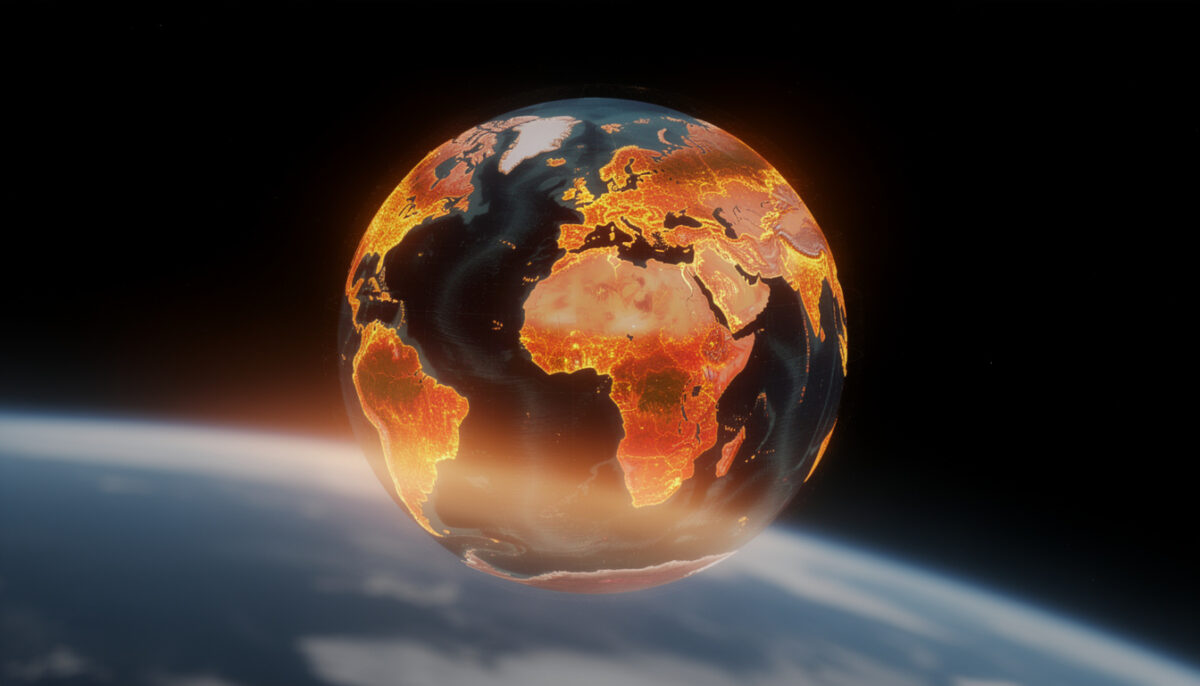
From 1970 to 2015, the planet warmed at a relatively steady rate, under 0.2°C per decade. That was already reshaping coasts, glaciers and weather patterns. Over the last 10 years, the same metric jumps to about 0.35°C per decade, according to the new analysis.
Ocean alkalinity enhancement: Boosting carbon storage in the sea
Rediscovery of the Large Tortoiseshell Butterfly: Species No Longer Extinct in the UK
This shift is the fastest recorded since systematic temperature measurements began in 1880. Independent work, as shown in a detailed report on the acceleration of warming, points toward the same signal of acceleration, even though some teams find a slightly lower rate, around 0.27°C per decade.
Filtering out natural noise to see the human trend
Researchers used a noise-reduction method on five major global datasets. They subtracted the estimated effects of El Niño, volcanoes, and solar variations to isolate warming linked solely to human activities.
In each database, the same shift appears around 2013–2014: the climate change curve bends upwards. This consistency across sources strengthens the credibility of the result and reduces the risk of a simple statistical artifact. Explore related patterns in remarkable creatures flourishing in London’s secret microclimates.
Why the current acceleration is so worrying
About 1.4°C of warming above pre-industrial levels has already been reached. This increase results from a thick blanket of CO₂ and other greenhouse gases, but also from a recent drop in sulfur aerosols, which had temporarily cooled the atmosphere by reflecting sunlight.
If the pace observed over the past decade continues, the 1.5°C limit of the Paris Agreement could be durably exceeded before 2030. A recent assessment published by researchers analyzing the acceleration of global warming confirms this tight timeline.
Concrete impacts: from heatwaves to terrestrial systems
The consequences are already visible in the landscape. The past three years have been the hottest three-year period ever measured. Heatwaves are becoming longer, more frequent, deadlier, while extreme rainfall increases the risks of flooding.
Beyond the weather, entire systems are being shaken: accelerated melting of the cryosphere, risks to carbon sinks, and warning signs in some marine and terrestrial ecosystems, as illustrated by the analysis on mountain regions heating up at unprecedented rates. See how half of the world’s largest cities face severe water stress as well.
What do other studies say about this “new era” of warming?
The new research doesn’t come out of nowhere. It fits within a series of analyses that, each in its own way, conclude there is an acceleration. A summary published on the increasing pace of global warming highlights a growing consensus among climate scientists.
Some cautious researchers, however, remind us that the recent strong El Niño phase may temporarily amplify the trend. The question then becomes: are we witnessing a structural leap, or a temporary “boost” layered on top of the long-term trend?
Natural variability or lasting shift?
Past episodes, like the strong El Niño in 1998, have already produced apparent peaks, followed by a relative slowdown. Some in the scientific community thus emphasize the need to monitor the trajectory for several more years.
For now, most climate change models accept the observed magnitude without major surprise. Warming remains in line with projections, but is now trending toward the high end of the range, reducing the leeway for meeting international targets.
How this acceleration is reshaping the near future
Climatologists estimate that the 1.5–2°C range could be enough to trigger gradual “tipping points”: destabilization of ice sheets, accelerated dieback of some forests, or profound changes in major ocean currents.
The risk isn’t like an instant disaster movie, but rather a series of irreversible shifts over decades, locking the Earth system into a new, warmer state.
A closing window to stay below 2°C
If the current pace of temperature rise continues, the margin for staying below 2°C shrinks drastically. This means climate policies that are faster, deeper, and better coordinated, with a decisive exit from fossil fuels.
Research on “points of no return,” such as explored in the analysis on the approaching climate point of return for Earth, reinforces this message: every tenth of a degree gained or lost changes the trajectory of collective risks.
What each of us can do in the face of accelerated warming
For a person like Alex, an imaginary but plausible urban engineer, the acceleration changes their daily work: new building codes, reimagined electrical grids, different management of water and urban heat islands.
At the individual level, the main levers fall into a few big actions, whose impact grows when they become shared social or political norms. For more on societal shifts, learn about the ancient Peruvian civilization: the guano advantage.
Five concrete ways to influence the trajectory
Individual actions alone aren’t enough, but they create the political ground for systemic transformations. Among the most influential actions:
- Dramatically reduce frequent flying and prioritize trains for regional trips.
- Decarbonize heating by switching to heat pumps, quality insulation, and renewable electricity.
- Adapt your diet by cutting back on meat from intensive livestock farming and reducing waste.
- Choose a low-carbon financial portfolio (bank, insurance, retirement) by scrutinizing fossil investments.
- Weigh in politically through voting, local action, and supporting robust climate regulations.
Collectively, the decisive variable remains how quickly fossil fuel-based CO₂ emissions fall to zero. This curve alone will determine whether today’s acceleration becomes an uncontrolled skid or a managed turning point.
Why talk about acceleration of warming rather than just a steady increase?
Records show that warming has changed pace: from around 0.2°C per decade between 1970 and 2015, it has jumped to about 0.35°C in the past ten years when natural phenomena are removed. This isn’t just a continuation of the trend, it’s warming happening faster than before.
Do natural phenomena like El Niño alone explain recent records?
No. El Niño and other natural factors temporarily amplify or dampen global temperatures. The new study corrects for these effects in five major datasets, and the acceleration remains in each of them. Natural phenomena add “noise,” but the underlying trend is linked to human activities.
When could the 1.5°C limit be durably breached?
At the current rate, sustained overshooting of 1.5°C could occur before 2030. According to some datasets, the threshold could be reached as early as the end of the decade, or even sooner if warming does not slow. The precise timeline mostly depends on how quickly global emissions are reduced.
What does this acceleration mean for the 2°C threshold?
Evaluating the Environmental Footprint: Dairy Milk vs. Plant-Based Alternatives
Love and Survival Beneath the Waves: How a Daring Marine Lab Rescued a Sea Snail from Extinction
If the rapid trend persists, the window to stay below 2°C narrows sharply. This requires faster-than-expected emission cuts, an accelerated phase-out of fossil fuels, and large-scale deployment of low-carbon solutions. Every year of delay raises the technical and economic difficulty of meeting this goal.
How do my individual choices connect to a global problem?
Taken alone, one choice changes the global curve very little. But millions of similar decisions create political and economic pressure: they make ambitious laws acceptable, redirect investments, and shift company offerings. Lifestyle changes, combined with collective action, determine how quickly emissions come down.