
Show summary Hide summary
- Pollution alters ants’ scent and triggers aggression
- Behavioral change and colony dynamics under polluted air
- Why pollution that confuses ants concerns us
- What this study changes for research and for you
- How do ants recognize their nest-mates?
- Why does ozone change the scent of ants?
- Do these effects of pollution on ants already exist in nature?
- What are the consequences for ecosystems if colonies become unstable?
- What can be done to limit this impact of pollution on ant life?
Imagine stepping back into your nest after a quick forage, only to be mauled by your own team. That is what happens to ants exposed to air pollution: a subtle tweak in their scent is enough to flip nest-mates from cooperation to attack. A tiny chemical shift, a massive shock to colony life.
This discovery turns a familiar story upside down. Ants, often cited as models of cooperation, are seeing their solidarity shatter because of the same pollutants that saturate our cities. Understanding this shift helps to better measure the environmental impact of ozone, far beyond human lungs.
Pollution alters ants’ scent and triggers aggression
Ant societies rely on ultra-precise chemical communication. Each individual carries a cocktail of molecules on their cuticle, including hydrocarbons and alkenes, which signal their identity and colony membership. When this code is intact, nest-mates recognize each other and cooperate.
How to Create a DIY Worm Farm That Can Compost Food Scraps, Paper, and Even a Whole Kangaroo
How Squid Triumphed Over Earth’s Greatest Extinction to Dominate the Oceans
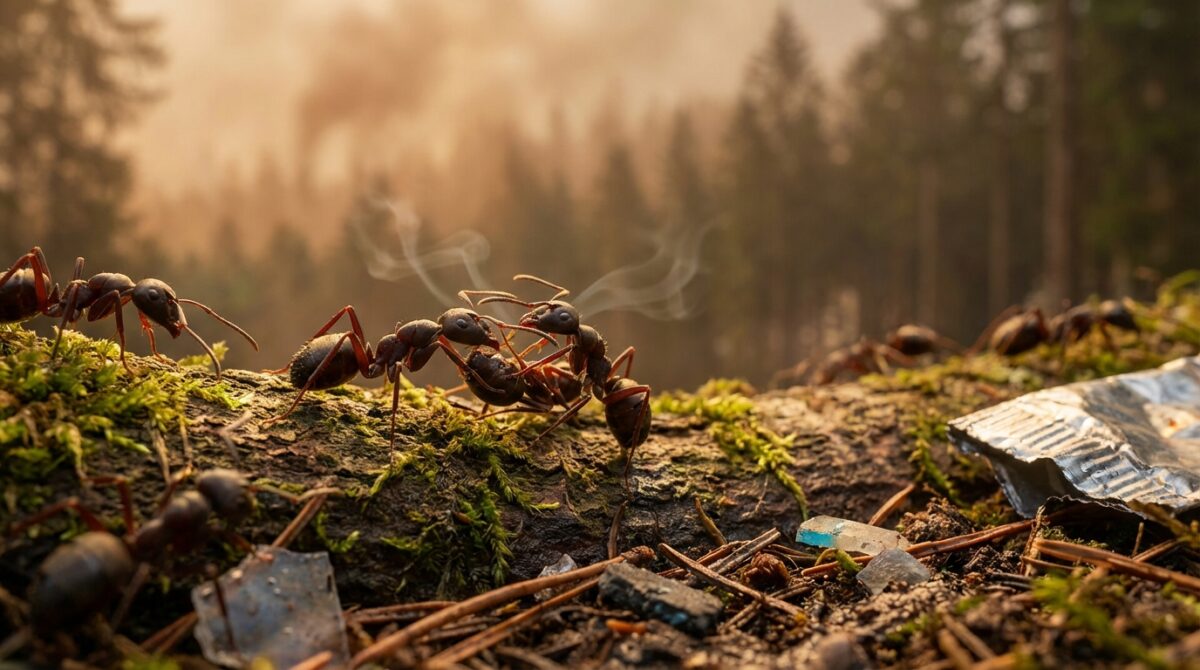
Markus Knaden’s team at the Max Planck Institute for Chemical Ecology wondered what happens when this chemical language encounters ozone, an oxidizing gas common near roads and industrial areas. In experiments detailed in a recent scientific publication, workers briefly exposed to ozone return to the nest… only to be treated like foreign intruders, facing biting, chasing, and sometimes death.
How ozone disrupts the chemical language of colonies
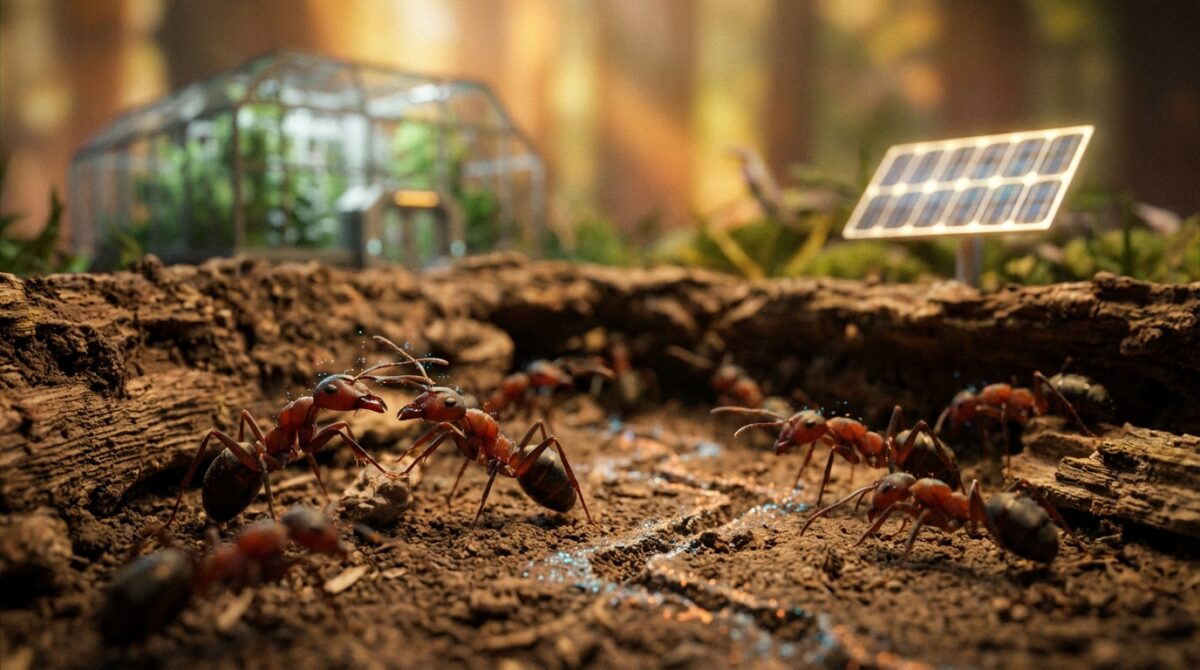
The heart of the mechanism plays out at the molecular scale. Ozone primarily attacks alkenes, a small but crucial fraction of the ants’ scent mixture used for colony signatures. Even though these compounds represent only a few percent of cuticular hydrocarbons, their oxidation is enough to make an individual’s chemical profile unrecognizable.
In tests, a worker spent about twenty minutes in a glass chamber where ozone concentrations mimicked summer peaks measured over European cities. Upon returning to artificial colonies of six species, five out of six showed generalized aggression against the exposed individual—identical to the reaction normally reserved for intruders from another colony. A simple passage through degraded air suddenly fractured the trust within the group.
Behavioral change and colony dynamics under polluted air
This behavioral change is not limited to aggressive antennal exchanges. In the clonal raider ant Ooceraea biroi, a widely studied laboratory species, researchers observed a more insidious effect: adults exposed to ozone neglect their larvae more often. Care, usually delivered like a precisely timed ballet, becomes irregular and less frequent.
Colony dynamics then begin to drift. When nurses neglect the brood, the entire development cycle slows down. Ants, often described as the “circulatory system” of forests due to their role in seed dispersal and soil reworking, see their capacity as ecosystem engineers diminish. This destabilization, described in analyses such as recent work on social instability in colonies, suggests a discreet link between air quality and soil health.
What attacks between nest-mates reveal
For an observer like Lina, a young ecologist who has followed wood ant mounds in a peri-urban forest for years, these results offer a new perspective. She had already noticed frequent fights when ants returned from trails near a main road, without being able to explain them. The data from Jena now provides a solid hypothesis: the pheromone profile of workers changes upon contact with air heavy in oxidizing pollutants.
This phenomenon adds to other stress signals. Studies on aggressive ant behaviors detailed in resources like behavioral analyses of ant conflicts show that internal struggles often arise when chemical recognition cues become blurred. The nest then behaves like an over-reactive immune system, eliminating anything that no longer exactly matches the group’s “olfactory ID card.”
Why pollution that confuses ants concerns us
Looking at an anthill is like looking at a miniature version of how entire societies hold together through reliable signals of trust. When ozone damages this chemical grammar, the colony spends its energy on internal wars rather than foraging or nest maintenance. The parallel with the economic effects of poor air quality in humans is striking, even if the mechanisms differ.
Ants play a key role in topics already tracked, such as the winter life of nests described in observations on wood ant activity in winter. If ozone alters this collective functioning, the consequences ripple through soil fertility, forest dynamics, and the resilience of ecosystems in the face of a warming climate. The environmental impact of these chain reactions goes far beyond simple entomological curiosity.
What this study changes for research and for you
For biologists, these results open a specific agenda:
- Measuring how different levels of pollution modify the chemical profile of ants in urban, agricultural, and forest habitats.
- Tracking the effect of these alterations on colony survival and insect community structure over several seasons.
- Integrating signals from ants into soil and forest health indicators, alongside data on birds or pollinators.
- Testing whether other highly social species, such as bees or termites, undergo similar disruptions to their chemical communication.
For policymakers and urban planners, this work strengthens the argument for limiting ozone peaks near natural areas—for example, by reconfiguring traffic flows or developing filtering green belts. Protecting the social chemistry of ants is equivalent to preserving thousands of micro-engineers working for free for the stability of our landscapes.
How do ants recognize their nest-mates?
Ants identify their nest-mates thanks to a chemical signature carried on the surface of their cuticle. This mixture of hydrocarbons, including alkenes, forms a sort of olfactory identity card shared by members of the same colony. When this profile is modified, for example by ozone, guardians interpret the individual as an intruder and react with aggression.
Why does ozone change the scent of ants?
Ozone is a powerful oxidant that reacts particularly with alkenes, a family of molecules involved in ants’ social signals. When these compounds oxidize, the scent mixture changes structure. Even if the proportion of alkenes is small, their alteration is enough to make the chemical signature unrecognizable to the antennae of nest-mates.
Do these effects of pollution on ants already exist in nature?
The concentrations used in the laboratory reproduce ozone levels observed during peaks in certain cities and peri-urban areas. It is therefore likely that similar scent alterations are already occurring outdoors, especially near roads and industrial zones. Observations of increased aggression in colonies near these sources support this idea, although precise quantification is ongoing.
What are the consequences for ecosystems if colonies become unstable?
Unstable ant colonies work less efficiently. Seed dispersal slows down, soil aeration decreases, and certain mutualistic interactions, such as protecting plants from herbivores, weaken. On a large scale, this decline in social performance can reduce ecosystem resilience, particularly in landscapes already weakened by habitat fragmentation and climate change.
What can be done to limit this impact of pollution on ant life?
Jungle Wildlife Shares a Common Tree as Their Preferred Latrine Spot
How Beavers Transform Rivers into Potent Carbon Capture Ecosystems
The levers are the same as for human health: reducing emissions of ozone precursors, such as certain nitrogen oxides from traffic and industry, and smoothing out concentration peaks. Locally, creating vegetated buffer zones, limiting roads near sensitive forests, and monitoring air quality can help. Protecting the chemical communication of colonies means preserving a key link in the ecological chain.