Show summary Hide summary
- A gigantic Asteroid Strike that reshaped the ground of Brazil
- What does this mysterious Brazilian Glass Desert look like?
- What chemistry reveals about the impact and its target
- Tracing back 6.3 million years ago thanks to argon
- Why this impact is changing how we read the history of extinctions
- What data analysts and science enthusiasts can take away
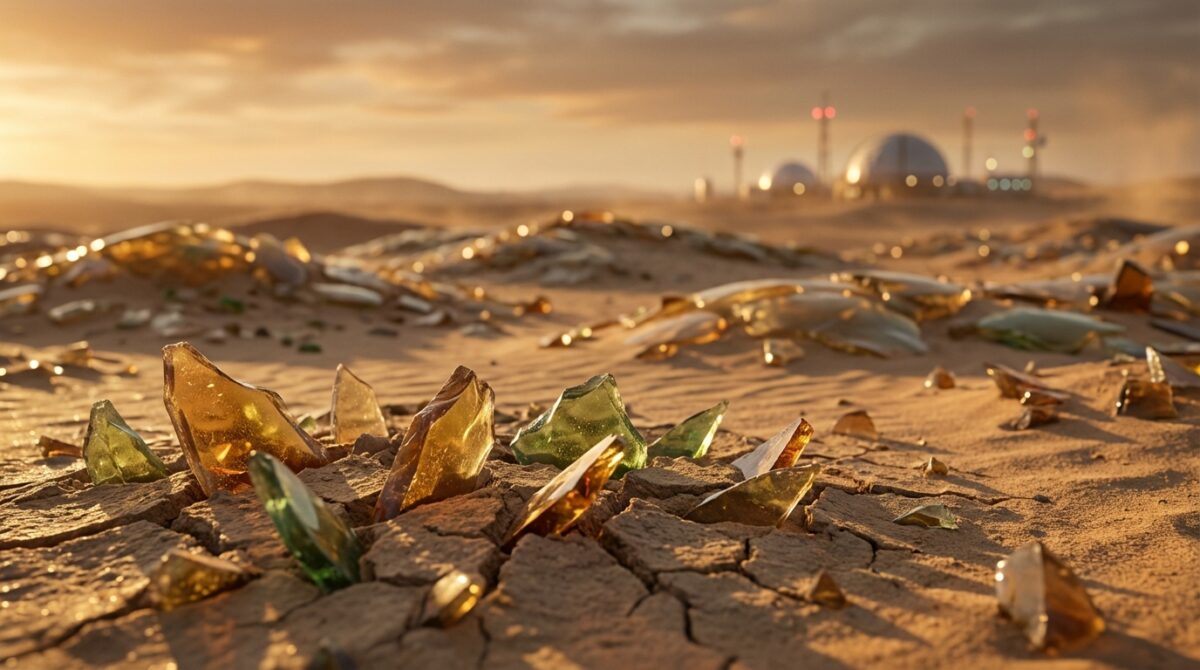
Imagine traveling through northeastern Brazil and stumbling, in the middle of the bush, upon a Glass Desert made of dark, smooth fragments shaped by emptiness. These shards don’t come from a volcano, but from a Gigantic Asteroid that crashed down millions of years ago. In fact, what you encounter here is the geological aftermath of a gigantic asteroid strike, an event that would later fascinate scientists worldwide.
In just a few years, this discovery has become a textbook case for understanding how the planet absorbs a violent Asteroid Strike without leaving a visible crater on the surface.
A gigantic Asteroid Strike that reshaped the ground of Brazil
Researchers have confirmed the existence of Brazil’s first large field of tektites, a unique impact glass field in the world. These fragments, named geraisites, mark the trace of an Asteroid Strike that occurred about 6.3 Million Years Ago, at the end of the Miocene.
Covering Farms with Crushed Rock Could Capture 1 Billion Tonnes of CO2
How an Innovative Plastic Made from Milk Disappears in 13 Weeks
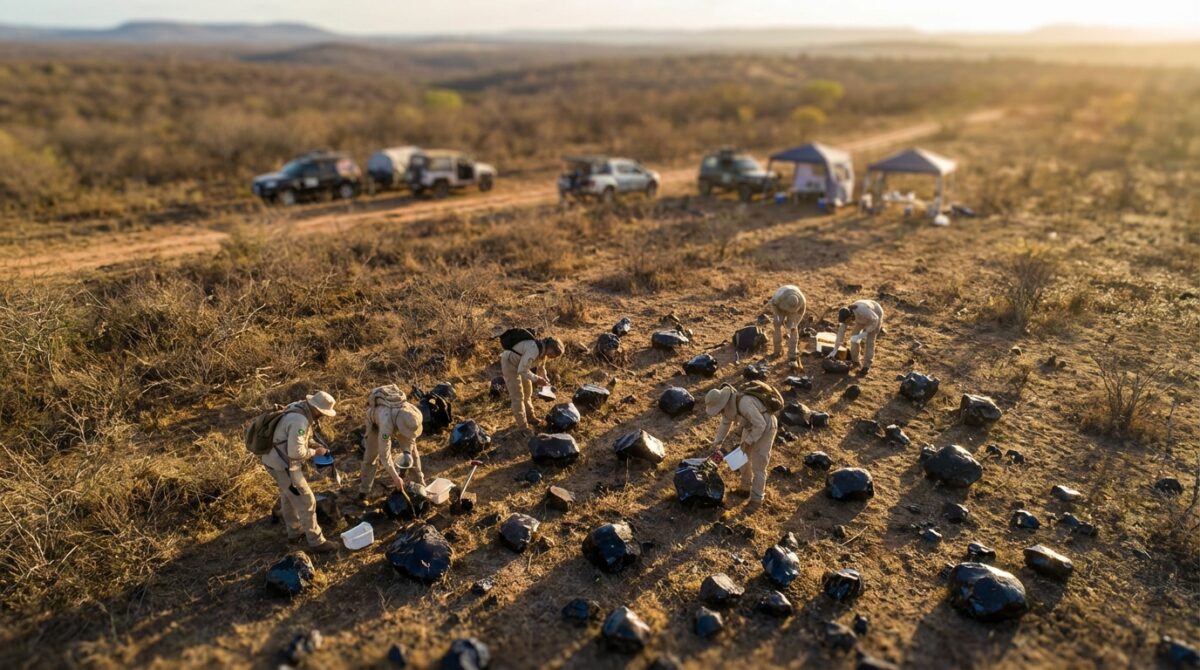
The starting point is in the north of Minas Gerais, around Taiobeiras, Curral de Dentro, and São João do Paraíso. The first surveys described a 90-kilometer zone. With later discoveries in Bahia and Piauí, the field now stretches over more than 900 kilometers, forming a kind of glassy scar at the heart of modern Brazil.
A sixth large tektite zone on a global scale
Before this discovery, the major tektite fields were limited to Australasia, Central Europe, Ivory Coast, North America, and Belize. The Brazilian field now joins this very exclusive group, as detailed in several analyses in this scientific explainer.
For a specialist like Álvaro Penteado Crósta, who leads the study, the size of this field directly reflects the energy released by the impact. The further the glass is spread, the more violent the initial impact was—even if the event is far from Extinction Event scenarios like Chicxulub.
What does this mysterious Brazilian Glass Desert look like?
In the field, the scene could almost go unnoticed by an untrained eye. The geraisites are black, opaque, and blend in with some local stones. Yet under a strong beam of light, they reveal a translucent greenish-gray tint, quite different from the bright green moldavites famous in Europe.
Each fragment measures up to 5 centimeters, with weights from less than a gram to over 80 grams. The shapes are typical of tektites: drops, spheres, ellipsoids, discs, “dumbbells,” and twisted silhouettes, as if the matter had been stretched by wind at very high altitude.
Frozen bubbles that tell the story of a flight through the atmosphere
The surfaces display countless small cavities, traces of ancient gas bubbles released during cooling. This pattern is reminiscent of volcanic lava, but the context and chemistry point clearly to impact glass. The bubbles emptied while the overheated liquid sped through the atmosphere, before falling as a solid rain onto what would become northeastern Brazil.
Each fragment serves as a miniature record of this supersonic journey, fusing atmospheric dynamics, extreme heat, and the chemistry of Earth’s crust into a single object.
What chemistry reveals about the impact and its target
In the lab, geraisites show a silica content between 70.3% and 73.7%. Sodium and potassium oxides together reach just over 8%, a chemical profile slightly different from other tektite fields. Small variations in chrome and nickel suggest a varied rocky target, not a uniform base.
Researchers have also identified inclusions of lechatelierite, a glassy silica formed at very high temperatures. This mineral suggests the rocks were heated beyond normal volcanic conditions—pointing squarely to a highly energetic Meteorite impact.
An almost “dry” glass, far drier than obsidian
Another decisive clue: the very low water content, measured between 71 and 107 ppm. Volcanic glasses like obsidian often contain ten times more water or even more. This “dry” quality perfectly matches the tektites known worldwide.
Infrared spectra confirm this diagnosis. For Crósta and his team, it’s the combination of this water signature, trace elements, and fragment morphology that rules out a volcanic hypothesis and makes it undeniably impact glass.
Tracing back 6.3 million years ago thanks to argon
To date the impact, geologists used the ⁴⁰Ar/³⁹Ar method. Three very similar ages were obtained: 6.78, 6.40, and 6.33 million years. Altogether, they point to a single event, about 6.3 Million Years Ago, at the end of the Miocene.
Crósta stresses one point, however: this figure probably represents a maximum age, as some of the argon may come from the ancient rocks struck by the impact. The general timescale remains clear: this glass field tells the story of a relatively recent episode geologically, long after the Cretaceous-Paleogene Boundary.
An Impact Crater yet to be found under Brazil
Despite the extent of the Glass Desert, no associated Impact Crater has been located. This is not unusual: for several major tektite fields, the source structure remains unknown or is buried under sediments or the ocean.
Isotopes indicate a source in an Archean continental crust 3.0–3.3 billion years old, probably within the São Francisco craton. The next steps involve large-scale gravimetric and magnetic surveys to reveal any hidden circular structure. An accessible summary of this crater hunt is available in this report on the Brazilian impact.
Why this impact is changing how we read the history of extinctions
For readers used to associating a large Meteorite with an Extinction Event, it’s tempting to imagine a global disaster. The data do not support this. The impact was powerful, but there’s no evidence of a planet-wide crisis like at the Cretaceous-Paleogene Boundary, when Chicxulub shook the biosphere.
This Brazilian case shows something else: the Earth sometimes receives major shocks that mostly leave a diffuse geological imprint, without massive ecosystem collapse. For geologists, these in-between events are key to refining risk statistics and understanding the true frequency of large impacts.
A natural laboratory for modern planetary defense
In 2026, planetary defense discussions increasingly rely on real-world cases. The geraisites field serves as a practical example for Crósta’s students, who run the Instagram account @defesaplanetaria with him. Their goal: to explain the mechanics of impacts and calm alarmist rumors.
For readers curious about astronomy, this glass field illuminates the gray area between local small bolides and global extinction asteroids. It proves that a Gigantic Asteroid can transform hundreds of square kilometers of Earth’s crust without necessarily having a dramatic impact on the biosphere.
What data analysts and science enthusiasts can take away
For Clara, an environmental engineer at a fictional energy company, this tektite field has become an internal case study. Her team uses the dispersion data of geraisites to model particle propagation during major industrial accidents, inspired by this “natural experiment” millions of years old.
This approach shows how the impact Geology is useful far beyond pure astronomy. The same trajectory, fragmentation, and dispersion models can be found in technological risk management, predicting volcanic fallout, or studying large-scale sedimentary deposits.
Key points to remember about the Brazil impact
To keep the core of this geological story in mind, here are some facts that sum up the discovery:
- A field of more than 900 kilometers of impact glass has been identified in Brazil.
- The geraisites were formed by a single Asteroid Strike, dated to around 6.3 million years ago.
- No visible Impact Crater has yet been found, but the isotopic signature points to the São Francisco craton.
- The chemistry, low water content, and presence of lechatelierite confirm meteoritic origin.
- This case enriches understanding of “intermediate” impacts, far from Extinction Event scenarios.
What exactly is a geraisite?
A geraisite is a fragment of natural glass formed when terrestrial rocks were melted and thrown into the atmosphere by an Asteroid Strike. Cooling as it flew through the air, the molten mass solidified into aerodynamic drops, now found in the north and northeast of Brazil.
Did this impact in Brazil cause a mass extinction?
Available data show no link to a mass extinction. The event happened about 6.3 million years after the Cretaceous-Paleogene Boundary and left no comparable global signature. It’s better described as a powerful regional impact, highly instructive for impact Geology but without an identified planetary crisis.
Why hasn’t the crater been found yet?
The crater could be buried under sediments, partially eroded, or hidden by vegetation and terrain. Researchers rely on gravimetric and magnetic surveys to detect possible deep circular structures. Several major tektite fields worldwide have the same situation of a still-hidden crater.
How can these impact glasses be distinguished from volcanic glass?
Ancient Peruvian Civilization: The Guano Advantage
Approaching Point Return: Earth’s Imminent Climate Risk
Geraisites contain very little water—far less than obsidian. Their detailed chemistry, the presence of lechatelierite, and their geographic distribution all point to an impact scenario. Volcanic glasses, by contrast, remain concentrated around volcanoes and show different chemical and water signatures.
How does this discovery aid planetary defense?
This glass field offers a real-world case to calibrate models of trajectory, energy, and dispersion related to a significant Asteroid Strike. Agencies and researchers can test their simulations on an actual event, sharpening risk assessment and planning for future strategies to divert potentially hazardous asteroids.