Show summary Hide summary
- Fukushima frozen towns where nature is taking over
- Wildlife boom in Fukushima’s abandoned areas
- Human return, memory and contested recovery
- Living with radiation and rebuilding safer communities
- What you can learn and apply from Fukushima’s experience
- Is Fukushima safe to visit as a tourist now?
- Why have some residents decided not to return to Fukushima’s evacuated towns?
- How has wildlife been affected by the Fukushima nuclear disaster?
- Can forests around Fukushima ever be fully decontaminated?
- What does Fukushima teach about future nuclear and climate risks?
In one Fukushima classroom, open textbooks still wait on tiny desks, shoes line the corridor, and bento boxes sit unfinished. Outside those frozen rooms, boar, bears and raccoons now roam streets once lit by vending machines. This contrast captures a question that matters far beyond Japan: what happens when nature resilience races ahead of human return after a nuclear disaster?
Fukushima frozen towns where nature is taking over
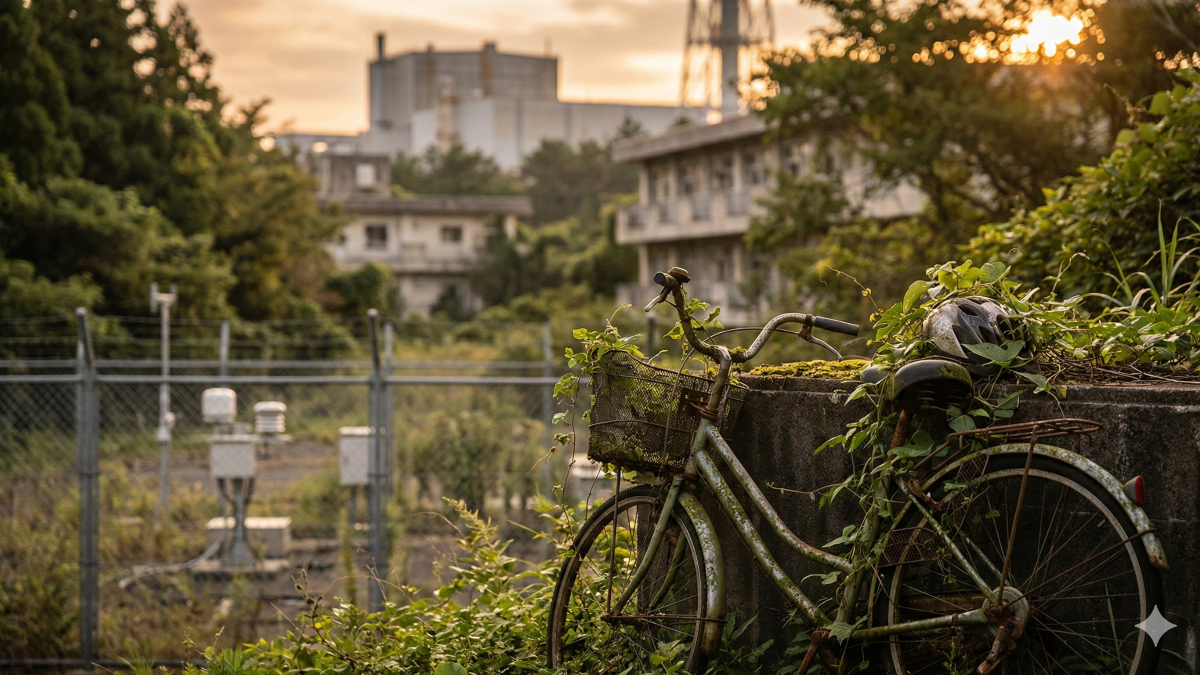
Along the coast near the Fukushima Daiichi plant, playgrounds are now thickets of wild grass, and rusting bicycles disappear into shrubs. In places like Okuma and Tsushima, the once neat grid of houses has blurred into semi-forest, a visible experiment in environmental recovery inside abandoned areas.
These “Frozen Towns” were emptied after the magnitude‑9 earthquake and tsunami of 11 March 2011 triggered triple reactor meltdowns, the worst nuclear accident since Chornobyl. Government data cited in analyses such as The Ghost Towns Behind the Gates and recent reporting in international environmental coverage show that, even after decontamination, many streets remain silent at night.
Europe’s Supermarket Shelves Filled with Confusing Claims on Recycled Plastic Packaging
Country Diary: Bright White Blossoms Breaking Through Winter’s Gloom
Radiation, forests and invisible contamination cycles
The main obstacle to human return is not what the eye sees, but what still moves through soil, water and trees. After 2011, Japan removed contaminated topsoil around homes and schools, generating about 15 million cubic metres of waste that now sits in black bags near the plant, as documented in studies such as ScienceDirect’s analyses of decontamination policy.
Yet around 70% of the affected region is forest, which was never fully cleaned. Research at Fukushima University’s Institute of Environmental Radioactivity indicates that trees absorb radiocaesium‑137 through their roots alongside potassium, then recycle it via leaves and rain. This ongoing circulation means that while short visits are safe, living beside some slopes still carries a long‑term radiation exposure risk.
For residents like former cattle farmer Sanjiro Sanpei, whose house stands near dense woodland, the forest is both lifeline and barrier. Decontamination crews can scrape gardens clean, but they cannot re‑engineer an entire mountain. That ecological reality shapes every discussion about where people can live, farm and gather food.
Wildlife boom in Fukushima’s abandoned areas
Camera traps set by Japanese and international teams, including those featured in recent wildlife surveys, tell a consistent story. In streets once busy with commuters, wild boar, raccoons, black bears and macaques move freely. According to researchers like Prof Vasyl Yoschenko, overall mammal numbers have not collapsed under chronic low‑level radiation. They have, in many zones, expanded.
One retired Fukushima University professor, Thomas Hinton, summarises a pattern seen also near Chornobyl: remove people and traffic, and even in contaminated landscapes, ecosystems rebound. Light pollution vanishes. Noise fades. Corridors once blocked by fences reopen. The result is a form of rewilding driven by disaster, not by design.
Nuclear disaster as an accidental rewilding experiment
The paradox is stark. Environmental recovery here does not mean “back to normal”, but “forward to something wild”. Studies referenced in Japan-focused resilience research argue that Fukushima has become a living laboratory for understanding how ecosystems respond when human pressure suddenly drops while contamination lingers.
Yet not every species benefits equally. Wild boar, for example, thrive in the mosaic of fields, orchards and regenerating woodland, but their rooting damages infrastructure and crops in areas where farmers are trying to restart. Without active management, the very animals that signal nature’s resilience can make repopulation challenges even tougher for returning communities.
This tension between flourishing wildlife and fragile human recovery forces a basic question: should parts of Fukushima remain a quasi‑reserve, or should every habitable hectare be steered back toward human use as evacuation zones shrink?
Human return, memory and contested recovery
Government policy has shifted from blanket exclusion to selective repopulation. Evacuation orders have been lifted in several municipalities, and in 2023 a legal change allowed households in designated “difficult‑to‑return zones” to come back once their immediate surroundings meet exposure thresholds. Even so, data cited in analyses like reconstruction and resilience assessments indicate that only about 17% of former residents of seven evacuated towns and villages were back by March 2025.
Many evacuees have built lives elsewhere over fifteen years. Children who fled at seven are adults today, with jobs and families in new cities. For them, return is no longer only a health calculation; it is a decision about identity, opportunity and the meaning of home in a warming, risk‑layered world.
From frozen schools to living eco‑museums
Places like Kumamachi primary school, where time appears to have stopped on that March afternoon, now sit at the intersection of grief, science and policy. Local voices, echoed in pieces such as coverage of Fukushima’s frozen school, call for the site to be preserved as a disaster memory space rather than quietly erased.
Some residents and researchers propose turning parts of the interim soil storage zone into an eco‑museum once waste is transferred, currently scheduled around 2045. Visitors could walk from overgrown streets into curated exhibits on radiation, wildlife, and climate‑driven technological risk, drawing on work described in Nature’s reporting on Fukushima research centres. Such a site would not only honour loss, but also help other regions prepare for compound disasters.
Living with radiation and rebuilding safer communities
For families weighing a return, the question is practical: what would everyday life look like? Monitoring by Japanese agencies, reviewed in international journals and in resources like recent synthesis articles, suggests that most market produce from Fukushima now falls well below safety limits. Yet certain wild foods, especially some mushrooms, bamboo shoots and boar meat, remain restricted because they accumulate caesium.
That means adaptation, not simple restoration. Households that once depended on foraged forest food must diversify diets. Farmers adjust planting choices and market strategies. Urban planners incorporate evacuation corridors, seawalls and new building codes shaped by frameworks like the Sendai Framework for Disaster Risk Reduction.
What you can learn and apply from Fukushima’s experience
Fukushima’s Frozen Towns are not only a Japanese story. They offer a preview of how communities worldwide might navigate contaminated or climate‑stressed abandoned areas in the future. For readers far from Japan, several lessons stand out:
- Disaster risk is layered: Natural shocks such as earthquakes or storms can trigger technological failures, from nuclear disaster to chemical spills. Local preparedness plans need to integrate both.
- Nature rebounds faster than social systems: Wildlife may return within years, but repopulation challenges for humans extend over decades, influenced by economy, trust and memory.
- Transparent science builds confidence: Independent monitoring of radiation, food safety and ecosystem health, shared in accessible language, helps residents make informed choices.
- Memory spaces reduce future risk: Preserved schools, coastal markers and eco‑museums keep collective attention on low‑probability, high‑impact threats.
- Community voices matter: Reconstruction strategies that treat residents as partners, not only victims or statistics, tend to foster more resilient, fair outcomes.
From coastal seawalls to forest research plots, Fukushima shows that recovery is less a straight line than a negotiation between atoms, animals and human expectations. The decisions taken now will decide whether this landscape becomes a cautionary tale, a shared research field, or a new model of coexisting with a damaged yet living environment.
Is Fukushima safe to visit as a tourist now?
Most areas of Fukushima Prefecture are considered safe for short-term visits, with external radiation doses comparable to many other regions worldwide. Exclusion zones remain around parts of the Fukushima Daiichi plant and some nearby districts. Tour operators and local authorities provide up-to-date maps and monitoring data so that visitors can avoid restricted zones and understand remaining risks.
Why have some residents decided not to return to Fukushima’s evacuated towns?
Decisions not to return are often driven less by radiation levels and more by livelihoods, education and community ties. After more than a decade, many evacuees have stable jobs, schools and social networks elsewhere. Some worry about long-term health uncertainties or limited services in small, partly repopulated towns. Others choose to preserve memories of loss by not rebuilding on former homes.
How has wildlife been affected by the Fukushima nuclear disaster?
Field studies indicate that mammal populations such as boar, raccoons, bears and macaques have increased in many evacuated areas, largely because human disturbance has fallen. Chronic low-level radiation has produced subtle biological effects in some species, but no large regional population collapse has been observed. The main ecological change is the rapid expansion of habitat use by animals in zones where people were forced to leave.
Can forests around Fukushima ever be fully decontaminated?
Ensuring Scientific Rigor Amidst the Emerging Threats of Microplastics
Termination Shock Risks Escalating the Economic Toll of Climate Change
Complete removal of radiocaesium from forests is not realistic. Trees absorb and recycle the isotope through leaves, soil and roots, making the system dynamic. Over decades, physical decay of radionuclides and natural processes reduce overall contamination. Management focuses on monitoring, restricting certain forest foods, and controlling how close permanent housing or intensive agriculture is placed to the most affected slopes.
What does Fukushima teach about future nuclear and climate risks?
Fukushima underlines how extreme natural events can cascade into technological crises, especially near coasts where sea-level rise and stronger storms are expected. It suggests that nuclear plants and other hazardous facilities require continuous risk review, robust backup systems and clear evacuation planning. The region also shows how long recovery takes, reinforcing the value of prevention, community engagement and transparent science in managing complex environmental risks.