Show summary Hide summary
- Europe’s supermarket shelves and the illusion of circular plastic
- The science behind “recycled” plastic: pyrolysis and mass balance
- Why the climate benefits are weaker than advertised
- Supermarket recycling schemes, consumer trust and plastic waste
- Plastic dependency in European supermarkets and what can change
- Pathways to more honest and lower-impact packaging
- What shoppers, brands and regulators can do now
- Why are recycled plastic claims on supermarket packaging considered misleading?
- Does chemical recycling through pyrolysis significantly reduce plastic waste and emissions?
- How can consumers in Europe make better choices about plastic packaging?
- What role do supermarkets play in the plastic waste problem?
- Are regulations changing how recycled plastic claims can be used?
Pick up a “green” yogurt pot or a “circular” ketchup bottle in a European supermarket and you may be holding 95% virgin fossil plastic dressed up as sustainability. Behind those recycled plastic logos lies a chemistry trick that turns plastic waste into marketing gold while the environment keeps paying.
Europe’s supermarket shelves and the illusion of circular plastic
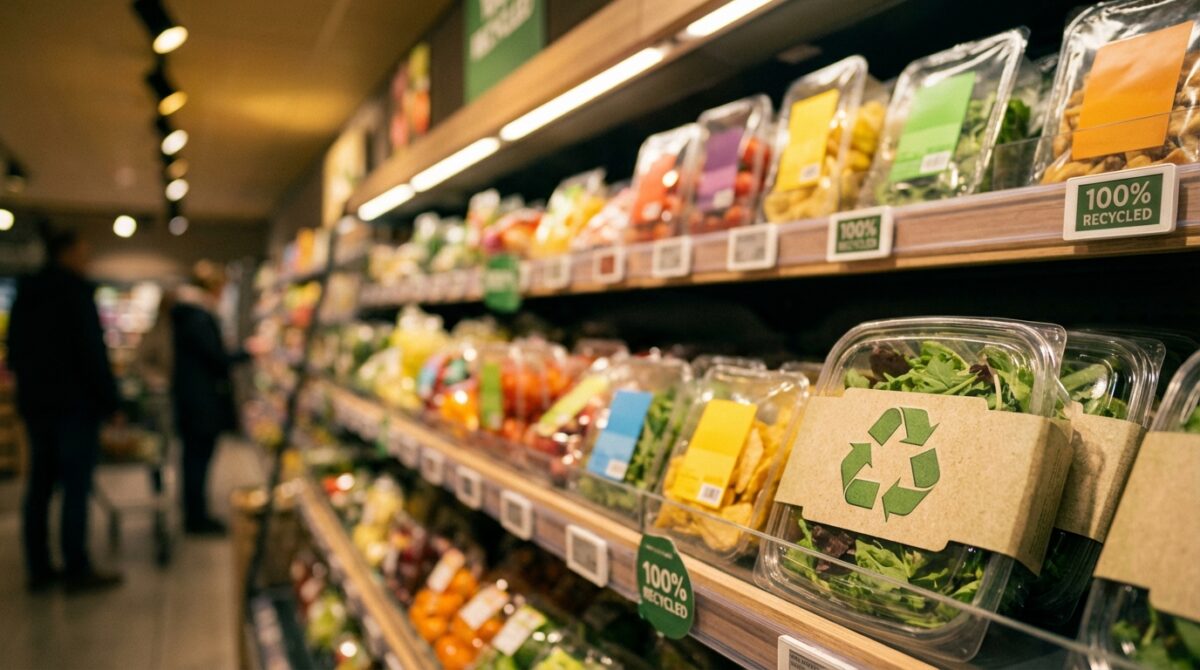
Across Europe, supermarket shelves are crowded with brands promoting “recycled plastic” and “low-carbon” packaging. Shoppers see soft greens and blues, circular arrows and claims of “climate-smart” choices and feel reassured.
Investigations, including recent cross-border reporting and expert analysis reported by environmental journalists, have found that often only a small fraction of the material in these packs has ever been waste. The rest is newly made from petroleum, even when labels suggest a circular loop.
Jungle Wildlife Shares a Common Tree as Their Preferred Latrine Spot
How Beavers Transform Rivers into Potent Carbon Capture Ecosystems
How fossil fuel companies sit behind “recycled” supermarket packaging
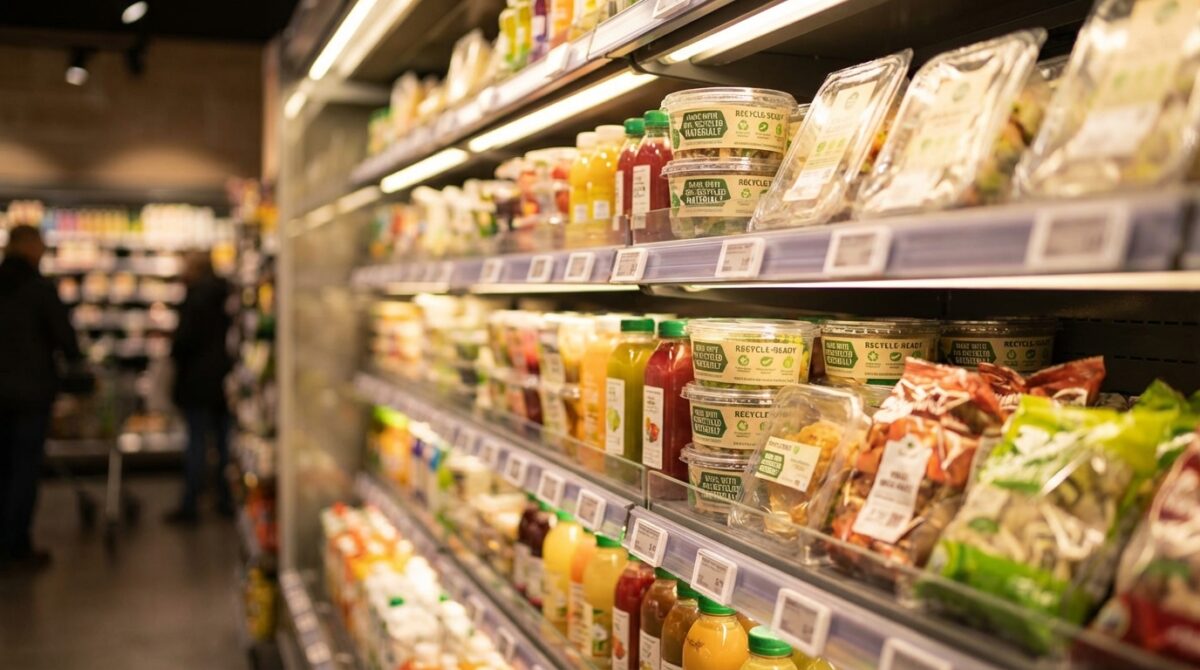
Many household brands rely on plastic supplied by petrochemical giants linked to oil and gas extraction. Kraft’s Heinz Beanz and Mondelēz’s Philadelphia, for example, use materials produced by the plastics arm of Saudi Aramco, the state-owned oil giant widely reported as the world’s largest corporate greenhouse gas emitter, with more than 70 million tonnes of CO₂ released up to 2023.
As demand for fossil fuels in energy and transport declines, analyses by bodies such as the International Energy Agency indicate that plastics are becoming a vital growth sector for oil majors. So turning supermarket packaging into a story of circularity is not just public relations; it is a long-term business strategy.
The science behind “recycled” plastic: pyrolysis and mass balance
The petrochemical industry now promotes pyrolysis, a form of chemical recycling, as the pathway to sustainable plastic. In this process, mixed plastic waste is heated to high temperatures without oxygen to produce a liquid called pyrolysis oil, which is then blended into the feedstock for new plastics.
In practice, technical limits mean that this pyrolysis oil can make up only about 5% of the total feedstock. To protect delicate steam crackers, it must be heavily diluted with roughly 95% virgin naphtha, a petroleum derivative. Former European Commission environment expert Helmut Maurer has argued that the whole chain is marketed as plastic recycling while fossil fuel use actually expands.
How a 5% blend becomes “100% recycled” on the label
The transformation from modest recycling input to bold confusing claims on supermarket packs hinges on accounting methods rather than chemistry. The most influential is called mass-balance bookkeeping, an approach already challenged in reports such as “Under Wraps”.
Imagine a cracker plant processing 100 tonnes of mixed feedstock, where 5 tonnes is pyrolysis oil and 95 tonnes is virgin naphtha. Under mass balance, a brand can allocate that 5% “recycled” share entirely to one product line. As a result, 5 tonnes of plastic packaging can be certified and sold as “100% recycled”, even if, in physical terms, every molecule in those packs originated from fossil-based naphtha alone.
Why the climate benefits are weaker than advertised
Companies present life cycle assessments (LCAs) to show that pyrolysis-based recycled plastic cuts emissions. Sabic, a major producer for European markets, reports that the full chain from pyrolysis to cracking emits around 6–8% more CO₂ than making plastic directly from fossil feedstock.
The numbers only appear favourable once “avoided emissions” are included. By assuming that the same volume of plastic would otherwise be incinerated, companies subtract hypothetical incineration emissions from their balance. This produces a claimed saving of about 2 kg of CO₂ per kilogram of “recycled” plastic, even though the actual industrial process emits more greenhouse gases on the ground.
When plastic recycling doubles as advertising
Publicly available data show the scale of the gap between marketing and physical recycling. In 2022, Sabic reported using around 2,600 tonnes of recycled feedstock for its European plants, which processed roughly 4 million tonnes of naphtha in the Netherlands alone. That suggests that recycled content may be below 5% of total input.
Experts such as Professor Peter Quicker of Aachen University caution that LCAs can be framed to deliver preferred results. Research cited by NGOs like Ecos warns that when recycled feedstock replaces only a tiny fraction of fossil-based plastic, any climate savings are marginal and can be exaggerated as they travel down the value chain through mass-balance credits.
Supermarket recycling schemes, consumer trust and plastic waste
Marketing does not stop at the factory gate. Retailers have launched flexible plastic collection points and promoted “store drop-off” recycling. Yet investigations, including one summarised in a recent report on supermarket schemes, found that around 70% of flexible plastic collected in some UK initiatives between 2022 and 2024 could not be traced back to effective recycling.
Other reporting, such as coverage of UK retailers in national newspapers, revealed that some bags gathered for “recycling” were instead exported or burned. This mismatch deepens public confusion and undermines the very consumer awareness that sustainability campaigns claim to build.
How shoppers interpret recycling labels on packaging
Survey work commissioned by legal NGO ClientEarth, summarised in its briefing on recycling claims, found that most people interpret a recycling logo in a straightforward way: if a pack is disposed of correctly, they expect it to be recycled and for this to significantly reduce its environmental impact.
An Ipsos survey across France, Germany, Great Britain and Poland, reported in Food and Drink Technology, confirms a gap between these expectations and the real fate of much plastic waste. When labels promise “recycled” or “recyclable” while infrastructure, chemistry and trade flows tell another story, trust erodes.
Plastic dependency in European supermarkets and what can change
Recent analyses of supermarket supply chains reveal how embedded plastic has become in Europe’s food systems. DS Smith’s Material Change Index, reported in outlets such as Sustainability Magazine, tracked around 1,500 products across six European countries and found UK retailers particularly dependent on what researchers call “unnecessary plastic”. About one quarter of companies were falling short of their own reduction targets.
Data highlighted in packaging industry reporting show a structural reliance on lightweight but hard-to-recycle formats such as films, pouches and laminated trays. These are exactly the items often targeted by chemical recycling narratives, even though reuse systems and simpler materials could often replace them.
Pathways to more honest and lower-impact packaging
Policy debates in Brussels and London are now focused on how to treat mass-balance claims. New EU rules due to apply from 2026, and planned UK regulations from 2027, are expected to set the boundaries for what “recycled content” can legally mean. NGOs argue that recycled content should be physically present in any pack that claims it, rather than based on accounting alone.
Some retailers are already exploring different routes. Industry observers have documented a shift towards fibre-based alternatives for fruit and vegetable trays, with analysts, for instance in specialist packaging media, projecting annual growth of more than 8% for recycled corrugated formats in Europe until 2028. Combining such material changes with refill stations, deposit systems and bans on the most problematic formats can cut both plastic waste and emissions more directly than complex credit systems.
What shoppers, brands and regulators can do now
The supermarket shopper is not powerless in this story. Clearer expectations at the checkout send signals back through the supply chain, nudging brands and, ultimately, their petrochemical suppliers to change course. Meanwhile, regulators are sharpening tools against vague or exaggerated environmental promises.
Key actions that different players can take include:
- Shoppers: Prioritise products in refillable, reusable or genuinely recyclable glass, metal or cardboard; treat bold recycled plastic claims with scepticism and look for independent certifications.
- Brands: Phase out unnecessary formats, publish transparent, third-party reviewed LCAs, and ensure that any recycled content claim matches physical content, not just mass-balance allocations.
- Retailers: Redesign aisles to favour low-waste options, set stricter criteria for on-pack green claims, and invest in local reuse or refill partnerships instead of relying solely on take-back points.
- Policymakers: Tighten definitions of “recycled” and “recyclable”, restrict the use of avoided-emissions accounting in marketing, and prioritise reduction and reuse in environmental targets.
When labels reflect reality, supermarket packaging can become part of an honest transition rather than a distraction from the hard work of cutting fossil plastics at the source.
Why are recycled plastic claims on supermarket packaging considered misleading?
Many claims rely on accounting methods such as mass-balance, where a small share of recycled feedstock entering a large petrochemical plant is statistically allocated to specific product lines. This allows packaging to be sold as 100% recycled even when the material is, in physical terms, almost entirely made from virgin fossil-based plastic. Surveys show that consumers usually assume such labels reflect the real composition of the pack they hold, so this gap between perception and reality is viewed by experts as misleading.
Does chemical recycling through pyrolysis significantly reduce plastic waste and emissions?
Current evidence suggests that pyrolysis-based recycling has limited impact. Technical constraints mean that pyrolysis oil can typically make up only about 5% of the feedstock for new plastic, with the rest coming from virgin naphtha. Life cycle assessments published by industry indicate that the process from pyrolysis to cracking can emit 6–8% more greenhouse gases than conventional plastic production. Claimed climate benefits mainly appear when companies count hypothetical emissions that would have arisen if plastic waste had been incinerated.
How can consumers in Europe make better choices about plastic packaging?
Consumers can focus on avoiding unnecessary plastic altogether by choosing loose produce, refill options and products packaged in glass, metal or simple cardboard that local systems can readily recycle. When plastic cannot be avoided, it helps to look for clear, specific information such as a verified percentage of recycled content, and to be cautious about vague terms like circular, climate-smart or eco-friendly without independent verification. Supporting retailers and brands that invest in reuse systems is one of the most effective ways to encourage structural change.
What role do supermarkets play in the plastic waste problem?
Rising Ocean Temperatures Trigger a Dramatic Shift in Antarctic Sea Ice Patterns
Microplastics Descend from the Sky, Contaminating Forest Ecosystems
Supermarkets are the main point of contact between the public and single-use packaging. Studies covering more than 1,500 products across several European countries indicate that retailers still rely heavily on unnecessary plastic, especially flexible films and pouches that are hard to recycle. At the same time, supermarkets promote recycling schemes that sometimes fail to deliver the promised outcomes. Because of their central position, retailers can either perpetuate high-plastic systems or use their purchasing power to shift suppliers towards reusable formats and truly recyclable materials.
Are regulations changing how recycled plastic claims can be used?
Yes. The European Union is developing rules scheduled to apply from 2026, and the United Kingdom is working on similar regulations such as its Green Claims Code. These frameworks aim to restrict exaggerated or vague environmental statements and clarify how terms like recycled content and recyclable can be used. Civil society groups advocate that recycled content should be physically present in any product that claims it, while industry lobbies for acceptance of mass-balance methods. The outcome of these debates will strongly influence what you see on supermarket shelves in the coming years.