Show summary Hide summary
- How cleaner ship fuel intensified Great Barrier Reef bleaching
- What coral bleaching really means for ocean health
- Why a small temperature bump can mean coral collapse
- Who feels the impact when the Great Barrier Reef bleaches
- Rethinking sustainability in the shipping industry
- Actions that matter: from policy rooms to living rooms
- Why did cleaning up ship fuel make coral bleaching worse?
- Does this mean sulphur regulations for the shipping industry are a mistake?
- How many bleaching events has the Great Barrier Reef experienced?
- What role does climate change play compared with shipping pollution?
- What can individuals do to help protect coral reefs?
On a single week in late February 2022, parts of the Great Barrier Reef received up to 10% more heat stress than expected. The trigger was not only hotter oceans, but a cleaner Shipping Industry sky letting more sunlight punch straight through to the corals.
This counterintuitive twist, reported in Communications Earth & Environment, has turned a climate success story into an uncomfortable warning: some pollution cuts can quietly amplify Coral Bleaching if carbon emissions remain high.
How cleaner ship fuel intensified Great Barrier Reef bleaching
In 2020, the UN’s International Maritime Organization cut the sulphur limit in marine fuels from 3.5% to 0.5%. The goal was clear: reduce Marine Pollution that harms lungs, causes acid rain and damages Ocean Health along busy sea routes.
Six Decades of Data Reveal How Extreme Weather Severely Impacts Baby Birds
Researchers Unveil Seven Mysterious Frog-Inspired Insect Species Concealed within Uganda’s Rainforest
Over the Coral Sea, thousands of ships trading between Asia and Australia were part of this shift. According to a new analysis led by atmospheric scientist Dr Robert Ryan at the University of Melbourne, this cleaner fuel unintentionally removed a protective veil over the Great Barrier Reef just as a marine heatwave arrived.
The “shade” ships used to provide to marine ecosystems
Burning sulphur-rich fuel releases sulphate aerosols. These fine particles brighten clouds and scatter sunlight, acting like a thin, temporary parasol over the ocean. Ryan’s team used real ship tracking data for 18–28 February 2022, when heat was building fast over the reef, and modelled what would have happened with and without the new standards.
Their simulations show that prevailing winds would have pushed those aerosols directly across key reef areas. With sulphur removed, an extra 5–10% of the sun’s energy reached the water surface, enough to raise local thermal stress and tip corals further into bleaching.
What coral bleaching really means for ocean health
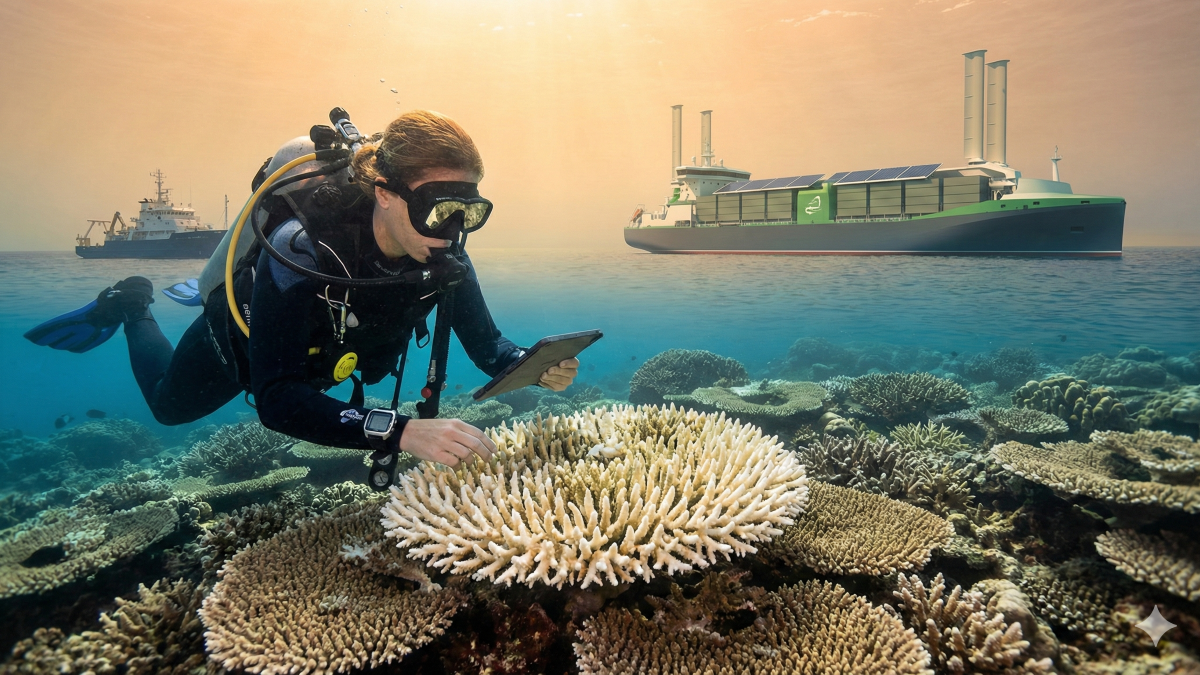
Bleaching is more than a colour change. Corals live in partnership with microscopic algae that feed them and give reefs their bright tones. When water becomes too hot, or sunlight too intense, corals expel these algae. Their white skeletons then show through their transparent tissue, creating the bleached look documented by groups like the Great Barrier Reef Foundation.
If heatwaves are short and mild, some colonies recover. When heat is extreme or repeated, they starve, grow slowly, become more vulnerable to disease and often die. This is why scientists describe recent events as a systemic Environmental Impact on reef-based Marine Ecosystems, not a passing disturbance.
A global pattern of climate change and coral loss
The 2022 event on the reef was already unusual: it occurred during a La Niña phase, which typically brings cooler conditions to eastern Australia. Yet it became the reef’s sixth mass bleaching since 1998, followed by another major event in 2024. Reports such as recent analyses of catastrophic bleaching describe how intervals between events are shrinking.
Beyond Australia, more than 80% of the world’s coral reefs have been exposed to the worst bleaching event on record, according to coverage of global datasets summarised by institutions like the Smithsonian (“worst bleaching event on record”). Coral systems that evolved over millennia are being pushed to adapt within decades.
Why a small temperature bump can mean coral collapse
On a planetary scale, removing sulphur from ships has warmed the climate by an estimated 0.05°C at most, according to climate scientist Prof Steven Sherwood of the University of New South Wales. That may sound tiny. Yet over tropical oceans, where corals already live near their upper thermal limit, local effects can be larger.
Sherwood notes that aerosols not only reflect sunlight back to space but also absorb some of it in the atmosphere. The new study suggests that in the Coral Sea this translated to local temperature boosts of up to 0.15°C, enough to significantly raise heat stress on corals during a marine heatwave.
“No free lunch”: pollution cuts without CO2 cuts
This is the paradox. Air pollutants such as sulphur stay in the atmosphere only for days before being washed out by rain. Carbon dioxide, by contrast, lingers for a century or more. Ryan summarises the lesson starkly in coverage by outlets like The Guardian and other international reports: society cannot treat cooling side-effects of dirty fuels as a climate shield.
The more quickly short-lived pollutants are cleaned up without cutting greenhouse gases, the more hidden warming is revealed. For the Great Barrier Reef, that means a hotter, brighter ocean unless deep decarbonisation accelerates.
Who feels the impact when the Great Barrier Reef bleaches
For a Cairns dive operator like the fictional “Ella Reef Tours”, a bleached site is not an abstract climate metric. It is cancelled boat trips, anxious phone calls from visitors and nervous staff wondering about next season. Tourism on the reef supports billions of dollars in economic activity and tens of thousands of jobs.
Communities that depend on reef fisheries feel the shock another way. Declining coral cover reduces habitat for fish that provide protein and income. According to organisations such as WWF, which chronicled how the reef was hammered by widespread bleaching, these losses ripple through regional economies and cultural traditions.
Cascading effects on biodiversity and regional stability
Coral reefs occupy less than 1% of the ocean floor but support an estimated 25% of marine species. When bleaching events become more frequent, entire food webs destabilise. Predators lose prey, algae overgrow once-vibrant structures and nursery grounds for young fish disappear.
For Pacific and Indian Ocean islands, similar patterns raise concerns about food security and coastal protection. Healthy reefs help buffer shorelines against storms; degraded ones crumble more easily, leaving villages and infrastructure more exposed to extreme weather linked to Climate Change.
Rethinking sustainability in the shipping industry
The study does not argue for reversing sulphur rules. Health and acid rain benefits are significant and immediate. Instead, it invites a more integrated view of Sustainability in the Shipping Industry that considers climate, air quality and Ocean Health together rather than in isolation.
Several options already exist or are emerging. Low- or zero-carbon fuels, such as green ammonia or methanol, can reduce both CO2 and some pollutants. Slower steaming cuts fuel use. Smarter routing keeps vessels away from the most sensitive reef zones during peak heat periods, reducing both noise and physical disturbance.
What effective conservation efforts could look like
Researchers and conservationists are also testing Conservation Efforts directly on the reef. Projects documented by initiatives like coral restoration groups explore selective breeding of heat-tolerant corals, shading experimental patches and restoring damaged areas with nursery-grown fragments.
Complementary policy steps may include dynamic no-anchor zones, stricter shipping lanes away from shallow reefs and coordinated early-warning systems that trigger local protections when Coral Bleaching risk surges. Each measure buys time while global emissions pathways determine the reef’s longer-term fate.
Actions that matter: from policy rooms to living rooms
The complex interaction between cleaner fuels and bleaching could feel disheartening. In reality, it highlights how every part of the system is connected. Cutting sulphur without cutting CO2 exposes hidden warming; cutting both together brings clear net benefits to Marine Ecosystems.
For readers far from Queensland, several concrete steps can still influence this story and others like it:
- Support ambitious climate policy by backing representatives and organisations pushing for rapid emissions cuts in energy, transport and industry.
- Choose lower-carbon transport and products, which reduces demand for high-emitting shipping routes and fuels.
- Engage with science-based organisations such as those issuing alerts on reef bleaching risks and global calls to action.
- Reduce local pollution through community actions that protect nearby coasts, from cutting plastic waste to restoring mangroves.
- Stay informed and share credible reporting, helping others understand why half a degree or a fuel regulation can reshape entire seascapes.
The Great Barrier Reef has already endured seven mass bleaching events since 1998. The cleaner skies over its shipping lanes show that partial fixes are not enough. Only coordinated action on climate, pollution and conservation can keep its colours from fading further.
Why did cleaning up ship fuel make coral bleaching worse?
Removing sulphur from ship fuels reduced sulphate aerosols in the atmosphere. These particles used to brighten clouds and scatter sunlight, providing a modest shading effect over the ocean. With fewer aerosols, more of the sun’s energy reached the surface, increasing local heat stress on corals already pushed to their thermal limits by climate-driven marine heatwaves.
Does this mean sulphur regulations for the shipping industry are a mistake?
No. Reducing sulphur emissions cuts air pollution that harms human health and ecosystems, and helps limit acid rain. Scientists involved in the research emphasise that sulphur controls are needed, but they expose the urgency of reducing carbon dioxide at the same time. Without deep CO2 cuts, removing cooling pollutants reveals additional warming that especially threatens coral reefs.
How many bleaching events has the Great Barrier Reef experienced?
Since 1998, the Great Barrier Reef has experienced seven mass bleaching events: 1998, 2002, 2016, 2017, 2020, 2022 and 2024. Several of these have affected very large areas and high percentages of corals. Scientists are concerned that the gap between events has become too short for many coral communities to fully recover before the next heatwave arrives.
What role does climate change play compared with shipping pollution?
London, San Francisco, and Beijing Make Significant Strides in Slashing Air Pollution Levels
The Reappearance of a ‘Ghost’ Great White Shark Sparks New Questions in the Mediterranean
Climate change, driven mainly by greenhouse gas emissions from fossil fuels, is the primary force behind rising ocean temperatures and more frequent, intense marine heatwaves. Shipping pollution changes how sunlight is distributed but does not drive the long-term warming trend. The study shows that cleaning up sulphur can intensify local impacts on corals, yet without global decarbonisation, reefs will continue to face escalating thermal stress.
What can individuals do to help protect coral reefs?
Individuals can support strong climate policies, reduce personal and organisational carbon footprints, choose products and services with lower shipping emissions and back reputable conservation groups working on reef monitoring and restoration. Staying informed about coral science, sharing trustworthy information and reducing local coastal pollution all contribute to creating better conditions for coral survival and recovery.