
Show summary Hide summary
- Webb’s sharpest view of the Helix Nebula so far
- From comet-like knots to layered shells of gas
- What Webb’s Helix image tells us about our Sun
- Color, chemistry and the story hidden in light
- Limits, open questions and what comes next
- What future observations will target
- What makes the Helix Nebula special compared with other nebulae?
- Does the Helix Nebula show what will happen to the Sun?
- How does Webb improve on earlier images from Hubble?
- Can planets survive when a star becomes a planetary nebula?
- Why do astronomers call this object a planetary nebula if it involves no planets?
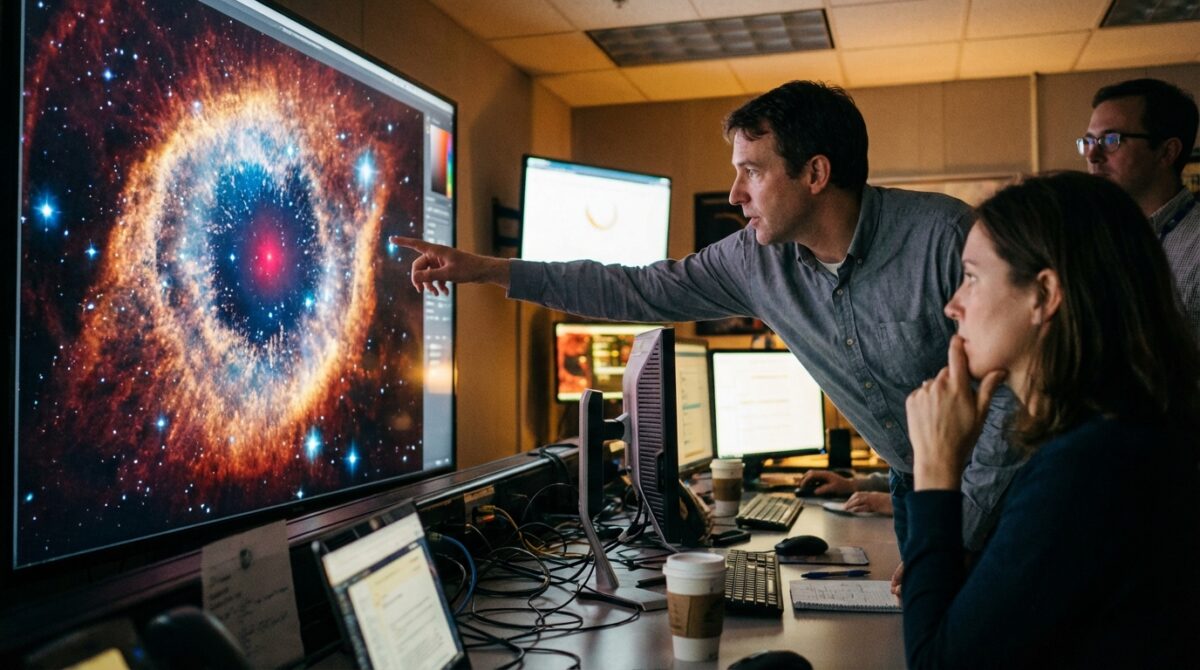
The latest image from the James Webb Space Telescope shows something both beautiful and unsettling: a Radiant Exhalation from a Dying Star that previews the distant fate of our own Sun. In a single frame, the Helix Nebula becomes a time machine for Stellar Evolution.
What we now know, more clearly than ever, is how a Sun-like star peels off its outer layers, how those layers are sculpted into complex structures, and how that expelled material turns into the seeds of future planetary systems. Webb’s infrared image, released by NASA, ESA, and CSA and analysed by teams across Europe and North America, brings long-debated details of this planetary Nebula into sharp, quantitative focus.
Webb’s sharpest view of the Helix Nebula so far
The Helix Nebula, about 650 light-years away in Aquarius, has been observed since the early 1800s. It is among the nearest and best-studied planetary nebulae, yet its internal knots, arcs and temperature layers were only partially understood from earlier optical images.
Rare Daytime Fireball Lights Up Texas Sky: Discover Where Meteorites Could Have Landed
Discovery of Fluorescent Ruby-Like Gems Marks a First on Mars
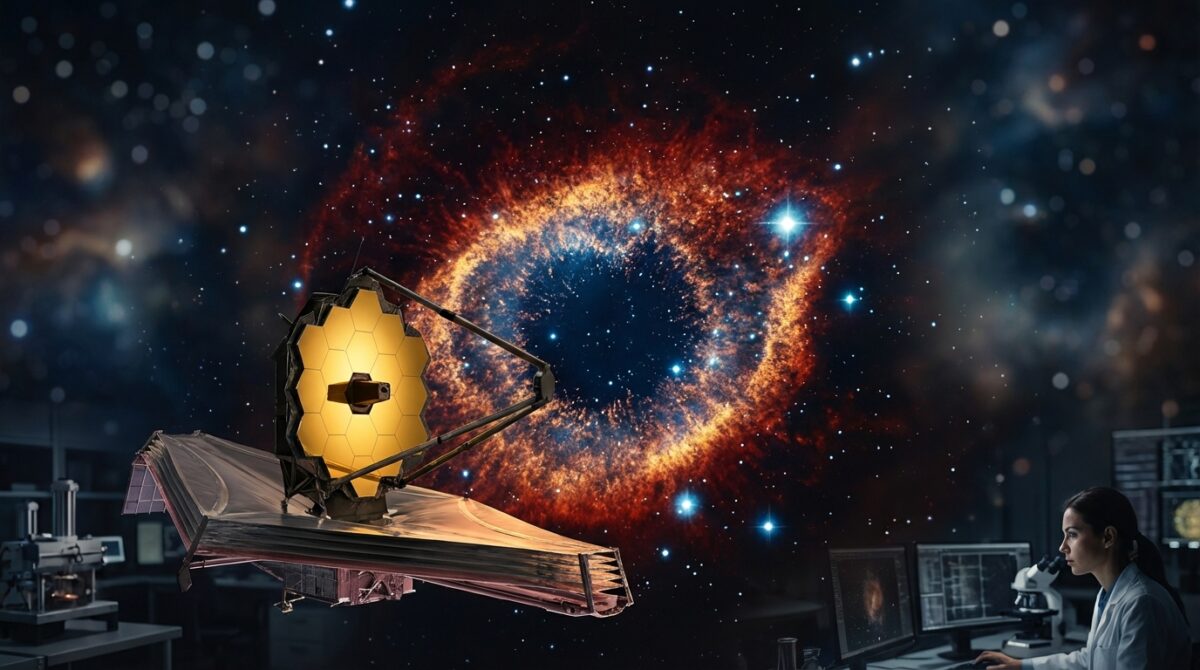
Using its NIRCam near-infrared instrument and mid-infrared coverage, the James Webb Space Telescope now resolves structures down to a scale that older facilities, including Hubble, could not separate. Analyses reported by teams affiliated with ESA and institutions such as the University of Arizona, detailed in releases like ESA Webb’s Helix overview and summaries on NASA’s science portal, combine the imaging with models of gas density and temperature.
How astronomers captured the dying star’s last breath
In practical terms, the methodology is simple to describe: Webb recorded the Helix in multiple infrared wavelengths, and researchers compared the brightness of each pixel across those bands to infer temperature, composition, and density. This multi-band approach underpins many reports, including independent syntheses on Universe Magazine’s Helix analysis and technical summaries highlighted by ESA’s image feature.
Because different molecules and atoms glow at distinct infrared colors, the team can map where gas is ionized, where hydrogen has recombined into molecules, and where dust is beginning to condense. While the image itself looks like art, each color gradient corresponds to carefully calibrated physical parameters, with uncertainties generally within tens of percent for the dominant components.
From comet-like knots to layered shells of gas
One of the most striking findings is the abundance of dense, comet-shaped pillars at the inner edge of the Helix’s bright ring. These “knots” had been hinted at in Hubble images, but Webb’s higher resolution in the infrared reveals their length, orientation, and density with far greater clarity, as also emphasized in coverage by NASA and The Debrief.
These knots trace a boundary where very fast, hot stellar winds plough into slower, cooler shells of gas and dust expelled earlier in the star’s life. This collision zone sculpts the nebula’s texture, creating long tails that point away from the central white dwarf. The pattern supports models where the dying star experiences several distinct mass-loss episodes rather than a single, smooth outflow.
A layered atmosphere turned inside out
Another key result concerns the temperature gradient. Close to the unseen white dwarf, Webb sees intense emission from hot, ionized gas, corresponding to strong ultraviolet radiation. Moving outward, the emission shifts to wavelengths characteristic of molecular hydrogen, then to colder regions rich in dust.
This layered structure matches theoretical expectations for late Stellar Evolution but had not previously been mapped with such spatial precision. Studies summarized in outlets such as SciTechDaily’s overview of Sun-like star death describe confidence in this gradient as high, with consistent results across independent models and instrument calibrations.
What Webb’s Helix image tells us about our Sun
At the heart of the Helix, just off the edge of the featured Webb frame, lies a compact white dwarf: the stellar core left after the star discarded its outer layers. That compact object floods the remaining gas with radiation, powering the nebula’s glow. For readers wondering about long-term solar forecasts, models predict a similar outcome for the Sun in about 5–7 billion years.
For a planetary system, this phase is both destructive and creative. Inner planets can be stripped or engulfed, while outer material, asteroids and comets may be perturbed into new orbits. As highlighted in interpretive pieces like “The last exhalation of a dying star”, the Helix provides an empirical template for such scenarios rather than a purely theoretical sketch.
From stellar remains to future worlds
Why should distant gas clouds interest someone focused on Earth and future societies? Because those colorful shells are the raw material from which later generations of stars and planets form. Inside the Helix’s cooler, shielded pockets, carbon-bearing molecules and small dust grains begin to aggregate.
Over tens or hundreds of millions of years, material like this can collapse into new stellar systems. Analyses in sources such as Ars Technica’s Webb feature stress that Webb is effectively catching the transition from “old star” to “future nursery” in action. The Helix therefore serves as a case study in how the universe recycles elements, including those that make rocky planets and, potentially, life.
Color, chemistry and the story hidden in light
While the Helix image looks like a piece of abstract art, its colors encode quantitative information. Blue tones mark the hottest gas, energized by ultraviolet radiation close to the white dwarf. Yellow regions trace areas where hydrogen atoms pair up into molecules, while deep reds outline the coldest, dust-rich outskirts of the Nebula.
Specialists compare these color maps with spectral models to infer the relative contributions of hydrogen, oxygen, and carbon-bearing species, often quoting uncertainties and confidence intervals for line strengths. Public explainers on platforms such as Futurism’s coverage of the “star crumbling into dust” help translate this spectral analysis into accessible visuals.
How this affects your view of Astronomy and Space Imaging
For a student or professional following Astronomy, the Helix results demonstrate how modern Space Imaging connects directly to physical models. A single, high-resolution dataset can constrain mass-loss rates, wind speeds, and chemical enrichment, all with quantified uncertainties. It is not simply a pretty picture; it is a data-rich laboratory.
For policy-makers or research funders, this case reinforces the value of large, collaborative missions like Webb, which involve NASA, ESA and the Canadian Space Agency. Articles compiled through platforms such as ScienceDaily’s research summaries underline how one observation feeds into multiple studies on Stellar Evolution, dust formation, and exoplanetary environments.
Limits, open questions and what comes next
Despite its unprecedented clarity, the Helix dataset does not answer every question. The exact timing and number of mass-loss episodes remain uncertain, because Webb provides a snapshot rather than a full time series. Researchers must infer the history from the shapes and velocities of shells, introducing model-dependent assumptions.
Another limitation concerns the smallest dust grains and the most complex molecules. Some may lie below Webb’s detection threshold, so estimates of total dust mass and chemical diversity are still incomplete. Correlation between observed structures and theoretical predictions is strong, but causation — for example, how specific stellar pulsations trigger each shell — requires further modelling and complementary observations at other wavelengths.
What future observations will target
Teams are already planning follow-up spectroscopy of selected knots and filaments in the Helix. By measuring subtle shifts in spectral lines, they aim to determine precise expansion speeds and reconstruct a more detailed three-dimensional structure. Combined with models of magnetic fields and binary-star interactions, this could clarify why some planetary nebulae, including the Helix, show such pronounced asymmetries.
For readers tracking broader trends, the Helix joins a growing list of planetary nebulae studied in comparable detail. This will allow statistical studies of how common features such as comet-like knots or layered chemistry really are. In that sense, one dying star’s Radiant Exhalation becomes a key data point in a much larger story about how stars live, die, and seed the galaxy with building blocks for future worlds.
- Location: Helix Nebula, about 650 light-years away in Aquarius.
- Central object: Hot white dwarf, remnant of a Sun-like star.
- Instruments: Webb’s NIRCam and mid-infrared capabilities.
- Key structures: Comet-like gas knots, layered shells, dust-rich outer regions.
- Main insight: Direct visual evidence of how stellar death recycles matter into material for new stars and planets.
What makes the Helix Nebula special compared with other nebulae?
The Helix Nebula is one of the closest planetary nebulae to Earth, about 650 light-years away, which makes its structures appear relatively large on the sky. This proximity, combined with its ring-like geometry, allows telescopes such as the James Webb Space Telescope to resolve fine details in its gas, dust, and comet-like knots that are harder to study in more distant objects.
Does the Helix Nebula show what will happen to the Sun?
The Helix does not provide an exact blueprint for the Sun’s future, but it offers a physically similar case. Both involve stars with roughly comparable masses reaching the end of their nuclear-burning lives and shedding their outer layers. Models suggest that in several billion years the Sun will also pass through a planetary nebula phase, leaving behind a white dwarf surrounded by expanding shells of gas and dust broadly analogous to what Webb now observes in the Helix.
How does Webb improve on earlier images from Hubble?
Hubble’s optical images revealed the overall ring structure and some internal knots but were limited in sensitivity to cooler gas and dust. Webb observes in the infrared, where molecules and dust grains emit strongly, and its larger mirror delivers sharper resolution. As a result, Webb can distinguish individual comet-like pillars, map temperature changes from the hot inner gas to the cold outer regions, and trace the chemistry in ways that Hubble alone could not achieve.
Can planets survive when a star becomes a planetary nebula?
The fate of planets depends on their distance from the star and its exact evolution. Inner planets may be engulfed or stripped by intense radiation and stellar winds. More distant worlds, such as outer gas giants or icy bodies, can survive but often have their orbits disturbed. The Helix Nebula shows the environment that any surviving objects would experience: a bright, radiation-filled shell gradually thinning as it expands into interstellar space.
Why do astronomers call this object a planetary nebula if it involves no planets?
Astrophotographer Captures Stunning Image of Thor’s Helmet Nebula Emitting Light from 15,000 Light-Years Away
Officina Stellare Secures $2 Million Deal to Develop Laser Communications Ground Station in Spain
The term “planetary nebula” is historical. Early telescopes showed these glowing disks as small, round patches resembling distant planets such as Uranus, so observers adopted the planetary label. Modern Astronomy recognizes that planetary nebulae are actually shells of gas expelled by dying stars, not related to planets, but the name has remained in use for continuity.