Show summary Hide summary
- A chirping supernova that behaves like merging black holes
- The magnetar engine hidden in the exploding star
- How global space observation caught the chirp in real time
- What SN 2024afav changes for neutron stars and pulsars
- Key takeaways for your mental “cosmic playbook”
- What makes SN 2024afav different from normal supernovae?
- How does a magnetar create chirping signals in a supernova?
- Why is Lense–Thirring precession important in this discovery?
- How did astronomers detect such fine details in the light curve?
- Will more chirping supernovae be found in the future?
A distant supernova has just “sung” a rising cosmic note, a true chirping signal that finally exposes what powers the universe’s brightest stellar blasts. This time, the data line up so cleanly that the long-debated magnetar supernova connection scenario steps out of theory and into direct evidence.
A chirping supernova that behaves like merging black holes
When Joseph Farah, a graduate researcher at UC Santa Barbara, plotted the light from superluminous supernova SN 2024afav, the curve refused to stay smooth. Instead of a clean rise and fall, the brightness showed a sequence of bumps that occurred faster and faster.
Those bumps formed a chirp: a quasi-periodic pattern whose frequency increases with time, reminiscent of gravitational-wave signals from coalescing black holes. For the first time, astronomers saw such a structured pattern emerging from a stellar explosion rather than a compact-object merger, challenging every standard model of supernova behavior used in modern astrophysics. Learn more about surprising stellar explosions by reading about the sudden signal flare that unmasks the elusive companion behind fast radio bursts.
Chickpeas Poised to Become the Moon’s First Cultivated Crop
Researchers Potentially Unveil a Novel Mineral Discovery on Mars
Why superluminous supernovae puzzled astronomers for years
Most stellar deaths follow a predictable script. A massive star exhausts its fuel, its core collapses into a neutron star or black hole, and the outer layers blast outward. The light brightens, peaks, then steadily fades. Even then, a classic core-collapse event can briefly rival a whole galaxy.
Superluminous events are different. They shine 10 to 100 times brighter and often show erratic variations in brightness. Researchers proposed dense surrounding gas, central engines, or exotic radioactive processes. Studies like earlier work on superluminous supernovae and magnetars hinted at answers, but none predicted a neat, accelerating pattern of bumps.
Farah’s light curve for SN 2024afav forced a new question: what astrophysical engine can produce a tidy, accelerating lighthouse-like pattern in visible light, inside expanding supernova debris?
The magnetar engine hidden in the exploding star
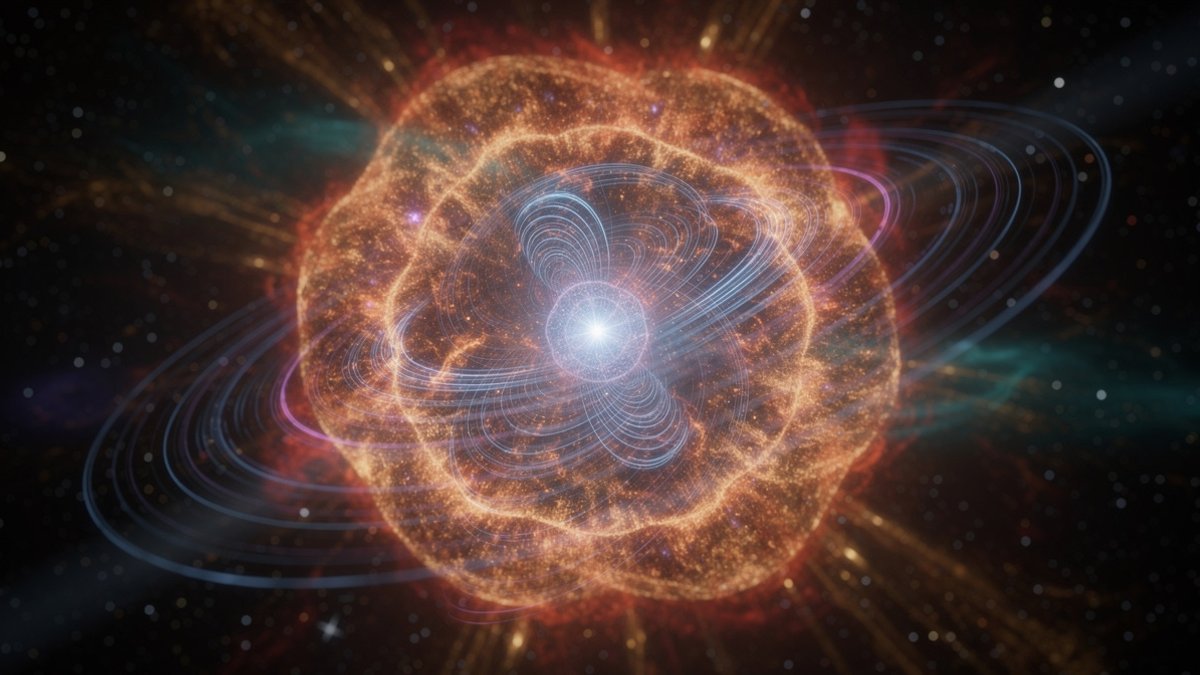
Farah was, at the time, auditing a general relativity course at UCSB. That background nudged him toward an idea many teams had floated but never fully nailed down: a rapidly spinning magnetar supernova connection buried in the wreckage, with gravity and magnetic fields working together to sculpt the light. You may also enjoy reading about the Apollo moon rocks reveal new insights into lunar magnetic mysteries.
A magnetar is a special kind of neutron star. Its magnetic field is trillions of times stronger than Earth’s, strong enough to twist charged particles and space-time itself. This kind of object has already been linked to exotic cosmic phenomena such as fast radio bursts, as shown by studies of FRB-producing magnetars and related work like observations of mysterious radio bursts.
From smooth models to a wobbling disk and chirping signals
Standard magnetar-powered supernova models assume a fairly steady energy injection: the newborn neutron star loses rotational energy and pumps it into the ejecta, boosting the luminosity and shaping the overall light curve. That framework can explain the extreme brightness but not the clean, repeating bumps seen in SN 2024afav.
Farah proposed that some of the ejected material fell back, forming a tilted accretion disk around the magnetar. Due to Lense–Thirring precession, a general relativity effect, the spinning star drags nearby space-time, forcing the disk to wobble. As that disk slowly spirals inward, its precession accelerates, periodically blocking and reflecting light like a cosmic shutter, creating the observed chirping signals.
To validate this, the team tested Newtonian wobble mechanisms and magnetically driven precession. Only the relativistic Lense–Thirring model reproduced both the period of the bumps and the rate at which that period shrank, bringing general relativity directly into the mechanics of a supernova light curve.
How global space observation caught the chirp in real time
The story of SN 2024afav is also a story of coordination. The ATLAS survey first flagged the explosion in late 2024. Las Cumbres Observatory then used its global telescope network to watch the event for more than 200 days, adjusting exposures on the fly as each new bump appeared exactly where the model predicted.
This high-cadence signal detection was so clean that researchers could forecast upcoming pulses and verify them within hours. That kind of responsive observing echoes other breakthroughs, such as campaigns following suspected magnetar births described in sources like reports on capturing the birth of a magnetar, and shows how flexible observing is reshaping time-domain astronomy.
What SN 2024afav changes for neutron stars and pulsars
For years, magnetar-powered superluminous explosions were one hypothesis among several. The “chirp” of SN 2024afav ties the bumps, brightness, and timing into a single, GR-driven framework. That elevates the magnetar model from plausible idea to firmly supported mechanism.
It also strengthens the connection between magnetars, pulsar-like behavior, and other cosmic phenomena. A single newborn neutron star can act as a lighthouse in multiple bands: shaping optical light, potentially driving radio bursts, and leaving signatures similar to those seen in other chirping supernova analyses or in work on hidden companions behind sudden signal flares, such as studies of elusive fast radio burst sources.
Key takeaways for your mental “cosmic playbook”
If you follow cutting-edge space observation projects, SN 2024afav is worth filing next to gravitational-wave detections. Both reveal compact objects through changing frequencies rather than static snapshots. For this supernova, the light curve itself became a precision probe of general relativity.
Here is how this shifts the landscape of high-energy astrophysics:
- First optical chirp: a rising-frequency pattern measured in light, not gravitational waves.
- Magnetar confirmation: strong evidence that a spinning neutron star powered this superluminous explosion.
- Relativity in action: Lense–Thirring precession directly shaping observable brightness changes.
- New class of events: “chirping” supernovae as a target population for future surveys.
- Path to discovery: upcoming Rubin Observatory scans should uncover many more of these signals.
What makes SN 2024afav different from normal supernovae?
SN 2024afav is a superluminous supernova, roughly 10 to 100 times brighter than typical events. Instead of showing a smooth brightening and fading, its light curve displayed a sequence of bumps that sped up over time, forming a chirp-like pattern. That structured acceleration points to a central energy source, most likely a newborn magnetar shaping the light through relativistic effects.
How does a magnetar create chirping signals in a supernova?
In the proposed model, some material from the explosion falls back and forms a tilted accretion disk around the rapidly spinning magnetar. Due to Lense–Thirring precession, the magnetar drags nearby space-time and forces the disk to wobble. As the disk moves inward, its wobble speeds up, periodically blocking and reflecting light, which produces the observed accelerating pulses, or chirp, in the brightness.
Why is Lense–Thirring precession important in this discovery?
Lense–Thirring precession is a general relativity effect where a rotating mass drags the surrounding space-time. In SN 2024afav, only a model using this effect correctly reproduced both the period of the brightness bumps and how quickly that period changed. This makes the event one of the first cases where general relativity is needed to explain detailed timing in a supernova light curve, not just its overall energy. For more on fundamental phenomena in cosmic timing, explore the article on dark stars unveiling three key mysteries of the early universe.
How did astronomers detect such fine details in the light curve?
Cosmic Voids: The Invisible Forces Potentially Ripping the Universe Apart
A Peculiar Black Hole Type That Could Unlock Three Cosmic Enigmas at Once
The detection relied on a global telescope network operated by Las Cumbres Observatory. Once the event was flagged, astronomers monitored it with high cadence over more than 200 days. They adjusted their strategy as each new bump appeared, testing predictions in near real time. This dense, carefully planned coverage made it possible to resolve the small, rapidly changing features that make up the chirp.
Will more chirping supernovae be found in the future?
Yes. Wide-field surveys, especially the Vera C. Rubin Observatory’s Legacy Survey of Space and Time, will scan large areas of the sky repeatedly and generate massive time-series datasets. That level of coverage should reveal many more superluminous supernovae with structured variability, including additional chirping events, helping astronomers refine magnetar models and understand how often these powerful engines form.