
Show summary Hide summary
- Radio waves turn a star explosion into a time machine
- What the radio signals say about this exploding star
- Why Type Ibn supernovae matter for astrophysics
- What this means for future space observation and policy
- Key takeaways from the study
- What is a Type Ibn supernova and why is it rare?
- How do radio waves reveal what happened before a star exploded?
- Does this study prove that all massive stars die in binary systems?
- Why are radio telescopes needed if we already have optical images of supernovae?
- How could these findings change future astronomy observations?
What if astronomers could rewind the final decade of a massive star’s life and watch every violent breath before its cataclysmic explosion? Using radio waves as a kind of cosmic replay system, a new study has done exactly that for a rare exploding star, revealing an intense storm of gas loss just years before its supernova.
For the first time, researchers have captured radio signals from a Type Ibn supernova, a short-lived and unusual form of stellar death. The work, led by Raphael Baer-Way at the University of Virginia and published in The Astrophysical Journal Letters, shows that the doomed star shed enormous amounts of helium-rich gas in its final years, likely under the influence of a hidden companion star.
Radio waves turn a star explosion into a time machine
The key finding is straightforward yet striking: faint radio emissions recorded after the star’s explosion carry a readable imprint of what the star was doing up to a decade before its final blast. By tracking those cosmic signals, astronomers reconstructed the star’s late-life behavior rather than only the instant of the cataclysmic event.
Potential First Observation of a ‘Dirty Fireball’ Star Explosion Unveiled
Historic Artemis II Mission Launches Astronauts on Pioneering Journey to the Moon

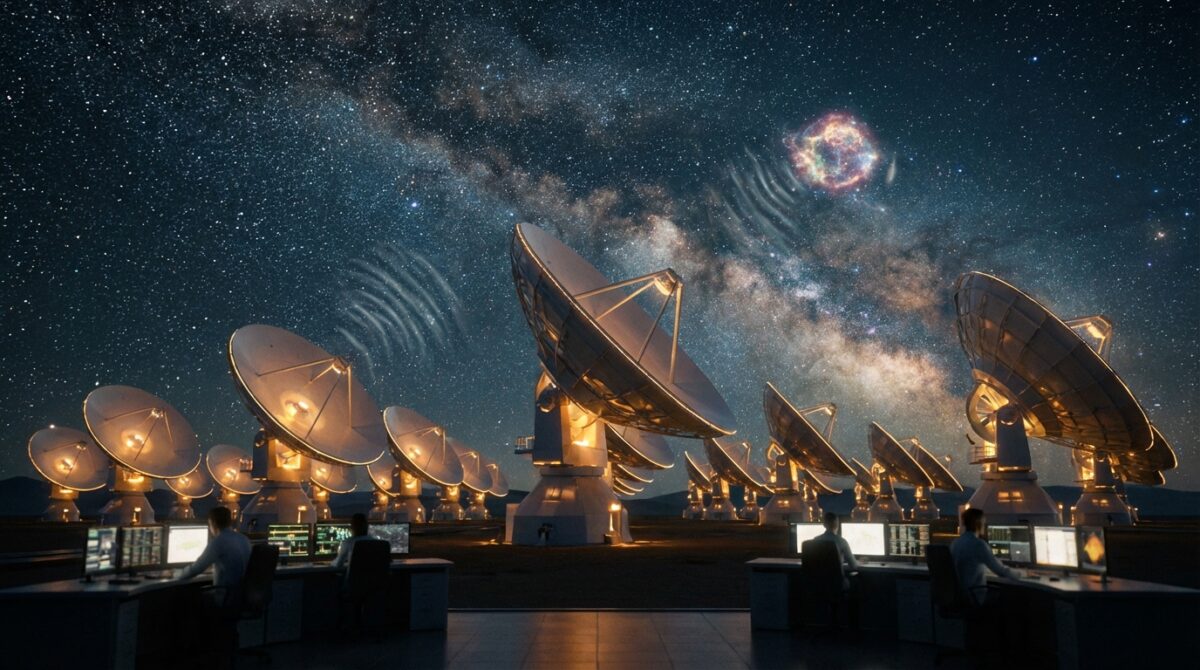
To do this, the team used a simple but powerful approach: observe the same supernova repeatedly with a sensitive radio telescope and see how its emission fades over time. The National Science Foundation’s Very Large Array in New Mexico followed the object for roughly 18 months, long after the initial flash that optical telescopes typically chase has dimmed.
How the methodology exposes a decade of stellar history
In practical terms, the method rests on one core principle: when the blast wave from a star explosion slams into gas previously ejected by the star, it generates radio waves. Measuring how strong that radio emission is, and how fast it declines, tells astronomers how much material was there and how far from the star it sat.
Because the expelled gas expands outward at a known speed, its distance from the star maps directly to when it was launched. That turns the surrounding material into a time-stamped shell. By combining radio brightness, expansion speeds and models from astrophysics, Baer-Way’s team effectively read off a timeline covering roughly the last five to ten years before the supernova.
What the radio signals say about this exploding star
The data show that the star went through a dramatic, short-lived phase of mass loss in its final stretch of life. Radio and X-ray measurements indicate that helium-rich gas surrounded the star in a dense shell, evidence that it was shedding material at an extraordinary rate in those last years.
Previous work by radio teams, such as the first radio detection of a rare supernova type, hinted that these violent episodes might occur. The new UVA study goes further by tracking the emission over many months and connecting specific peaks and plateaus in the radio light curve to distinct phases of late-stage mass loss.
A binary companion hidden behind the cataclysmic event
The intensity and timing of the gas shedding point strongly toward a binary system. A single star, acting alone, would struggle to lose mass this quickly. Interactions with a close companion, however, can strip material, pull off outer layers and channel gas into space in focused outbursts.
Baer-Way and colleagues argue that the observed mass-loss rate, at levels comparable to a fraction of the Sun’s mass per year, is best explained by two stars gravitationally bound and exchanging material. While the study cannot yet prove that the companion was present, the radio profile is highly consistent with such a scenario, and similar patterns appear in other exotic astronomy events.
Why Type Ibn supernovae matter for astrophysics
Type Ibn supernovae are rare, making up only a small slice of known stellar explosions. They are characterized by helium-rich surroundings but little hydrogen, marking them as products of very massive, heavily stripped stars. Because of their scarcity and distance, they have been hard to probe in detail before the blast.
By showing that space observation at radio wavelengths can illuminate the years leading up to such an event, this work gives researchers a way to fill in a missing chapter of massive star evolution. It links the brief, bright flash of a supernova to a much longer and messier story of instability, mass exchange and orbital drama.
Connecting this result to other cosmic radio signals
This study also fits into a broader trend: using radio waves to crack mysteries across the Universe. Other teams have recently traced bizarre repeating radio signals to compact neutron stars and far-off galaxies, as documented in reports on strange repeating radio bursts and new portraits of the Milky Way such as the radio color map of our galaxy.
Together with analyses of powerful fast radio bursts and other cosmic signals, this growing body of work suggests that radio astronomy is entering a high-precision era. Each detection adds another piece to a puzzle linking stellar death, dense remnants and the large-scale structure of galaxies.
What this means for future space observation and policy
Beyond the astrophysics, the UVA result highlights a strategic shift: to catch these fleeting radio flashes, observatories must point their antennas at supernovae far earlier than they used to. As UVA astronomer Maryam Modjaz notes, waiting too long means missing the brightest, most informative phase of the radio glow.
For agencies investing in next-generation arrays, such as the Square Kilometre Array, this offers a clear science case. Early, automated follow-up of optical alerts could build a statistical sample of Type Ibn and related events, revealing whether this intense late-stage mass loss is rare theater or part of a wider pattern in massive star evolution.
Key takeaways from the study
For readers keen to keep track, the work can be summarized in a few main points:
- Astronomers used the Very Large Array to monitor a Type Ibn supernova via radio waves for about 18 months.
- The radio emission encodes when and how much gas the star expelled in the last decade before its explosion.
- Results show extreme, helium-rich mass loss in the final five years, likely driven by a binary companion.
- The study opens a new way to study stellar death by targeting rare supernovae with early radio observations.
- Findings are consistent with, but do not prove, strong binary interaction and cannot yet be generalized to all massive stars.
These insights sit alongside complementary studies reported by outlets such as Earth.com’s coverage of radio waves before a star exploded and Mirage News’ overview of how radio waves unveil pre-explosion secrets, forming a consistent narrative: radio observations are now central to decoding how and where massive stars meet their end.
What is a Type Ibn supernova and why is it rare?
A Type Ibn supernova is a stellar explosion where the blast interacts with helium-rich, hydrogen-poor gas surrounding the star. These events come from very massive, heavily stripped stars and occur infrequently, so astronomers rarely catch them with enough detail to study the years before the explosion.
How do radio waves reveal what happened before a star exploded?
When the shock wave from a supernova hits gas the star expelled earlier, that collision produces radio emission. By measuring the strength and timing of those radio waves, astronomers can infer how much material was lost and when it was ejected, effectively reconstructing the final years of the star’s life.
Does this study prove that all massive stars die in binary systems?
No, it does not. The radio data from this single event strongly suggest that a companion star played a major role in the extreme mass loss, but this is evidence for one system, not a universal rule. Larger samples are needed to see how common binary-driven mass loss is among massive stars.
Why are radio telescopes needed if we already have optical images of supernovae?
A Groundbreaking New Theory Sheds Light on the Origins of the Big Bang
Webb Telescope Uncovers Enigmatic Explosion Challenging the Laws of Physics
Optical light mainly shows the explosion itself, while radio telescopes probe the interaction between the blast wave and earlier expelled gas. That interaction carries information about the star’s behavior in the years before the explosion, which visible light alone usually cannot reveal. Both types of data are complementary.
How could these findings change future astronomy observations?
The study suggests observatories should trigger radio follow-up on new supernovae much earlier than before to capture brief, bright radio phases. This shift in strategy could build a richer dataset on rare explosions, refine models of stellar evolution and help prioritize funding for sensitive radio arrays worldwide.