Show summary Hide summary
- How the Lunar X and V appear on the Moon
- Scientific meaning behind the Lunar X and V illusions
- Practical guide: how to observe the Lunar X and V
- Why this visual astronomy trick matters beyond the Moon
- Planning your next night sky session with expert resources
- Deepening your understanding with mission-style thinking
- When are the Lunar X and Lunar V visible each month?
- What telescope do I need to see the Lunar X and V?
- Where on the lunar surface are the X and V located?
- Why do the Lunar X and V look different from month to month?
- Can photographing the Lunar X and V help scientific studies?
For just a few hours each month, the moon hides a secret: a glowing Lunar X and Lunar V that switch on like celestial signposts along the line between night and day. Catching them feels less like routine Moon observation and more like stumbling upon a cosmic Easter egg that was always there, waiting for the light to hit just right.
These fleeting lunar phenomena do not require a space agency budget or an observatory dome. With a modest telescope, some planning, and a clear night sky, you can watch geometry appear on the Moon’s battered face. The effect is so striking that many first-time observers struggle to believe it is not digitally added.
How the Lunar X and V appear on the Moon
During the first quarter moon phase, the Sun illuminates the Moon from the side. Along the boundary between day and night, the terminator, shadows stretch across craters and mountains, carving sharp contrasts in the lunar topography.
Officina Stellare Secures $2 Million Deal to Develop Laser Communications Ground Station in Spain
Artemis 2 Moon Rocket Returns to Launch Pad | Stunning Space Image Feature for March 20, 2026
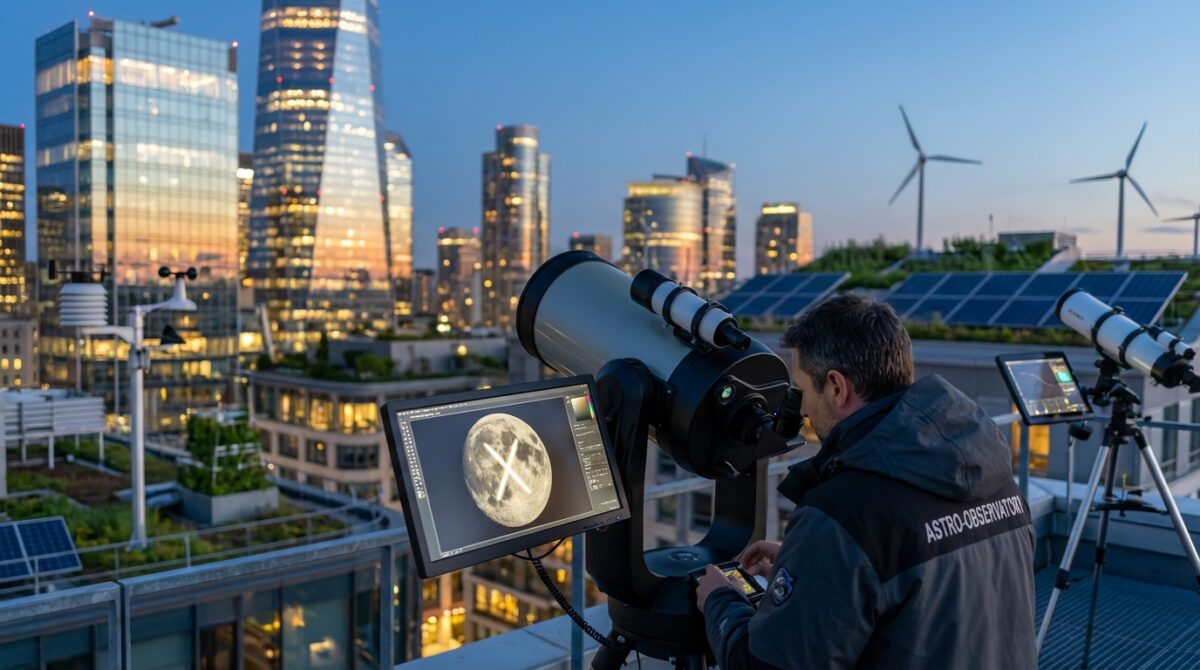
At a very specific angle, sunlight grazes the rims of the craters La Caille, Blanchinus, and Purbach. Their bright, sunlit ridges line up to form the Lunar X, perched just off the terminator. Nearby, light washing over the crater Ukert and several smaller depressions weaves together the Lunar V. Both shapes are illusions, but they arise from real relief on the surface.
Timing these fleeting lunar phenomena
The alignment that creates the Lunar X and Lunar V lasts for only about four to six hours around first quarter. Because the Moon’s position in the sky changes with longitude and local time, not every observer on Earth will see the effect during the same cycle.
For example, a first quarter around midnight in New York can offer a perfect window between roughly 22:00 and 02:00, while at the same moment Sydney may be in daylight with the Moon invisible. Planning tools, such as the observing charts on Find and observe the Lunar X on the Moon, help you pinpoint your own opportunity.
Scientific meaning behind the Lunar X and V illusions
At first glance, the Lunar X and V look like cosmic graffiti. In reality, they are a live demonstration of how planetary scientists read lunar topography from light and shadow. The same visual astronomy principles helped early NASA and ESA mission planners map safe landing sites for spacecraft.
These claire-obscure effects show how even small changes in the Sun’s angle reveal new structure on crater rims and mountain chains. The bright “letters” are essentially cross-sections of crater walls picked out by sunlight, illustrating the depth, slope, and erosion history of the lunar surface.
From backyard telescopes to robotic explorers
The same physics that lets an amateur spot the Lunar V also guides professional missions such as NASA’s Lunar Reconnaissance Orbiter. Engineers use high-contrast imagery, taken under low solar angles, to study boulder fields, landslides, and subtle fault lines.
Understanding how light behaves on rough terrain feeds directly into hazard maps for future landers from NASA, ESA, JAXA, and private companies. That expertise will matter for upcoming crewed surface missions that must avoid shadow-filled craters where solar power drops and temperatures plunge.
Practical guide: how to observe the Lunar X and V
For many observers, the first successful sighting happens by accident, much like an early photographer who unknowingly captured the Lunar X from Tokyo in 2025. To make your own observation intentional rather than lucky, a simple strategy helps.
Start by checking when the next few first quarter moons occur for your location. Planetarium software and online ephemerides can list the exact time, while guides such as this overview of the Lunar X and practical instructions for viewing Lunar X and V give approximate viewing windows.
Equipment, conditions and a simple observing routine
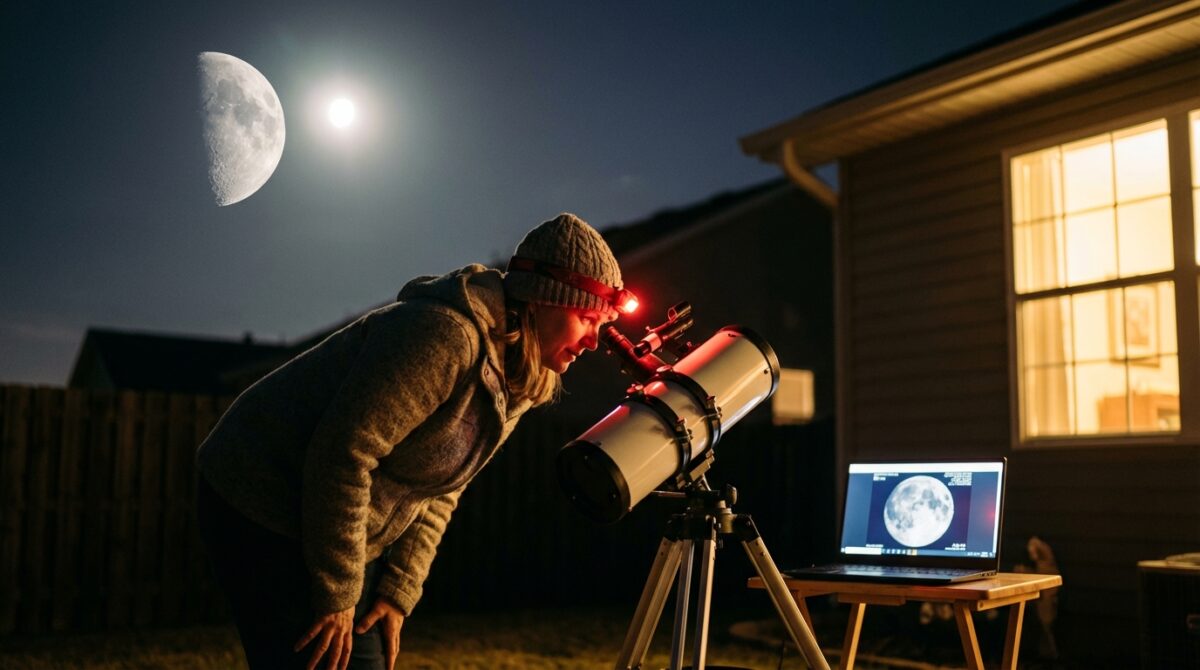
The Lunar X and V are not faint; they are high-contrast features. A small telescope with 60–80 mm aperture and moderate magnification is sufficient. Steady mounting matters more than extreme power, because shimmering air can blur the sharp lines that create the illusion.
A basic observing sequence can help you build the habit:
- Step 1: Check local first quarter timing and ensure the Moon is high in a dark sky.
- Step 2: Set up your telescope at least 20 minutes before the predicted window so optics can stabilise.
- Step 3: Center the terminator in the eyepiece and scan slowly along it, looking for bright, detached shapes.
- Step 4: Revisit every 30 minutes; the X often “grows” from partial to complete as the Sun’s angle changes.
- Step 5: Capture photographs with a smartphone through the eyepiece to document how the illusion evolves.
Why this visual astronomy trick matters beyond the Moon
On the surface, these effects seem like a niche curiosity for lunar enthusiasts. Yet the same interplay of geology and sunlight underpins how astronomers interpret landscapes on Mars, icy moons, and asteroids visited by missions from agencies worldwide.
Explorers who watched shadow lines on the Moon during the Apollo era refined techniques now used to assess landing zones for private spacecraft and to prepare for long-duration stays. Profiles of pioneers such as Sunita Williams’ career at NASA show how operational experience and precise surface knowledge have merged over decades of exploration.
From lunar light to Earth applications
Learning to read the Moon’s relief by eye sharpens skills that carry back to Earth. Remote-sensing experts use similar lighting angles when satellites map mountain glaciers, monitor mining sites, or evaluate landslide risks in future cities.
High-latitude auroral studies, such as those captured by a Russian cosmonaut and shared as a striking aurora video from orbit, likewise rely on understanding sunlight scattering, camera exposure, and vantage point. The Lunar X and V offer an accessible training ground for this kind of visual literacy.
Planning your next night sky session with expert resources
For observers building a regular Moon observation routine, curated schedules are invaluable. Detailed predictions of claire-obscure timings, such as the lists maintained on specialised clair-obscur observing blogs, show when the X and V favor different continents.
Observer reports and field notes collected by groups like the Skyscrapers astronomy society, summarised in resources such as their dedicated Lunar X & V pages, add nuance. They describe how sometimes the V appears while the X is still forming, letting you watch the illusion assemble in real time.
Deepening your understanding with mission-style thinking
Many experienced amateurs plan a “lunar campaign” over several months, mirroring the structured approach of professional missions led by NASA or ESA. One quarter, they focus on the X and V; another, on subtle rilles or domes revealed by similar low-angle lighting.
Rich explainers such as this in-depth guide to spotting the Lunar X and V and narrative reports like coverage of giant X and V apparitions help frame each viewing as part of a longer personal mission. In the process, a simple trick of light becomes a recurring appointment with the changing geometry of our nearest neighbour.
When are the Lunar X and Lunar V visible each month?
The Lunar X and Lunar V appear around the Moon’s first quarter phase, for roughly 4–6 hours when sunlight strikes specific crater rims at a grazing angle. Exact times vary with your longitude and local moonrise, so you need to match first quarter to when the Moon is above your horizon and the sky is dark.
What telescope do I need to see the Lunar X and V?
A small refractor or reflector with an aperture of 60–80 millimetres is usually enough. Moderate magnification, steady mounting, and good atmospheric conditions matter more than high power. Binoculars rarely show a clear X or V, because the shapes are compact and require some magnification to separate them from the surrounding terrain.
Where on the lunar surface are the X and V located?
The Lunar X is formed by sunlight on the rims of the craters La Caille, Blanchinus and Purbach, close to the lunar terminator at first quarter. The Lunar V appears nearby, created mainly by the crater Ukert and several small adjacent craters. Both sit near the Moon’s centre as seen from Earth, making them convenient targets for most observers.
Why do the Lunar X and V look different from month to month?
Blue Origin Enters the Competition for Orbital Data Centers
Astronomers Initially Overlook Gigantic Space Explosion—Equivalent to a Billion Suns—Until Detecting Its Echo
Because the Moon’s orbit and the Earth–Moon–Sun geometry change slightly, the solar illumination angle is not identical at each first quarter. As a result, the X and V can appear brighter, fainter, or slightly distorted, and sometimes one forms earlier than the other. Local seeing conditions and telescope focus also influence how sharply the shapes stand out.
Can photographing the Lunar X and V help scientific studies?
Casual photographs mainly serve educational and outreach purposes, but time-stamped images do contribute to long-term records of how these features develop over a viewing window. For learners, attempting such images is excellent practice in managing exposure, focus, and contrast, skills directly relevant to more advanced planetary and Earth observation imaging projects.