Show summary Hide summary
Imagine a predator so slow it cruises like a ghost, yet may have watched dynasties rise and fall. The Greenland shark hides in the deep sea, carrying timeless clues about aging, survival and our changing arctic oceans that scientists are only now unraveling.
Researchers, skippers and divers speak of this shark almost with reverence. Each encounter feels like brushing against living history. Behind its pale eyes and sluggish swim, this animal condenses centuries of marine biology questions: extreme longevity, mysterious shark behavior, unusual genetics and a lifestyle tuned to darkness and ice.
Greenland shark longevity that rewrites biology
When biologist Julius, our common thread, boards a research ship off the coast of Greenland, he knows he will likely only see this shark once in his life. Yet, the animal he follows using tags could outlive more than ten generations of scientists. Dating carried out on its eye lens has revealed probable ages ranging from 250 to over 400 years, placing this species at the pinnacle of vertebrate longevity. This record forces researchers to rethink their benchmarks on aging.
Discovery of New Fossils Could Resolve the Enigma of Sail-Backed Spinosaurs
Explore Five Breathtaking Shots in Photography Awards
The extremely slow growth of this predator, sometimes gaining less than a centimeter per year, aligns with its sexual maturity being reached only around 130 or 150 years. Such a life schedule, timed over centuries, is more reminiscent of an old oak tree than a marine carnivore. Analyses continue, with several teams, supported by DNA research, scrutinizing each genetic sequence for clues about this resistance to time.
An extreme life pace in the icy depths
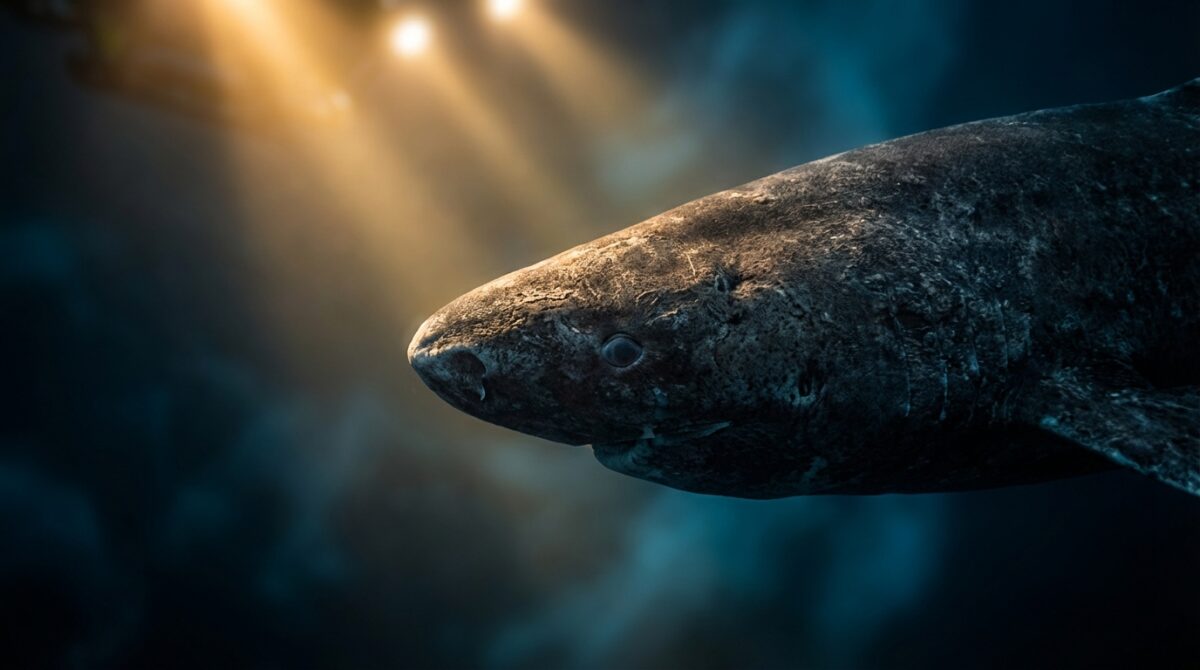
The key to this centuries-long fate seems to lie primarily in the environment that the Greenland shark inhabits. It mostly evolves between 600 and 1200 meters deep, in waters near freezing point. At these temperatures, everything slows down: blood circulation, digestion, chemical reactions within cells. Julius likes to compare this existence to a biological clock set on “slow mode,” where each heartbeat consumes little energy. At this reduced tempo, tissue wear extends over periods other vertebrates cannot reach.
Metabolic measurements of this species show among the lowest energy expenditures in the animal kingdom for such a large size. Individuals often reach four to five meters but burn fewer calories than a large temperate shark half their size. This metabolic sobriety limits the production of free radicals, those molecules that damage DNA over time. The shark thus seems to age slowly, while maintaining its place as an opportunistic predator in the Arctic food chain.
A genome calibrated to defy time
Genetic laboratories are now focusing on the hereditary makeup of this giant. Julius closely follows a team that sequences entire genomes to compare this species to other sharks and to short-lived mammals. The first analyses, supported by sources such as the study on the Greenland shark’s genome, point towards genes linked to DNA repair, protein stability, and cell cycle control. These mechanisms protect cells against errors that, in other animals, promote aging or tumors.
Researchers also find genetic variants associated with cold tolerance and fine fat management, crucial in polar waters. This combination is reminiscent of recipes present in other long-lived species, such as certain bowhead whales, but pushed here to the extreme. Each sequence discovered adds a piece to the puzzle of longevity secrets. Ultimately, Julius hopes these results will not only inform shark biology, but also enhance the general understanding of aging in vertebrates.
When science dissects muscles and enzymes
The genome doesn’t tell the whole story, so teams also analyze the cellular machinery. Muscle biopsies from animals of different ages have been used to measure the activity of enzymes involved in metabolism. Using spectrophotometers, researchers track how these proteins use oxygen and nutrients. Results show very moderate and remarkably stable activity, even when the temperature varies. This consistency aligns with the idea of an organism calibrated to function gently, but without faltering.
Julius often summarizes these data to his students as an “ultra-reliable diesel engine.” The tissues of the Greenland shark do not aim for explosive performance, they focus on longevity. The enzymes withstand oxidation, cell membranes remain supple despite the cold, and lipid reserves are used sparingly. Everything indicates an organism optimized to last, rather than to grow quickly or reproduce frequently. This life strategy sheds light on another aspect of the shark’s mystery.
Shark behavior in the darkness of the Arctic
Behaviorally, this giant contrasts sharply with the iconic sharks of tropical documentaries. Footage from onboard cameras shows an animal that moves slowly, often just faster than a recreational swimmer. Yet, its power remains real, and its robust jaw leaves clear marks on whale carcasses. Julius recounts a striking scene where the camera films a shark methodically inspecting a dead seal, circling it for minutes before biting. This patience illustrates an opportunistic strategy in an environment where every meal counts.
Autopsies of accidentally captured individuals reveal a varied diet: benthic fish, seals, cetacean remains, sometimes even human-made objects. The animal’s slowness suggests it captures weakened or inattentive prey rather than engaging in long chases. In the gloom of Arctic depths, discreet movement becomes an advantage. Researchers compare this hunting style to that of a silent tank, advancing unhurriedly but capable of hitting hard.
A predator that seems almost blind, but sees better than expected
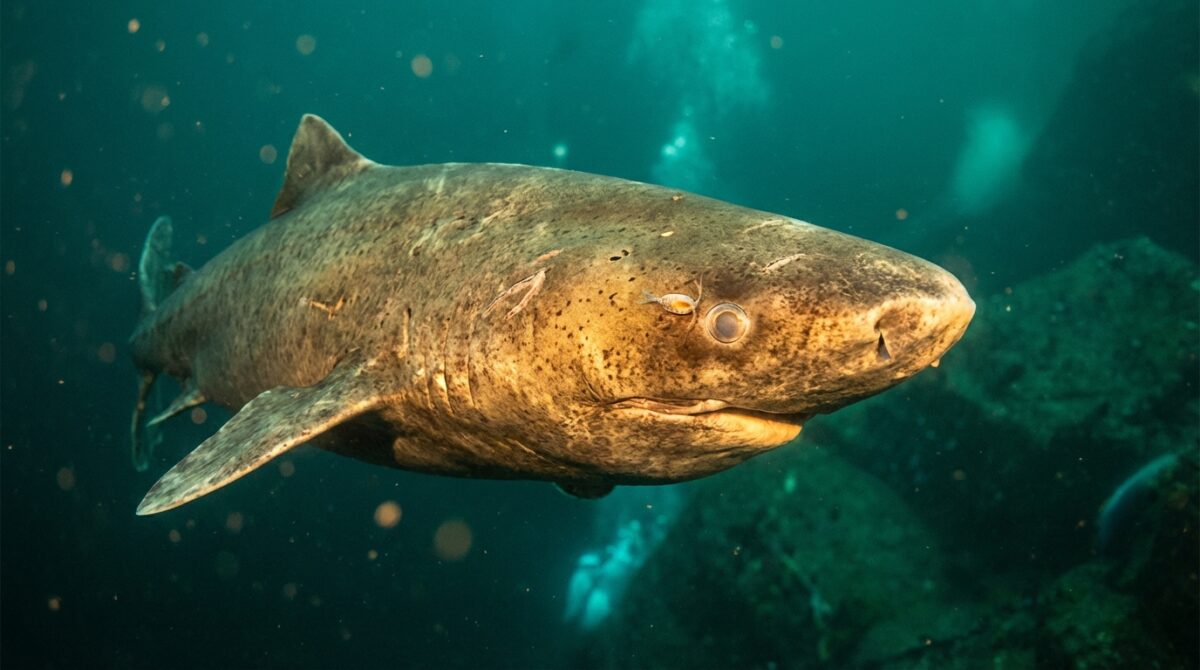
For a long time, scientists described the Greenland shark as nearly blind, its eyes often parasitized by a worm attached to the cornea. Julius himself observed these luminous parasites on a mission. This vision has been nuanced by recent work, supported by analyses like investigations into the truth behind slow, centuries-old sharks. Anatomical exams and sensory tests indicate that the animal retains functional vision, at least sufficient to distinguish contrasts and detect movement.
Researchers now believe this predator combines multiple senses: partial vision, extremely developed smell, perception of vibrations and the electric field of prey. In a dark ocean, this combination is better than sharp vision. The stereotype of the blind shark gives way to that of a sophisticated sensory hunter, adapted to near-permanent darkness. For Julius, this revision is a reminder that every certainty about this species deserves to be tested, as it remains shrouded in questions.
A reproduction method still shrouded in secrets
The reproduction of the Greenland shark represents one of the most mysterious chapters of its biology. Fishermen sometimes report massive females containing hundreds of ovules, but almost no direct observations of birthing exist. A study reported by specialized media shows, for example, a female carrying more than six hundred unfertilized eggs. Julius often mentions this discovery in his lectures to illustrate how even monumental species can remain unknown. The fertilization rate and survival of the young remain unclear.
New campaigns, specifically described in articles by Arctic researchers who equip females with tags, attempt to identify breeding areas. Satellites track these animals for several years to pinpoint areas where movements concentrate. The goal is to map potential deep “maternity” areas, possibly near remote continental shelves. Julius closely follows this data because understanding this life cycle phase is crucial for assessing the species’ resilience to environmental changes.
A risky life strategy in the face of human activities
Living slowly and reproducing late is an advantage in a stable ocean but a vulnerability when pressures increase. Each female takes decades to replace her presence in the population. Julius often highlights this point to policymakers: accidental capture of a single adult can represent the loss of several centuries of reproductive potential. Deep nets, some fisheries targeting other species, and expanding industrial activities in the Arctic add significant risks to this already fragile life cycle.
Scientists advocate for protected areas in the key habitats of this shark, even though these locations remain partially hypothetical. This demand is based on a simple argument: preserving the long term. The species takes centuries to mature, so management over a few years is not enough. For Julius, the survival of this discreet giant becomes a real-life test of our ability to respect biological rhythms that far exceed the human scale. Recent discussions have also highlighted the relevance of topics like shrinking Antarctic ice when considering long-term conservation strategies.
Arctic deep sea, a natural laboratory on the long term
The environment in which the Greenland shark lives acts as a gigantic experimental hall, where nature tests the effects of cold, pressure, and darkness on organisms. In these icy depths, daylight does not penetrate, the seasons are felt mostly by ice movements on the surface and the variations of nutrients descending from the upper waters. Julius appreciates this region because it forces biologists to think in terms of slow flows, food chains stretched over time, where each energy transfer matters.
The data collected indicates that these sharks frequent both the continental slopes of Greenland and some very deep fjords. They share this silent world with bottom fish, adaptable invertebrates, and other sleeper sharks. In this discreet assemblage, they play the role of recyclers, consuming carcasses and tired prey. This “cleaner” function prevents the accumulation of decomposing organic matter, which in the long term structures Arctic ecosystems. Observations like these extend our understanding of environmental interactions, much like studies regarding discovery of new fossils inform our knowledge of past ecosystems.
Climate pressures and the expansion of human activity
The latest temperature readings show that the Arctic is warming faster than the global average. This evolution is already changing the distribution of prey, ice cover, and shipping routes. Julius, on a recent mission, compared current temperature curves to those from research campaigns conducted twenty years earlier: the difference is striking. More ice-free areas mean more ship traffic, more underwater noise, and potentially more chemical pollution in these relatively preserved biomes.
In this context, the Greenland shark’s reaction time remains offset. Its slow biology doesn’t allow it to quickly adjust its reproduction or distribution in response to these rapid changes. Biologists fear that a species tailored for stability may find itself out of sync with a world accelerating. Closely monitoring the evolution of its populations becomes a concrete way to measure the deep impacts of warming on polar abyssal inhabitants.
A unique model for aging research
Beyond naturalistic fascination, the Greenland shark increasingly attracts the attention of human aging specialists. Julius has already been invited to several conferences bringing together gerontologists and oceanographers, as this extreme case is intriguing. A large, cold-blooded creature living for centuries without showing evident signs of rapid degeneration represents a valuable model for testing hypotheses on longevity. Biologists compare its situation to that of certain long-lived rodents, but on a much larger time scale.
Publications accessible to the general public, such as those questioning what is the secret of these 500-year-old sharks, reflect this enthusiasm. Each new genetic or physiological result provides leads on how to delay the onset of age-related diseases. Without turning the shark into a miracle cure, the scientific community sees it as a natural library of solutions to be decoded. Julius likes to remind that this species’ longevity is not summed up by a magic gene, but by a coherent set of evolutionary choices.
Limits and promises of this marine “master of time”
Despite the enthusiasm, researchers remain grounded. The Greenland shark lives in low temperatures, with a metabolism very different from that of warm-blooded mammals. Directly transposing its “recipes” to humans wouldn’t make sense. Julius insists to his students on the necessity of first understanding how these traits work in the context of deep, cold life. Only from this comprehensive understanding can more general principles applicable to other species be drawn.
Teams rely on multidisciplinary collaborations: geneticists, oceanographers, physiologists, modeling specialists. Each brings a different perspective to the data accumulated over expeditions. This dynamic reflects the species’ singular place: neither a simple curiosity nor a universal model, but an extreme case that broadens the framework. For Julius, the major lesson from this shark remains clear: a slow-life strategy, deeply rooted in a stable environment, can defy time over centuries.
How old can a Greenland shark really get?
Current estimates, based on radiocarbon dating of eye lens proteins, suggest many Greenland sharks live at least 250 to 400 years. Some models leave room for even greater ages, possibly approaching five centuries, but those extreme values remain under scientific discussion. What stays consistent across studies is that this species outlives every other known vertebrate by a wide margin.
Why does the Greenland shark grow and move so slowly?
Its slow pace reflects a very low metabolic rate, tightly linked to the near-freezing Arctic deep sea where it lives. Cold temperatures and limited food availability favor a lifestyle that conserves energy: minimal movement, slow growth and late maturity. This strategy reduces cellular wear and may help explain the shark’s extraordinary longevity, even if it makes reproduction and population recovery much slower.
Is the Greenland shark really blind?
Many individuals carry eye parasites that damage the cornea, which led to the idea that the species was almost blind. New anatomical and behavioral studies show that it can still detect contrasts and movement, although vision is probably poor. The shark relies heavily on smell, vibration and electric cues to find food in the dark, so it functions well even without sharp eyesight.
What does the Greenland shark usually eat?
Stomach analyses reveal a broad, opportunistic diet. Greenland sharks feed on fish living near the seafloor, seals, and large carcasses such as dead whales that sink into the deep. Their slow swim suggests they often take weakened or inattentive prey rather than chasing fast targets. They also act as recyclers of organic matter in Arctic ecosystems, cleaning up remains that would otherwise accumulate.
Why are scientists so interested in this species?
Nobel Laureate Announces Quantum Computer Breakthrough
Unlocking the Enigma: The Long-Awaited Solution to Nuclear ‘Magic Numbers’ Revealed
The combination of extreme longevity, cold-water adaptation and deep-sea lifestyle makes the Greenland shark a unique natural experiment in slow aging. By studying its genome, enzymes and behavior, researchers hope to understand how vertebrate bodies can function for centuries. These insights inform marine biology, conservation strategies and broader research into aging, without turning the shark into a simplistic model for human health.