
Show summary Hide summary
- What we now know about remote entangled quantum sensors
- How the Basel–Paris team engineered one sensor out of three clouds
- Detailed results: precision gains and multi-parameter sensing
- Why this matters: clocks, gravimeters and environmental sensing
- Methodology in context: what the experiment actually did
- Limitations, open questions and careful interpretation
- Next steps and what remains unknown
- How do remote entangled atoms improve sensor precision?
- Does this experiment prove faster-than-light communication?
- What kinds of measurements could benefit from this technology?
- How is this different from classical sensor networks?
- When might such quantum sensors be used outside laboratories?
What if a group of remote atoms could unite as a single sensor and read out tiny field variations with unprecedented precision? That is exactly what a Swiss–French team has now demonstrated, showing that shared quantum entanglement can beat classical limits when measuring several quantities at once across space.
This new result from the University of Basel and Laboratoire Kastler Brossel in Paris moves quantum sensing from thought experiment to deployable technology. It shows how remote entangled atoms can act like one extended instrument, opening the door to sharper clocks, gravimeters and field maps.
What we now know about remote entangled quantum sensors
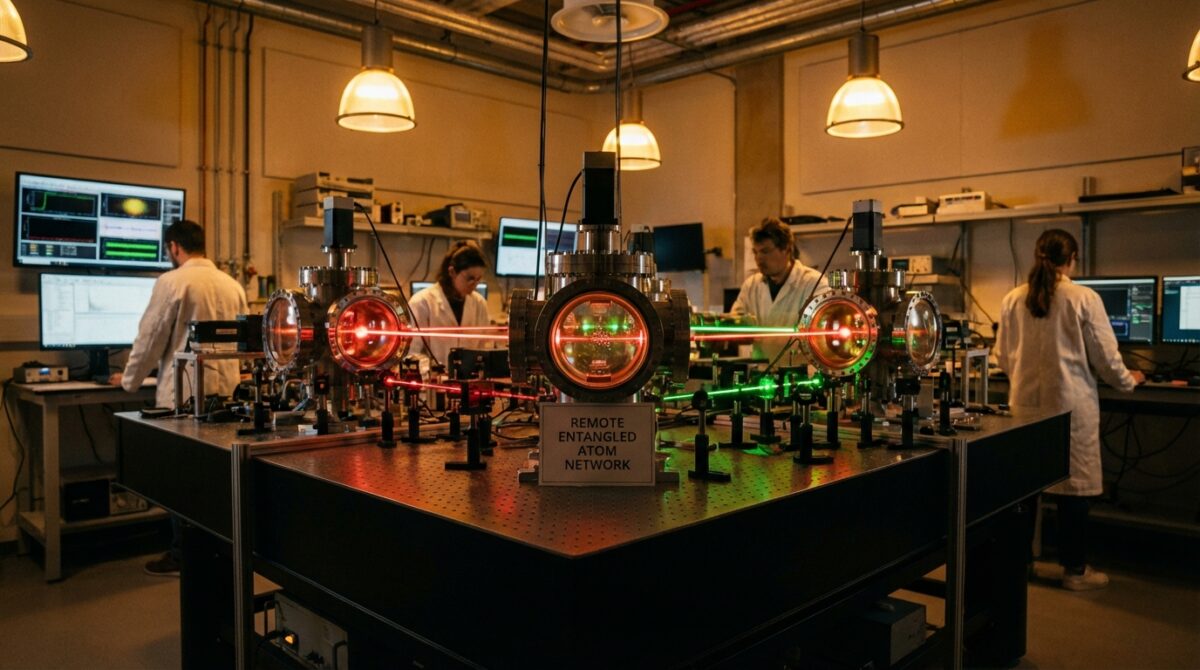
According to the study, published in Science, a team led by Prof. Philipp Treutlein and Prof. Alice Sinatra has shown that spatially separated atomic clouds can share entanglement and operate as a single composite sensor.
Researchers Unveil Groundbreaking 3D Light-Based Technology for Massive Data Storage
Ancient Fossils Unearthed in Egypt Could Represent the Closest Common Ancestor of All Apes
These remote ensembles measure not just one, but several parameters of an electromagnetic field simultaneously, with higher precision than any classical strategy that treats each cloud independently. Earlier work on entangled atomic clouds hinted at this advantage; the new experiment delivers it in a controlled, multi-point setting.
From EPR paradox to practical quantum measurement
Entanglement, first framed in the Einstein–Podolsky–Rosen paradox, describes correlations between quantum objects that remain strong even when those objects are far apart. The 2022 Nobel Prize in Physics recognized experiments proving that such links cannot be explained by classical hidden variables.
Quantum metrology harnesses these correlations to suppress noise and improve measurement precision. Earlier demonstrations, such as spin-squeezed ensembles and entangling quantum sensors, typically involved atoms or ions sitting in the same trap or optical lattice. The novelty here lies in spreading that entanglement across physically distinct regions.
How the Basel–Paris team engineered one sensor out of three clouds
The method can be summarised in one line: the researchers first generated entanglement in a single cold atomic cloud, then split it into three remote, yet still entangled, clouds and read out their spins to infer the spatial profile of a field.
Building on about fifteen years of spin-squeezing experiments in Basel, the group used ultracold atoms whose internal states behave like tiny compass needles. By driving carefully tuned light–matter interactions, they created a shared quantum state where the collective spin noise is reduced compared with uncorrelated atoms.
Creating and distributing entangled atoms across space
After preparing one large entangled ensemble, the team divided it into up to three separate atomic clouds. Despite the physical separation, the quantum correlations survived, meaning measurements on one cloud remained linked to the others. In effect, the entire system acted like a distributed quantum antenna.
Postdoctoral researcher Yifan Li and colleagues then exposed these clouds to an electromagnetic field that varied across space. Because the spins were entangled, the combined readout carried more information about the field differences than three independent measurements would allow, echoing concepts discussed in the entanglement advantage literature on shared resources in sensing networks.
Detailed results: precision gains and multi-parameter sensing
The experiment shows that a small number of remote measurements is enough to reconstruct the field distribution with clearly lower uncertainty than any classical strategy using the same number of atoms. This is a concrete instance of what theorists call the entanglement-enabled metrology advantage, explored in works like recent precision-limit analyses.
The researchers report that entanglement lets them estimate both the average field and its gradient across the three positions more accurately. In other words, the remote quantum sensor does not just read “how strong” the field is; it also identifies “how quickly it changes” in space.
Key quantitative insights and what they mean
While exact numbers depend on the specific configuration, the setup achieves a statistically significant reduction in measurement variance compared with uncorrelated atoms. In quantum metrology language, the scaling moves beyond the standard quantum limit and approaches the improved scaling expected from entangled resources, as discussed in recent overviews of entangled atoms for ultraprecise sensing.
The authors emphasise that the advantage is demonstrated within controlled uncertainties and with a clearly defined theoretical framework for multi-parameter quantum estimation. This framework, previously underdeveloped for spatially separated sensors, is essential to avoid over-claiming performance and to distinguish genuine quantum gains from better classical data processing.
Why this matters: clocks, gravimeters and environmental sensing
PhD researcher Lex Joosten notes that the same measurement protocols can be implemented in optical lattice clocks, among the most accurate timekeepers known. In those devices, atoms reside in a regular pattern formed by crossing laser beams, and spatial inhomogeneities can introduce subtle timing shifts.
By treating different regions of a clock as entangled sub-ensembles, engineers could monitor and correct spatial variations in laser intensity or magnetic fields. Insights similar to those in quantum sensing reviews suggest that such error suppression may be vital for future navigation systems or fundamental tests of relativity based on portable clocks.
Gravity mapping and climate-relevant applications
Atom interferometers already track gravitational acceleration and help map sub-surface structures. Turning multiple interferometer locations into one entangled instrument, as proposed in various advanced sensor network concepts, could sharpen these readings.
For a hypothetical geophysics team monitoring groundwater changes beneath a drought-prone region, an entangled array of atomic gravimeters might detect tiny mass redistributions sooner than classical arrays. That could feed into early-warning tools for water stress, tying abstract quantum technology directly to environmental and climate resilience.
Methodology in context: what the experiment actually did
To keep the logic clear, it helps to see the protocol as three steps: prepare, distribute, measure. Preparation created a spin-squeezed, entangled state in one atomic ensemble via controlled light scattering. Distribution physically split this ensemble into separate traps while preserving coherence.
Measurement then involved applying a spatially varying electromagnetic field and reading out the spin states of each cloud. From the correlated outcomes, the team reconstructed both local field values and their differences. Comparable schemes, discussed for example in recent quantum metrology studies, highlight how such correlations can be formally translated into gains in Fisher information and reduced estimation error.
How this compares to other quantum sensing platforms
The result complements parallel work on solid-state defects, nanoscale spins and atom–light hybrid interfaces. For example, studies on entanglement-enhanced nanoscale single-spin sensing show related gains at very short distances, while atom–light schemes such as those surveyed in quantum remote sensing with atom–light interfaces explore photonic links.
What distinguishes the Basel–Paris experiment is its clear demonstration that remote atomic clouds alone can operate as one composite sensor without needing permanent optical fibres between them during the measurement. That flexibility could matter for field deployments where infrastructure is limited.
Limitations, open questions and careful interpretation
Despite the impressive precision, the authors are explicit about constraints. The current setup uses only up to three clouds and a limited number of atoms, in a carefully shielded laboratory. Scaling to dozens of nodes or outdoor environments will require robust error correction and better isolation from vibrations and temperature drifts.
The work demonstrates enhanced quantum sensing performance; it does not imply any faster-than-light signalling or causal influence between the remote atoms. The strong correlations are statistical and fully compatible with relativity, a point that aligns with decades of theoretical analysis and experimental tests.
Next steps and what remains unknown
Future research will likely probe how far the multi-parameter advantage extends when the number of sensors grows, and how tolerant the protocol is to imperfections. There is also interest in combining entanglement with classical optimisation, machine learning and adaptive measurement strategies, as hinted in analytical pieces such as minute spin shift quantum reports.
Key unknowns include the ultimate trade-offs between noise resilience, network size and entanglement strength. Those trade-offs will decide whether remote entangled atoms become standard components in applied instruments or remain mostly tools for fundamental physics. For now, the experiment shows that even a modest network can unite into a single high-performance quantum sensor.
- Single-cloud entanglement reduces quantum noise locally but cannot map spatial variations.
- Remote entangled clouds recover both local values and spatial gradients with fewer measurements.
- Distributed quantum sensors may enhance clocks, gravimeters and environmental monitoring tools.
- Scalability and robustness remain open engineering challenges for real-world deployment.
How do remote entangled atoms improve sensor precision?
Remote entangled atoms share correlated quantum states, which reduces collective noise when measuring a field across several locations. By analysing the joint outcomes, researchers can estimate both average values and spatial variations more accurately than with uncorrelated atoms using the same resources.
Does this experiment prove faster-than-light communication?
No. The experiment shows strong correlations between distant atoms, but these are statistical and cannot be used to send messages faster than light. The findings are consistent with quantum theory and relativity, continuing the tradition of EPR and Bell-test experiments without implying any causal signalling.
What kinds of measurements could benefit from this technology?
Optical lattice clocks, gravimeters, electromagnetic field mappers and distributed environmental sensors could all benefit. Any application that needs precise information about how a quantity changes across space, rather than just its average value, is a candidate for remote entanglement-enhanced sensing.
How is this different from classical sensor networks?
Classical networks combine independent readings using clever algorithms but remain limited by uncorrelated noise. An entangled network, in contrast, shares a quantum state across nodes. This shared state changes how noise scales with the number of atoms, offering a fundamental precision advantage when the system is well controlled.
When might such quantum sensors be used outside laboratories?
The Tiny Titan: World’s Smallest QR Code, Smaller Than Bacteria, Promises Data Storage for Centuries
Earth’s Origins: The Possibility of Formation from Two Distinct Solar Rings
Timelines are uncertain, but incremental steps are underway. As control techniques, error mitigation and miniaturisation improve, one can expect early niche deployments in high-end timekeeping and geophysics, followed by more portable devices if stability and cost targets are met.