
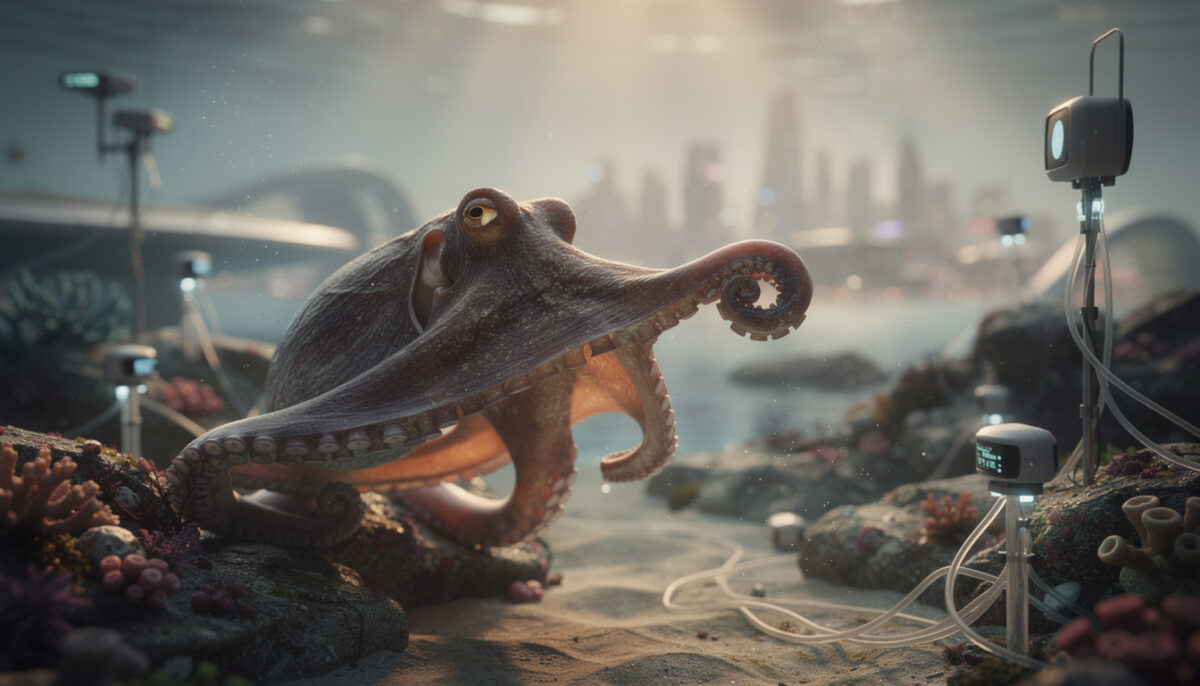
Show summary Hide summary
- Male octopus mating rituals and the “superarm”
- Protecting the sex arm: a risky reproductive strategy
- Sexual selection, animal communication and arm choice
- What this tells you about cephalopod behavior and evolution
- Which arm do male octopuses use for mating?
- Why do male octopuses protect their hectocotylus so much?
- Do female octopuses also have a specialised arm?
- Can the mating arm grow back if it is lost?
- How does the mating arm fit into cephalopod behavior research?
- FAQ
Imagine losing the one arm that decides whether genetics move on to the next generation. For a male octopus, that is not a metaphor. It is daily reality. For further insight into this specialization, see male octopuses use specialised arm to mate.
Every touch, every exploration of a rock or shrimp box can become a choice between feeding and future offspring. That trade-off sits at the heart of new research revealing how male octopuses guard a single, specialised limb like a treasure.
Male octopus mating rituals and the “superarm”
In species like the Japanese pygmy octopus and the webfoot octopus, one limb has a unique destiny. The third right arm, known as the hectocotylus, is not just another tool for grabbing prey. During octopus mating, it becomes the delivery system for sperm, turning a flexible arm into a reproductive pipeline.
Assessing the Real Risks: How Concerned Should We Be About an AI Apocalypse?
Unexpected Fossil Finds Rewrite the Timeline of Complex Animal Evolution
Researchers led by Keijiro Haruki at Nagasaki University noticed something odd while gently touching each arm of a captive male. The animal tolerated contact almost everywhere, yet one limb triggered a fierce reaction. The hectocotylus was instantly pulled tight against the body, as if the octopus knew that losing this arm would mean losing its chance to reproduce.
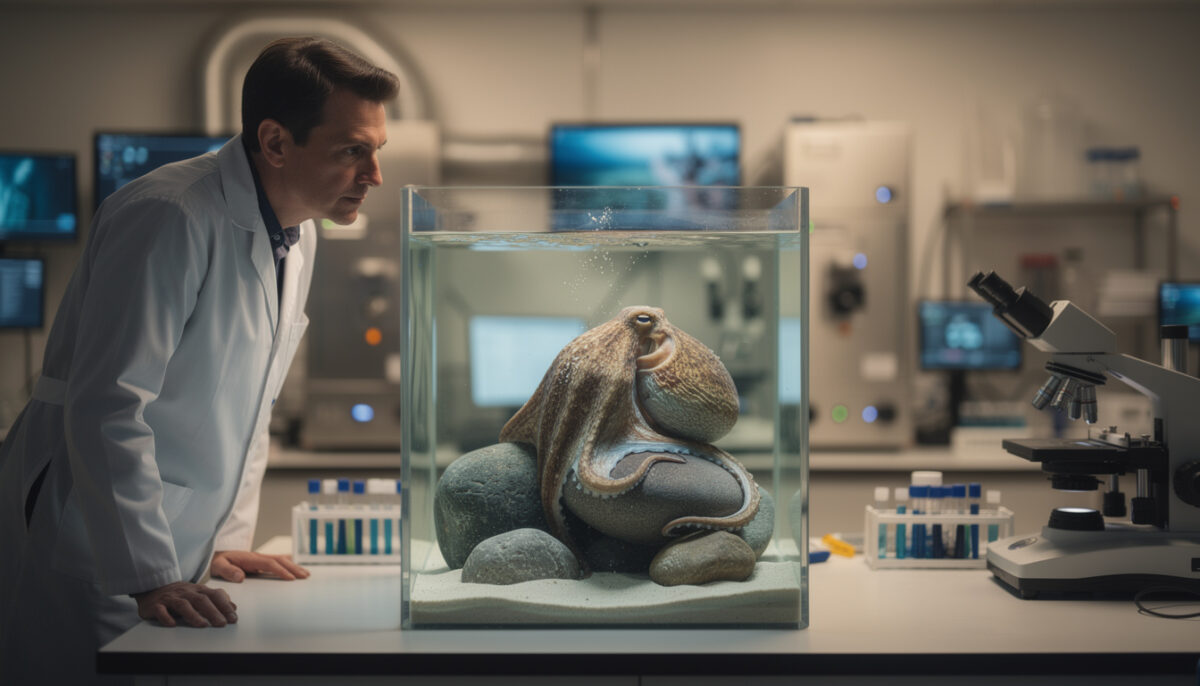
How the preferred arm works during octopus mating
Inside the mantle, the balloon-shaped section behind the head, males carry a single testis. This organ produces sperm, which are packed into elongated capsules called spermatophores. The penis itself is short, unable to reach a female directly. The solution is this one preferred arm, which acts like a courier, transporting spermatophores where the penis cannot. For more about how octopuses select this limb, see male octopuses have a favourite arm that they mostly use for sex.
When the moment comes, the male inserts the tip of the hectocotylus into the female’s body cavity. Just before ejaculation, the arm curls into a tube shape. The octopus then forces water down this living conduit, driving the spermatophore from the hidden penis along the arm and deep into the female. For a detailed sensory perspective on this process, studies such as recent work on tasting suckers and mate detection give extra context.
Protecting the sex arm: a risky reproductive strategy
Haruki’s team wanted to know just how far octopuses go to protect this limb. They collected dozens of Japanese pygmy octopuses: 32 males and 41 females. Among the females, 13 had lost their third right arm. Among the males? Only one was missing that limb. That sharp contrast suggests a distinct reproductive strategy in which males actively shield their mating arm from danger.
To test arm use, the researchers dropped a lead sinker into the tank and watched which limbs each animal used to investigate. Females freely explored with R3, treating it like any other. Males, by contrast, rarely risked the hectocotylus. They seemed to “know” that this arm should avoid ordinary tasks, a neat hint of arm dominance driven by reproduction rather than feeding. For readers interested in the evolutionary links between animal behaviors and reproduction, revealing ancient secrets of the Greenland shark offers fascinating parallels.
Food, exploration and calculated risk
The second experiment raised the stakes with something more tempting than a sinker: frozen shrimp inside a small container. Faced with a valuable meal, males still held back. They probed and manipulated the box with the other seven limbs, only deploying the hectocotylus once safer options had failed, an elegant display of cephalopod behavior shaped by cost-benefit calculations.
If a male does lose R3, mating stops until the arm regenerates, which can take months. In an ocean full of predators and competition, that delay could mean missing an entire breeding window. For background on how this “superarm” fits into broader reproductive science, articles like male octopus has ‘sex arm’ that can mate in the dark offer a wider context.
Sexual selection, animal communication and arm choice
This protective attitude links directly to sexual selection. Instead of evolving a longer penis, which would require major anatomical change, evolution seems to have chosen a cheaper route: specialise one arm and program the animal to defend it. The cost of losing that limb is high, but the cost of safeguarding it through behavior is lower than redesigning the entire reproductive system.
At the same time, the hectocotylus is not only a tube for sperm. Studies of octopus display suggest that during mating rituals, males use this arm to locate the female’s reproductive openings in near darkness, guided by chemical cues picked up by sensitive suckers. That kind of animal communication through touch and taste mirrors discoveries in other species, such as how jungle mammals share signalling sites around common latrine trees, described in work like field studies of shared scent-marking spots.
What this tells you about cephalopod behavior and evolution
For a coach or analyst used to watching players protect dominant hands or legs, this pattern feels oddly familiar. The octopus simply pushes that logic to the extreme, turning one arm into a protected “star player” of reproduction. Behavioral rules—resisting touch, avoiding risky use, prioritising other limbs—become part of a fine-tuned evolutionary playbook.
Researchers now view the hectocotylus as a model for understanding how anatomy and behavior co-evolve. The arm’s structure, its sensory receptors and the decisions the animal makes around it form a complete system. For readers curious about the broader landscape of mating systems and uniqueness among animals, work such as top must-read popular science books shows how varied reproductive tools and tactics can be across life.
- Hectocotylus role: transfers spermatophores from a short penis into the female.
- Arm dominance: males avoid using R3 for exploration or feeding.
- Risk management: losing R3 halts reproduction until regeneration.
- Behavioral defense: strong resistance when the arm is touched or threatened.
- Evolutionary payoff: cheaper to protect one specialised arm than redesign genital anatomy.
Which arm do male octopuses use for mating?
In many species, the third right arm, called the hectocotylus, serves as the dedicated mating limb. This arm is structurally modified to collect spermatophores from the penis and deliver them into the female’s mantle cavity during octopus mating.
Why do male octopuses protect their hectocotylus so much?
The hectocotylus is the only arm that can transfer sperm to females. If a male loses this preferred arm, he usually cannot mate until it regenerates, which may take months. That delay can cost him his only realistic chance to pass on his genes.
Do female octopuses also have a specialised arm?
Females have eight arms like males, but their third right arm is not specialised as a mating organ. Observations show females use R3 freely for exploration and feeding, unlike males, who tend to avoid risking their hectocotylus in everyday tasks.
Can the mating arm grow back if it is lost?
Yes, octopus arms can regenerate, including the hectocotylus. However, regrowth requires time and energy. During that period, a male’s reproductive strategy is effectively on hold, which is why he behaves so carefully with this limb.
How does the mating arm fit into cephalopod behavior research?
The hectocotylus provides a clear example of how anatomy, sensory systems and decision-making evolve together. It helps scientists study arm dominance, animal communication through touch and taste, and how sexual selection shapes complex behavioral rules in cephalopods.
FAQ
Why do male octopuses have a specialised mating arm?
Male octopuses use the hectocotylus, a specialised arm, to transfer sperm to females during mating. This octopus mating arm is uniquely adapted for reproduction, making it essential for passing on genetics.
How can you identify the octopus mating arm?
In many species, the third right arm of a male octopus is slightly different and is called the hectocotylus. It may appear thicker or have unique features compared to the other arms.
What happens if a male octopus loses its mating arm?
Losing the octopus mating arm means the male can no longer reproduce, as he cannot transfer sperm to a female. This makes the arm extremely valuable and explains why males protect it so fiercely.
Do female octopuses have a specialised mating arm too?
Stanford Researchers Develop Shape-Shifting Material Mimicking Octopus Color and Texture Changes
Groundbreaking Fiber Optic Breakthrough Enables Simultaneous Streaming of 50 Million Movies
No, only male octopuses possess the hectocotylus, the octopus mating arm. Females do not have this specialised limb.
Is the mating arm used for anything besides reproduction?
While the primary role of the octopus mating arm is reproduction, it may occasionally be involved in regular arm functions. However, males tend to guard it to prevent damage and ensure successful mating.