Show summary Hide summary
- Young sauropod giants that could briefly defy gravity
- How engineers’ tools uncovered prehistoric bone stress
- Stress, size and the hidden cost of being tall
- What the models missed: cartilage, tails and real life
- What this reveals about dinosaur evolution and limits
- Key takeaways for understanding tall prehistoric giants
- Could all sauropod dinosaurs stand on two legs?
- Why did standing upright help these prehistoric herbivores?
- How did scientists test bone stress in extinct animals?
- Did the study consider cartilage and tails in the models?
- What does this tell us about the limits of dinosaur size?
- FAQ
Picture a herd of long-necked dinosaurs, and one young animal suddenly rears up, standing tall like a giant above the others. For a few moments, its extra height changes everything: food, defense, even mating. If you’re interested in other surprising adaptations among prehistoric creatures, see how ancient giant kangaroos may have developed new ways of moving too.
Young sauropod giants that could briefly defy gravity
Around 66 million years ago, two South American sauropods broke the usual four-legged rule. Juvenile Uberabatitan ribeiroi, from Brazil, and Neuquensaurus australis, from Argentina, could rise onto their hind legs and stay upright for a while. This unusual posture gave these plant‑eaters access to foliage high in trees and probably made them look more threatening to any predator testing their limits.
Both species were long‑necked, four‑legged herbivores, roughly comparable in body mass to modern elephants. Adult Uberabatitan individuals may have stretched up to 26 meters in length, ranking among the largest known giants from Brazil. Yet the new research shows a twist: the elegant rear‑up stance seems to have been mostly a privilege of younger, lighter animals, before sheer size turned that trick into a biomechanical challenge.
Researchers Unveil Groundbreaking 3D Light-Based Technology for Massive Data Storage
Ancient Fossils Unearthed in Egypt Could Represent the Closest Common Ancestor of All Apes
Why only some dinosaurs could rise like cranes
This behavior did not turn sauropods into kangaroos. They still moved mainly on four legs, unlike bipedal predators. Yet their anatomy created a narrow window of opportunity. With the right combination of bone robustness, muscle power, and moderate body weight, young Uberabatitan and Neuquensaurus could rear up without overloading their skeleton. As they aged and their growth pushed them toward massive adult bodies, the physics changed, and standing tall became far more demanding.
That transition from agile juvenile to heavy adult mirrors a broader question explored in studies such as how dinosaurs reached such huge sizes. The same anatomy that enabled spectacular evolution toward giant forms also imposed strict limitations on their movements.
How engineers’ tools uncovered prehistoric bone stress
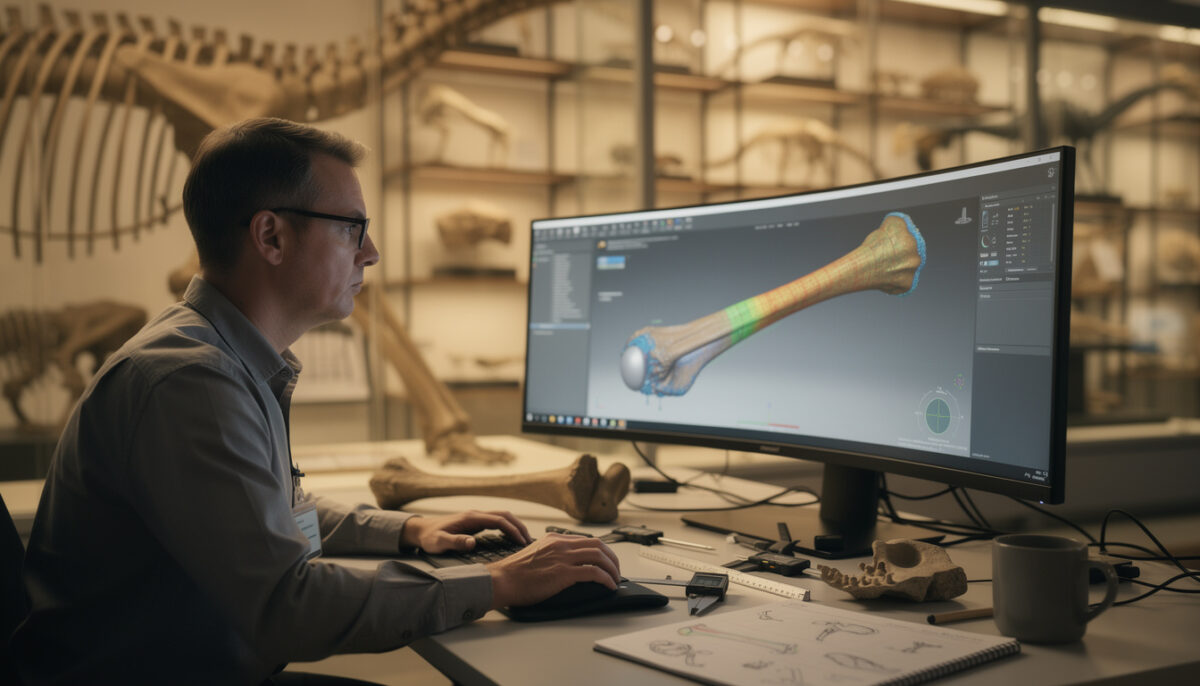
To understand this balance between power and constraint, researchers treated dinosaur bones like components in a bridge or skyscraper. Led by Julian Silva Júnior, working between Brazil and Germany, the team digitally reconstructed femurs from seven different sauropod species. These models came from museum fossils representing a range of body plans, adaptation strategies, and mass categories across sauropod evolution.
They then applied finite element analysis (FEA), a method widely used in engineering to predict how structures react to forces, vibrations, and pressure. By cutting the virtual femur into thousands of tiny elements and loading them with virtual gravity, the team could map where mechanical stress peaked when a dinosaur balanced on two legs. Learn more about simulation advances in paleontology in our article on how a tiny 2-pound dinosaur is transforming our understanding of evolution.
Extrinsic vs intrinsic forces: weight against muscle power
The simulations combined two main scenarios. First, an extrinsic case, in which gravity and the animal’s own body mass pressed down on the hind limb, mimicking the dinosaur’s full weight when standing bipedally. Second, an intrinsic case, estimating the pull of muscles attached to the femur, the forces needed to keep the body upright and stable in that tall pose.
By adding these loads together, the team estimated total stress on each femur. Juvenile Uberabatitan and Neuquensaurus showed the lowest stress values relative to their bone geometry. Their femurs were thick, with cross‑sections able to spread forces more efficiently than in several larger giants. That structural advantage translated into a safer, if still strenuous, rearing posture.
Stress, size and the hidden cost of being tall
The contrast with bigger sauropods is striking. Very large species, including some studied in works like analyses of maximum dinosaur size, carried massive muscles and enormous femurs. However, the FEA results suggest that even those giant bones struggled to keep pace with rising body mass. As total size increased, stress on the femur climbed faster than the bone’s ability to cope.
This does not mean huge sauropods were stuck on four legs forever. They probably could rear up briefly when the benefit justified the risk: reaching a particularly rich cluster of foliage or engaging in a short mating display. Yet any extended bipedal stance would have felt uncomfortable, with high internal stress and limited safety margin against fatigue or injury.
Why rearing up mattered for survival
For herbivores that lived before the extinction of non‑avian dinosaurs, every extra meter of reach could decide who accessed the best leaves. A juvenile Uberabatitan standing tall could browse from treetops beyond the range of competitors stuck near ground level. That vertical advantage reduced direct competition and turned three‑dimensional forest structure into a resource map.
The same posture also had social and defensive uses. A rearing male might appear more imposing during courtship, or when facing predators. In a Late Cretaceous landscape with large carnivores, suddenly doubling apparent height could change the risk calculation for an attacker. Height, in this context, was a temporary but powerful tool.
What the models missed: cartilage, tails and real life
The study’s authors underline the limits of any digital model. Their reconstructions did not include joint cartilage, the soft tissue that can cushion forces between bones. If cartilage absorbed part of the load, real stress levels may have been slightly lower than the raw FEA suggests, though the comparative pattern between species would remain similar.
The simulations also did not fully account for the tail acting as a counterweight or third point of support. Many paleontologists envision rearing sauropods forming a tripod posture: two hind legs plus the tail on the ground. Such a configuration would redistribute forces away from the femur alone, potentially extending how long some individuals could hold the position.
Comparing lineages to read prehistoric behavior
Despite these gaps, the comparative approach remains powerful. By analyzing different sauropod lineages with the same digital protocol, the team reconstructed behavior patterns that no camera ever captured. The repeated result — lower stress in juvenile Uberabatitan and Neuquensaurus — points toward a shared biomechanical window across these South American dinosaurs. For a broader perspective on life’s ancient transitions, explore the origins of terrestrial life from ancient fish fossils.
This window helps link biomechanics with broader questions about why giants evolved on land and why today’s large mammals stop far short of sauropod scale. Studies like work on dinosaur growth and analyses of sauropod size show how bone, muscle, and metabolism negotiate trade‑offs between height, mobility, and longevity.
What this reveals about dinosaur evolution and limits
For paleontologists like the fictional Dr. Carla Mendes, who guides students through South American fossil sites, this research turns static bones into mechanical stories. She can now explain to visitors why a juvenile femur from Uberaba hints at an agile, rearing youngster, while a huge adult bone from the same species whispers about heavy, deliberate steps and stricter biomechanical limitations.
These insights feed into the larger conversation about evolution toward giant body plans. Titans such as titanosaurs reached masses far beyond any living land animal, yet they still had to move, feed, and reproduce efficiently. Their adaptation strategy depended on balancing extreme growth with skeletal safety margins, a balancing act that may have approached the upper limit of what land vertebrates can physically sustain.
Key takeaways for understanding tall prehistoric giants
For anyone fascinated by prehistoric life, this study adds concrete, testable numbers to long‑standing debates. Instead of guessing whether a dinosaur could rear up, researchers now quantify bone stress and compare species. That shift from speculation to simulation transforms how we talk about extinct animals and their daily behavior.
If you follow debates on why dinosaurs became such towering giants while modern land animals remain smaller, connecting this work with broader overviews like analyses of dinosaur size or discussions on why we no longer see such huge species helps build a full picture. Mechanics, ecology, and extinction events all tie together. To see more on how the environment shapes adaptation, check out the link on microscopic plant mechanisms poised to boost crop production.
- Juvenile advantage: younger Uberabatitan and Neuquensaurus could rear up longer thanks to favorable bone geometry and lower mass.
- Stress trade‑off: larger sauropods carried stronger muscles but faced disproportionate femur stress when standing bipedally.
- Behavioral payoff: rearing helped reach high vegetation, aided mating interactions, and amplified visual deterrence.
- Model limits: cartilage, tail support, and soft‑tissue dynamics remain approximated, not fully captured.
- Evolutionary insight: the study clarifies how mechanical limits shaped the growth and posture of the tallest prehistoric herbivores.
Could all sauropod dinosaurs stand on two legs?
No. The new simulations suggest that only smaller or juvenile sauropods, such as young Uberabatitan and Neuquensaurus, could comfortably rear up and stay tall for more than brief moments. Larger giants probably managed short bipedal stances when necessary, but the stress on their femurs made the posture uncomfortable and risky over longer periods.
Why did standing upright help these prehistoric herbivores?
Rearing up let them browse vegetation that other animals could not reach, reducing competition for food. The extra height also likely played a role in social behavior, including mating displays, and could make them appear more intimidating to predators. This temporary vertical advantage was part of their adaptation to a crowded Late Cretaceous ecosystem.
How did scientists test bone stress in extinct animals?
Researchers used finite element analysis, a computational method borrowed from engineering. They built 3D models of sauropod femurs from fossils, then simulated gravity and muscle forces on the bone when the dinosaur stood on two legs. The resulting stress maps showed which species had femurs better suited to supporting a tall, rearing posture.
Did the study consider cartilage and tails in the models?
Cartilage was not modeled explicitly, and the tail’s role as a third support point was simplified. Cartilage would likely have reduced joint stress somewhat, while a tripod posture using the tail could have redistributed forces. However, because all species were analyzed under the same assumptions, the comparative results on which dinosaurs handled stress best remain reliable.
What does this tell us about the limits of dinosaur size?
The findings support the idea that as sauropods evolved toward extreme size, mechanical limits became tighter. Bones and muscles scaled up, but not fast enough to keep stress low during demanding postures like rearing. This suggests that dinosaur evolution toward ever larger giants was constrained by biomechanics, helping explain why even these titans had behavioral limits and how sauropod rearing behavior influenced their evolutionary path.
FAQ
Why could only young sauropods rear up on their hind legs?
Juvenile sauropods were lighter and more agile, which allowed them to briefly rear onto their hind legs. As these dinosaurs grew larger, their increasing weight made this behaviour biomechanically difficult or impossible.
What advantages did sauropod rearing behaviour provide?
Sauropod rearing behaviour allowed young dinosaurs to reach higher foliage for feeding and may have helped them appear more intimidating to predators. This adaptation likely gave juveniles a survival edge in their environments.
Did adult sauropods ever rear up like the juveniles?
Most evidence suggests that rearing up was mainly possible for young sauropods. As adults became massive, their size and weight prevented them from comfortably or safely standing on two legs.
How do scientists know about sauropod rearing behaviour?
The Tiny Titan: World’s Smallest QR Code, Smaller Than Bacteria, Promises Data Storage for Centuries
Earth’s Origins: The Possibility of Formation from Two Distinct Solar Rings
Researchers study fossilised bones, particularly limb structure and muscle attachment sites. These clues help them model how sauropods moved and whether their young could support themselves in a reared-up posture.
Are there other dinosaurs known for rearing behaviour?
While most rearing evidence comes from sauropods, some smaller plant-eating dinosaurs may have displayed similar postures to reach food or escape danger. However, sauropod rearing behaviour is particularly well-documented in these giant species.