Show summary Hide summary
You walk through a tropical forest, breathing heavy, humid air… and beneath your feet, colonies of ants are silently transforming the carbon dioxide in the air into real mineral armor. These “living scrubbers” could well inspire future climate technologies.
At the heart of this story is a group of fungus-farming insects, the fungus-growing ants, who have developed a form of biomineralization that chemists struggle to replicate in the lab. Their adaptation is not just for survival; it also points to a new path for climate sustainability.
Ants that turn carbon dioxide into living armor
In the underground nests of Acromyrmex echinatior and Sericomyrmex amabilis, the intense breathing of the ants and their cultivated fungi saturates the atmosphere with carbon dioxide. Without a specific strategy, these concentrations would become toxic. So, the colonies have developed a surprising response: capturing this gas and locking it directly into their exoskeleton.
Light Imitates Nobel Prize-Winning Quantum Phenomenon for the First Time
How Skeleton-Free Early Animals Revolutionize Our Understanding of Earth’s History
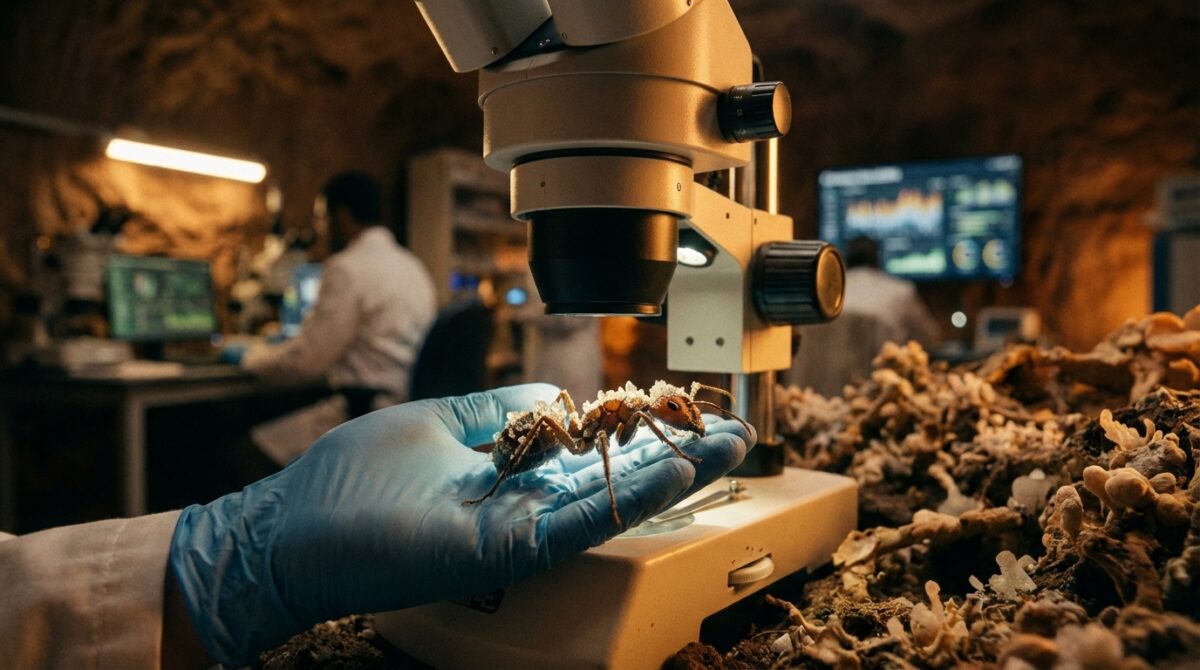
Researchers have shown that a thin mineral layer covers the bodies of these ants, forming armor as hard as stone. Each individual then acts as a biological filter, turning air CO2 into solid carbonate. For a climate biologist, this is the equivalent of a natural prototype for “carbon capture and storage” worn by millions of tiny workers.
The hidden chemical process behind ant biomineralization
In 2020, Cameron Currie’s team uncovered in Acromyrmex echinatior a biomineralization associated with bacteria of the genus Pseudonocardia. These microbes, already known for making protective antibiotics, are also involved in converting dissolved carbon dioxide into carbonate, which ends up embedded in the arthropod’s cuticle. The body surface thus becomes a mosaic of tightly packed minerals.
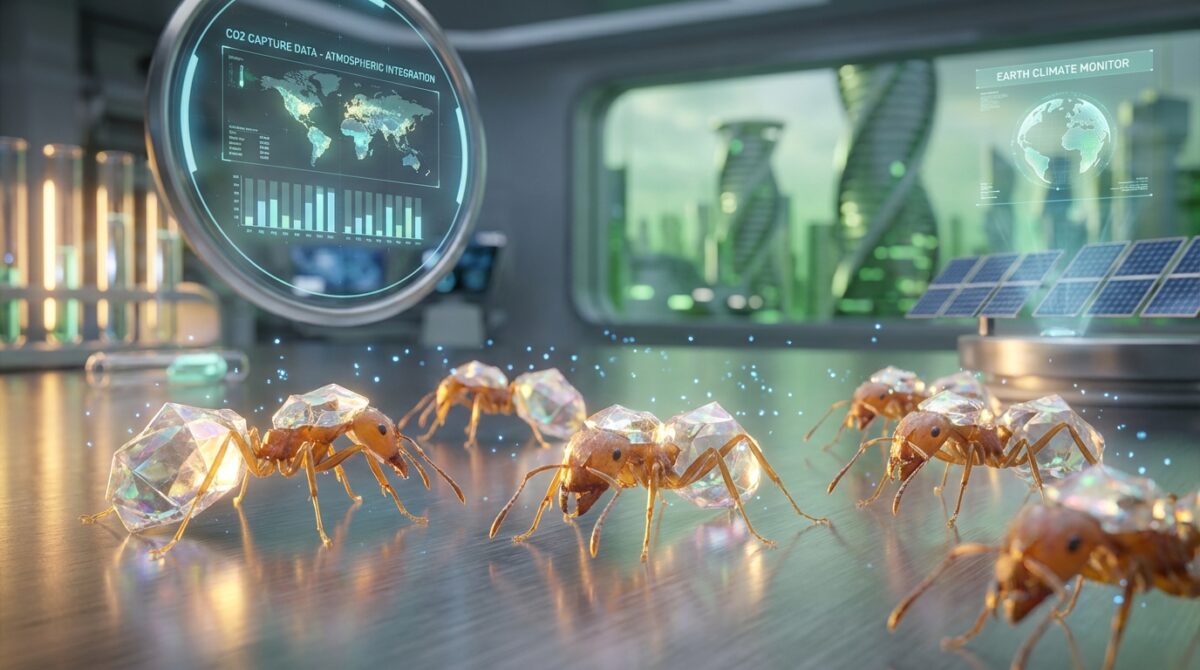
The scenario gets more interesting with Sericomyrmex amabilis. This species manages to make the same type of rock, without any apparent help from symbiotic bacteria. Scientists see this as the first known case of an animal able, through its own biological processes, to steer a chemical process of CO2 mineralization all the way to forming an external protective layer. The ant is no longer just a host; it becomes a true walking chemical reactor.
Dolomite armor: a mineral that defeats human chemists
The most puzzling part of this story is the material itself: the ants produce dolomite. This calcium and magnesium carbonate forms iconic mountains like the Dolomites in Italy, usually shaped over millions of years by complex geological conditions. Chemists, for their part, struggle to synthesize well-ordered dolomite without resorting to extreme temperatures and pressures.
The problem is the magnesium, which binds strongly to water molecules and disrupts regular carbonate crystallization. In labs, the reaction is forced using heat and pressure. In an ant colony, dolomite forms at room temperature, with no furnace or press. For Hongjie Li’s team, understanding this biochemical shortcut is a priority, as this mechanism could guide future industrial techniques for CO2 mineralization.
From nest respiration to mineral shield
In a fungus-growing ant nest, air circulates constantly to remove the heat and carbon dioxide produced by the colony’s collective respiration. Studies on nest ventilation, like those describing turrets in some leaf-cutter species in this nest ventilation study, already show their ability to shape architecture according to airflow.
In Sericomyrmex amabilis, this same CO2 is used in two ways. First, it fuels the chemical process that leads to dolomite formation. Then, once trapped in this crystalline armor, it reduces the residual concentration in the nest. Each ant’s mineralized body thus becomes at once a filter, a carbon archive, and a physical shield against pathogens and predators.
Why this ant adaptation matters for sustainability
For a climate engineer, these colonies function like field laboratories. Studies on how ants affect CO2 uptake by rocks, highlighted in this scientific article on their possible role in slowing global warming, already suggest that their large-scale geochemical activity is far from trivial.
The difference here is the level of organization. Fungus-growing ants don’t just modify the soil; they incorporate mineralized carbon into their own shells. Each colony becomes a network of micro-sensors managing the CO2 of the interior air while also reinforcing bodily protection. For R&D teams working on sustainability, these animals offer a complete model blending architecture, chemistry, and biological defense.
What engineers can learn from insect biomineralization
Let’s imagine Julia, a materials engineer at a São Paulo climate start-up. Facing the challenge of producing stable carbonates without expending too much energy, she turns to the latest research, accessible via a detailed report on ant CO2 capture. There, she finds three paths directly inspired by these tropical insects:
- Reproduce the nanocrystalline structure of dolomite armor to create low-carbon protective coatings.
- Mimic the controlled slowness of the biological chemical process to reduce the energy needed for crystallization.
- Design modulated “reactive surfaces,” like the ants’ cuticle, capable of fixing CO2 directly at the air-solid interface.
These ideas don’t mean copying ants exactly. Rather, they open up a conceptual toolbox for combining chemical CO2 capture, mechanical strength, and low energy costs, by following the example set by natural biomineralization.
How do ants turn CO2 into mineral armor?
Fungus-growing ants expose their cuticle to an environment saturated with carbon dioxide, a result of the colony’s and their fungus gardens’ respiration. Biochemical reactions guided by their bodies, sometimes helped by bacteria such as Pseudonocardia, convert this CO2 into carbonate. This mineral then forms into dolomite, creating a thin, rigid layer that reinforces the workers’ exoskeleton.
Why does the dolomite produced by ants intrigue researchers?
The dolomite associated with these ants forms at low temperatures and without high pressure, while lab synthesis usually requires extreme conditions and remains difficult to control. Understanding how ants manage to arrange calcium, magnesium, and carbonate in their armor could inspire new industrial methods for mineral CO2 sequestration, less energy-hungry than current processes.
Can this mechanism really help in the fight against climate change?
On its own, ant biomineralization won’t be enough to offset human emissions. However, it provides a highly instructive biological model. Engineers can draw inspiration from it to develop materials and reactors capable of trapping atmospheric carbon dioxide in stable carbonates. The key advantage is the combination of gentle conditions, high efficiency, and meaningful integration of captured carbon.
Are ants the only animals that trap CO2 as rock?
Decades of Comparing Dinosaurs and Mammals Overlooked This Crucial Distinction
Scientists uncover microbe rewriting a core genetic code principle
Many marine organisms, like corals and certain plankton, make carbonate skeletons, but they mainly use dissolved carbonate in seawater. Fungus-growing ants stand out because they turn the CO2 from the air in their nests into rock directly incorporated into their exoskeletons. To date, S. amabilis appears to be the first described animal case of such mineralization without the obligatory help of bacterial symbionts.
What can researchers do next?
The next steps involve decoding the detailed biochemical pathways involved, identifying the enzymes at work, and characterizing the precise structure of the formed dolomite. Teams are already comparing different nests, respiration conditions, and mineralization profiles using tools like electron microscopy and spectroscopy. The goal is twofold: to better understand the ants’ adaptation and to apply some principles to more effective carbon capture and storage technologies.