
Show summary Hide summary
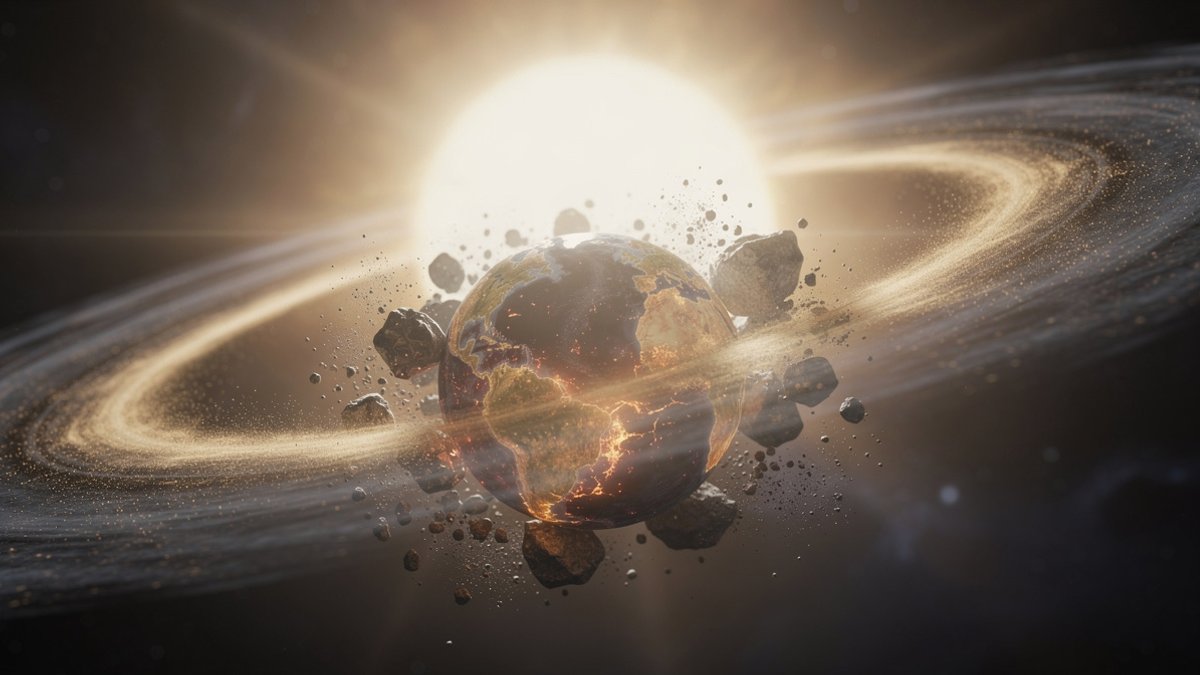
Imagine Earth built from two cosmic construction sites instead of one. That single twist reshapes your picture of planetary formation, from Mercury’s size to Mars’s strange chemistry.
This new scenario comes from high-powered simulations that challenge the classic story of a single dusty disc around the young sun. For anyone following cutting-edge astrophysics, it feels like watching the replay of our Earth origins with an unexpected camera angle that finally reveals the missing players.
Two solar rings rewriting Earth’s origins
For decades, models assumed the inner solar system grew from one continuous disc of gas, dust and rocks swirling around the baby sun. That picture looked elegant, but when researchers like Bill Bottke stress-tested it on supercomputers, the numbers stopped adding up.
The Selfish Gene: A Timeless Classic That Continues to Electrify Evolutionary Science
Ancient Elephant Remains Uncover Striking Insights into a Neanderthal Hunting Episode
With a single disc, simulations usually build a Mercury and Mars that are too massive. Venus and Earth end up huddled too closely. The compositions of Earth and Mars come out frustratingly similar, while meteorites and mantle rocks tell a different story. Something in the standard script of planetary science kept refusing to cooperate.
From failed models to the two-ring idea
Bottke’s team spent months running detailed formation scenarios from a single reservoir of material. They tweaked disc shapes, densities, migration patterns, collision histories. Every time, something broke: wrong sizes, wrong distances, wrong chemistries.
Out of that frustration came a “desperation play”: what if the early sun hosted not one, but two distinct solar rings of solid material? When they split the birth region into an inner and outer ring, planets finally assembled into realistic orbits and masses. The new layout suddenly looked a lot more like home.
Where the two cosmic rings were located
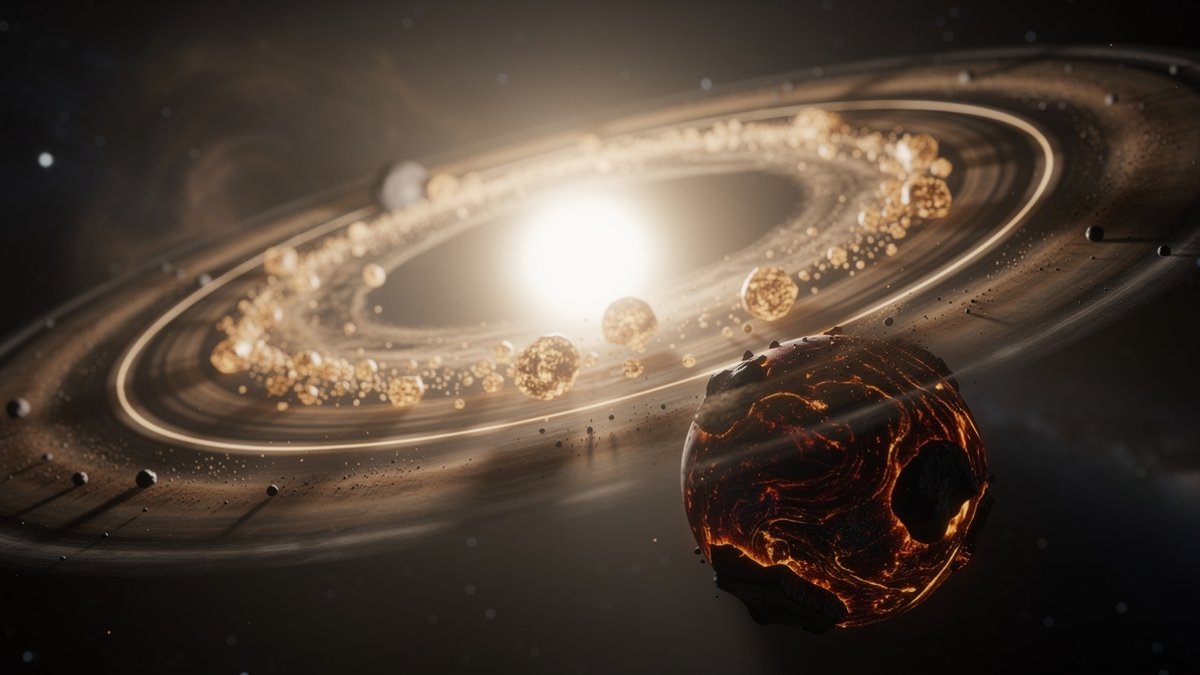
The simulations that fit best place the inner ring at about half today’s distance from Earth to the sun. Picture a dense band of rock and dust hugging close to the star, a furnace where proto-planets repeatedly collide and grow.
The outer ring appears around 1.7 times the Earth–sun distance. Between these two cosmic rings, gaps and gradients in temperature and material create very different building blocks. That contrast becomes the key to explaining why Earth and Mars look like siblings on the outside but cousins in their internal makeup.
Early Earth from the inner ring, Mars from the outer
Jan Hellmann and colleagues argue that early Earth formed mostly from material in the inner ring, with only a modest contribution from the outer one. That matches isotope signatures measured in terrestrial rocks and in the Moon’s samples returned by Apollo and later missions.
Mars, by contrast, appears to draw much more from the outer ring. This helps explain why Martian meteorites show distinct chemical fingerprints, and why new results from rover missions, combined with studies like novel mineral discoveries on Mars, keep revealing contrasts with Earth’s geology.
Why this two-ring formation solves old puzzles
Splitting the disc into two reservoirs does more than fix planet sizes. It naturally produces the current spacing between Mercury, Venus, Earth and Mars, without forcing extreme fine-tuning or exotic migration scenarios.
The model also lines up with other big stories in modern astrophysics. Observations of young stars frequently reveal broken, sculpted discs instead of smooth ones, and studies of “fluffy” infant planets in formation show that growth can stall or accelerate in narrow rings, just like those used in these simulations.
A new lens on solar system chemistry
When you allow two separate rings, you get two distinct chemical environments. Closer to the sun, volatile compounds boil away, leaving rockier ingredients; farther out, ices and different isotopes survive. The final planets record that contrast in their mantles and crusts.
This two-source recipe echoes other research on cosmic building blocks, from studies on the nuclear origins of gold to surveys of asteroids with unusual compositions. The inner solar system starts to look less like a monotone disc, more like a layered laboratory of distinct reservoirs.
Limits, fine-tuning and the supercomputer grind
The obvious criticism: does this model work only with extremely specific initial conditions? Bottke admits slight changes in disc shape dramatically shift where the terrestrial planets end up. That sensitivity raises questions about how stable or common such a configuration might be in other systems.
To tackle that challenge, the team is throwing serious supercomputing power at the problem, scanning through “every reasonable possibility.” The goal is clear: test how robust two-ring planetary formation really is, and whether small variations still reproduce something that looks like our solar system.
What this means beyond our solar system
If two rings can explain Mercury to Mars, they might also help interpret exoplanet systems with puzzling gaps or clustered rocky worlds. Many star-forming discs observed by ALMA and other facilities already show ringed structures that hint at similar dynamics.
The same way hidden structures deep within Earth’s mantle reshape climate and energy models, as suggested by work on concealed deep Earth structures, ringed discs could become a unifying theme in how we read young planetary systems across the galaxy.
Key takeaways from the two-ring Earth origins model
For a quick recap, here is what this new picture of Earth origins brings to the table for your understanding of formation physics and solar system history.
- Two solar rings, not one disc: An inner ring at ~0.5 Earth–sun distance and an outer one at ~1.7, each with distinct material.
- Better match to planet sizes: Mercury and Mars stay small, Venus and Earth land at realistic masses and separations.
- Distinct planetary compositions: Earth and the Moon draw heavily from inner-ring material; Mars reflects outer-ring chemistry.
- Alignment with observations of young systems: Ringed protoplanetary discs around other stars support the plausibility of this structure.
- Ongoing tests: Supercomputer campaigns continue to probe how stable and common such two-ring configurations might be.
What are the two solar rings in this model?
The model proposes two distinct regions of solid material around the young sun. One lies at roughly half the present Earth–sun distance, very close to the star, while the other sits around 1.7 times that distance. Each ring has different temperatures and compositions, feeding different building blocks to the forming planets.
How does this change our understanding of Earth’s formation?
Instead of growing from a single, uniform disc, Earth appears to form mainly from the inner ring, with a smaller contribution from the outer ring. This mixed origin explains why Earth’s rocks, the Moon’s samples and certain isotopes differ from those found on Mars and some meteorites.
Why is Mars so different from Earth in this scenario?
In the two-ring framework, Mars accretes most of its material from the outer ring, farther from the sun. That region preserves different ices and isotopes, so Mars inherits a distinct chemical profile, matching measurements from Martian meteorites and rover data.
Does this model explain the sizes of Mercury and Mars?
Yes. Single-disc simulations usually produce Mercury and Mars that are too massive. With two separate rings, the growth of proto-planets naturally stalls in the regions corresponding to Mercury and Mars, giving them smaller, realistic final masses.
Could other planetary systems also form from multiple rings?
Observations of young stars often reveal several bright rings and gaps in their discs. Those structures suggest that multi-ring formation is not unique to our system, so similar two- or multi-ring setups may shape the architecture of many rocky exoplanet systems.
FAQ
What are earth formation models?
Earth formation models are scientific theories and simulations that aim to explain how the Earth and other planets formed in our solar system. These models help us understand factors like planet size, composition, and orbital arrangement.
How do earth formation models explain the differences between Earth and Mars?
Traditional earth formation models often struggle to account for the chemical and size differences between Earth and Mars. Newer models, featuring two distinct solar rings, better explain why Mars is smaller and has a different composition from Earth.
Why are two-ring earth formation models considered significant?
Two-ring earth formation models are significant because they resolve several inconsistencies found in older, single-disc models. They offer more accurate predictions for planetary masses, orbits, and elemental differences seen in Earth, Mars, and other planets.
What challenges did classic earth formation models face?
Fossil Findings That Challenge T. rex’s Reign as the Dinosaur King
Honey Bees Exhibit Enhanced Dancing Skills in the Presence of an Audience
Classic earth formation models using a single disc often resulted in planets like Mercury and Mars being too large or in the wrong orbits. These models also struggled to match the chemical compositions observed in planetary rocks.
How do new earth formation models use simulations to test theories?
Modern earth formation models rely on advanced computer simulations to test different planetary birth scenarios. By adjusting initial conditions like the number of solar rings, these models can better replicate the solar system we observe today.