
Show summary Hide summary
- Arctic rhino discovery that rewrites evolution maps
- Haughton Crater, from impact zone to fossil time capsule
- Rhino migration and the hidden North Atlantic highway
- Ancient proteins and a new scientific toolbox
- Funding, logistics and the human side of Arctic science
- Key takeaways from the Arctic rhino
- How old is the Arctic rhino fossil Epiaceratherium itjilik?
- Did this Arctic rhino have horns like modern rhinos?
- Why does this discovery change ideas about rhino evolution?
- What does this fossil tell us about past climate change in the Arctic?
- Where is the Arctic rhino fossil kept now?
- FAQ
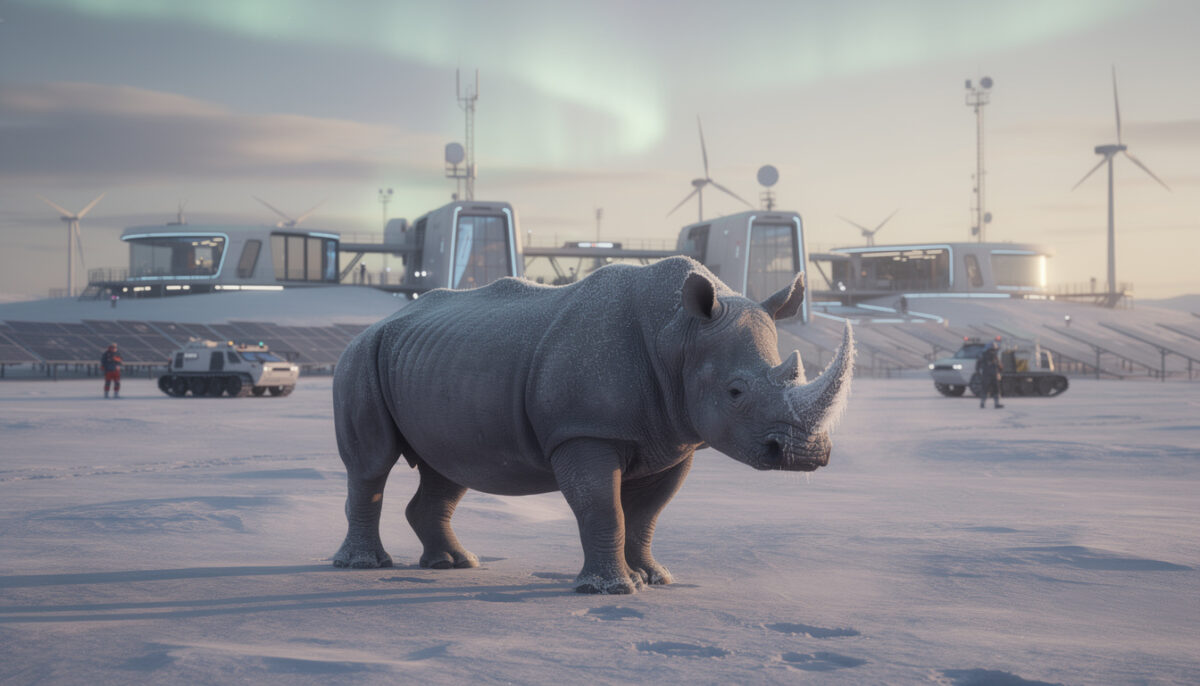
Imagine discovering a arctic rhino fossil in the High Arctic, buried in permafrost where only polar bears and ice are expected. This unlikely discovery is now reshaping how scientists see mammal evolution, migration routes, and even long-term climate change on our planet.
Arctic rhino discovery that rewrites evolution maps
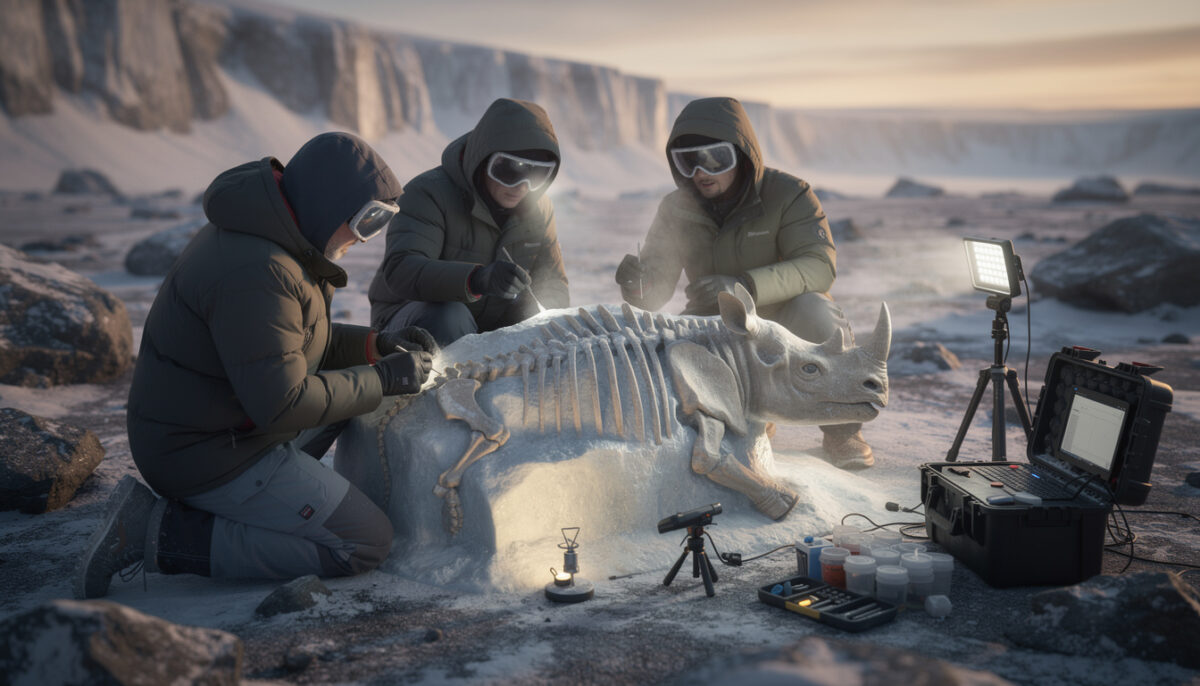
At Haughton Crater on Devon Island, Nunavut, researchers from the Canadian Museum of Nature uncovered a remarkably complete arctic rhino fossil of a hornless rhinoceros. The skeleton of Epiaceratherium itjilik, nicknamed the “Arctic rhino,” dates back about 23 million years to the Early Miocene.
This is the northernmost extinct species of rhino ever documented. The find, detailed in Nature Ecology & Evolution and reported widely by outlets such as Science news platforms, shows that rhinos once roamed far beyond today’s African savannas and Asian forests, into what is now a polar desert.
THOR AI Cracks a Century-Old Physics Mystery Within Seconds
Scientists Unveil How AI Boosts Human Creativity
A small, hornless rhino built for a cooler world
The animal would have looked very different from the massive, horned rhinos familiar today. Epiaceratherium itjilik was pony-sized and lightly built, comparable in bulk to a modern Indian rhino but without a horn. Wear on its cheek teeth suggests the known individual died in early to mid-adulthood.
The name “itjilik” comes from Inuktitut, meaning “frosty” or “frost.” Researchers worked with Inuit Elder Jarloo Kiguktak, who knows the region and has joined field expeditions, to ground the name in local language and land. That collaboration anchors this scientific story in living Arctic communities, not just ancient bones. To explore similar evolutionary adaptations, see ancient giant kangaroos.
Haughton Crater, from impact zone to fossil time capsule
Haughton Crater is about 23 km wide and today sits in a stark, cold landscape. During the Miocene, though, the crater held a lake surrounded by temperate forest. Leaves, branches, small mammals and this rhino fell into lake sediments that slowly locked them into stone.
Repeated freezing and thawing, a process called cryoturbation, later broke up the sediments and shuffled fossils toward the surface. The bones of E. itjilik were found within just 5 to 7 square meters, a compact graveyard that gave researchers an unusually coherent view of the animal’s skeleton and environment.
From 1986 fieldwork to 2020s revelations
Much of the key material was first collected in 1986 by Dr. Mary Dawson of Carnegie Museum of Natural History, an early pioneer of Arctic paleontology. She recovered jaws, teeth and skull fragments that would only later reveal a brand-new species. To see how advances in analysis continue to change our understanding of prehistoric creatures, read about fish to land evolution.
Subsequent expeditions led by Canadian Museum of Nature researchers added more bones, eventually reaching about 75% of the skeleton. Co-author Marisa Gilbert emphasizes how rare that level of preservation is in Arctic sites, where weathering usually destroys delicate parts before anyone can find them.
Rhino migration and the hidden North Atlantic highway
To understand where this arctic rhino fossil fits in the broader rhino family, lead author Danielle Fraser and colleagues compared it with 57 other rhinocerotid species, drawing on museum collections and global datasets. Each species was placed on one of five continental regions for biogeographic modelling.
The analyses point to a surprising route: rhinos appear to have moved between North America and Europe using a North Atlantic Land Bridge via Greenland. Earlier work suggested this pathway shut down around 56 million years ago. The new study proposes that it stayed open to large mammals far longer, probably into the Miocene, long after many scientists assumed it was gone.
What this means for climate and Arctic ecosystems
For a rhino to graze comfortably that far north, the climate had to be markedly warmer, with extensive forests and year-round access to vegetation. The Arctic acted as a “biological crossroads,” as described in reports such as recent coverage of the find, hosting species that could spread across continents when conditions allowed. Some findings also intersect with studies of how unique environmental adaptations evolve.
This ancient warmth is not a direct analogue for current climate change, driven by human emissions. Yet it demonstrates how sensitive high-latitude ecosystems are, and how shifts in temperature can transform “frozen edges” into thriving, forested corridors for mammal evolution.
Ancient proteins and a new scientific toolbox
The story did not end with bones. In 2025, a separate team led by Ryan Sinclair Paterson at the University of Copenhagen extracted partial proteins from the tooth enamel of E. itjilik. Their Nature paper pushed the age limit for useful protein sequences millions of years deeper into the past.
Why does that matter for you as a science follower? Protein-based data can illuminate relationships where DNA has long since decayed, giving a new way to test evolutionary trees built from anatomy alone. For groups like rhinos, with more than 50 fossil species, this is a powerful cross-check on traditional scientific methods. Learn how technological innovation is transforming scientific discovery in scientists unveil how AI boosts human creativity.
Funding, logistics and the human side of Arctic science
Behind the headlines, the project relied on layered support: national grants, private foundations, Nunavut organizations, and permits from territorial and Inuit authorities. Field teams camped in remote conditions, working short Arctic summers to recover each fragment.
That effort, echoed in detailed reports from outlets such as the Canadian Museum of Nature, underlines how every spectacular discovery rests on years of logistics, community partnership and patient preparation work in museum labs.
Key takeaways from the Arctic rhino
To navigate the flood of headlines, here are the main points you can share with a fellow science enthusiast:
- A hornless Arctic rhino lived about 23 million years ago on Devon Island, in a temperate forested environment.
- The fossil is about 75% complete, making it one of the best-preserved large mammal skeletons from the High Arctic.
- Biogeographic models suggest rhinos used a North Atlantic land bridge between Europe and North America longer than previously thought.
- Ancient proteins from its teeth extend how far back protein-based evolutionary studies can go.
- The Arctic emerges as a major arena for mammal diversification, not just a frozen fringe of the map.
How old is the Arctic rhino fossil Epiaceratherium itjilik?
The Arctic rhino lived around 23 million years ago, during the Early Miocene. At that time, the High Arctic around Haughton Crater was covered by temperate forest and a lake system, very different from the cold, dry permafrost landscape seen there today.
Did this Arctic rhino have horns like modern rhinos?
No. Epiaceratherium itjilik was hornless and relatively small, closer in size to a modern Indian rhino but more lightly built. Its skull and facial bones do not show the bony bases that support the large keratin horns seen in living African and Asian rhinos.
Why does this discovery change ideas about rhino evolution?
Placing E. itjilik in a detailed rhino family tree shows that rhinos reached very high latitudes and likely used a North Atlantic land bridge between Europe and North America. This timing extends when that route remained viable and highlights the Arctic as a key region in rhino and broader mammal evolution.
What does this fossil tell us about past climate change in the Arctic?
Finding a browsing rhino in Nunavut indicates that the High Arctic was once much warmer, supporting forests and diverse mammals. While the causes differ from today’s human-driven climate change, the fossil provides a vivid example of how shifts in climate can radically reshape which animals live in polar regions.
Where is the Arctic rhino fossil kept now?
The skeleton of Epiaceratherium itjilik is housed in the collections of the Canadian Museum of Nature. Parts of the fossil were prepared at the Carnegie Museum of Natural History, and researchers continue to study the material to refine our understanding of rhino anatomy and migration history.
FAQ
What is the significance of the arctic rhino fossil discovery?
The arctic rhino fossil is significant because it challenges previous beliefs about rhino habitats, showing that these animals once lived far north in the Arctic. This discovery provides valuable insights into ancient mammal evolution and climate change.
How old is the arctic rhino fossil found on Devon Island?
The arctic rhino fossil discovered at Haughton Crater on Devon Island is approximately 23 million years old. It dates back to the Early Miocene period, making it the oldest and northernmost rhino fossil known.
What species does the arctic rhino fossil belong to?
The arctic rhino fossil belongs to Epiaceratherium itjilik, a hornless type of rhinoceros. This extinct species was much smaller and lighter than today’s rhinos and adapted for cooler climates.
How does the arctic rhino fossil change our understanding of prehistoric migration?
Challenging Childbirths: Insights into the Birthing Struggles of Extinct Australopithecus Relatives
Researchers Uncover 400-Million-Year-Old Genetic ‘Switches’ Hidden Within Plants
The discovery of an arctic rhino fossil suggests that rhinos, and potentially other large mammals, travelled much further north than previously thought. It indicates past migration routes through what are now polar regions, reshaping ideas about animal distribution in Earth’s history.
Where was the arctic rhino fossil discovered?
The arctic rhino fossil was found at Haughton Crater on Devon Island in Nunavut, Canada. Its location in the High Arctic is surprising and highlights the ancient diversity of wildlife in this region.