
Show summary Hide summary
- Ancient elephant remains and a buried archaeological mystery
- New cut-mark analysis exposes a real hunting episode
- Reconstructing the Neanderthal hunting strategy at Lehringen
- What these insights change about Neanderthal lifeways
- Lehringen in the wider prehistoric and archaeological record
- How old are the Lehringen elephant remains?
- What proves that Neanderthals hunted the elephant instead of scavenging it?
- How big was the Neanderthal-hunted elephant at Lehringen?
- What tools did Neanderthals use to butcher the animal?
- Why is the Lehringen discovery so important for prehistoric research?
- FAQ
- What is neanderthal elephant hunting and why is it significant?
- How do we know Neanderthals hunted elephants?
- What tools did Neanderthals use for elephant hunting?
- Why are recent discoveries about neanderthal elephant hunting important?
- Where have the most important neanderthal elephant hunting sites been found?
A spear jammed between the ribs of an Ancient Elephant, forgotten in dusty boxes for decades, has just rewritten a famous Neanderthal Hunting Episode. These remains from Germany now offer some of the most vivid Insights into Prehistoric big-game tactics ever reconstructed.
Ancient elephant remains and a buried archaeological mystery
Picture the attic of a small-town museum near Schöningen: mismatched cardboard boxes, faded labels, almost no one remembering what lies inside. That is where bone specialist Ivo Verheijen rediscovered the Lehringen straight-tusked elephant remains, originally unearthed in 1948 from an old lakebed in northern Germany.
Back then, miners exposed the skeleton of a Palaeoloxodon antiquus, a massive Ice Age elephant, with a 2.3‑metre yew spear stuck between its ribs. Neanderthals were the only humans in Europe at that time, yet the excavation, led by a school principal and amateur archaeologist, left many doubts. Missing bones, no photographs, and no proper plan of the find turned a spectacular scene into a long‑running archaeological puzzle.
The Selfish Gene: A Timeless Classic That Continues to Electrify Evolutionary Science
Fossil Findings That Challenge T. rex’s Reign as the Dinosaur King
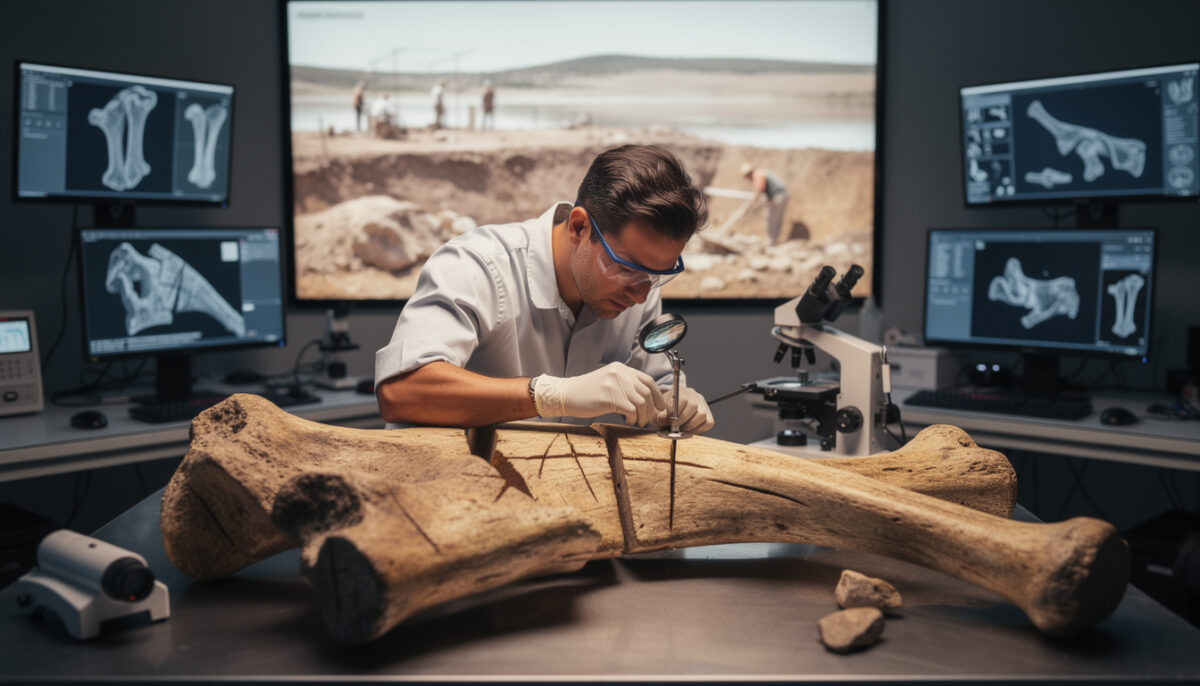
How a forgotten spear challenged ideas about Neanderthals
The Lehringen spear, carved from yew, was once hailed as the oldest complete wooden thrusting weapon known. It joined a tiny elite group of Paleolithic spears, alongside the famous Schöningen weapons and the earlier fragment from Clacton-on-Sea in Britain. Unlike those, this one was still lodged inside an extinct animal, turning it into a potential smoking gun for active Neanderthal hunting.
Yet the chaotic recovery raised suspicion. Were bones and spear truly associated, or simply lying together by chance in the sediment? Without clear documentation, some researchers preferred a cautious reading and focused instead on better-excavated elephant-hunting sites, such as Neumark-Nord or Lehringen’s neighbour Schöningen, already highlighted in studies like recent German–Dutch research on straight-tusked elephant kills.
New cut-mark analysis exposes a real hunting episode
When Verheijen and his team reopened the old boxes, they did not just find elephant bones. They uncovered flint tools, animal remains from bears, beavers and aurochs, and handwritten notes from the original excavator and his daughter. With fresh eyes and modern Paleontology methods, they began a systematic search for butchery marks on every fragment.
The results were immediate. Several ribs and other bones carried sharp, V‑shaped cut marks typical of stone tools, positioned exactly where butchers would slice meat or organs from a fresh carcass. Some traces came from the outside of the body, others from within the ribcage, showing that Neanderthals opened the animal to extract internal organs while it was still fresh enough to work.
A prime elephant, not a sick leftover
Earlier interpretations had imagined an old, weakened elephant that died naturally and was then scavenged. Detailed examination overturned that idea. Dental wear and bone development indicate a male around 30 years old, in his physical prime, standing probably more than 3.5 metres at the shoulder, among the biggest land mammals in Prehistoric Europe.
This fits a deliberate hunting strategy. Lone males are more often separated from herds, making them safer targets than females surrounded by protective relatives. The pattern of cuts, combined with the embedded spear, now points strongly toward an organised hunt rather than opportunistic scavenging, matching broader evidence from sites like Neumark-Nord and syntheses such as recent overviews of elephant hunting by Neanderthals.
Reconstructing the Neanderthal hunting strategy at Lehringen
To grasp the scene, imagine a small Neanderthal group tracking this giant across a forested Ice Age landscape. A thrusting spear like the Lehringen weapon demands close range. Hunters probably approached from several sides, aiming for the flanks where ribs protect vital lungs and major blood vessels.
Modern elephant behaviour offers a striking parallel. When severely wounded, elephants tend to seek water. Verheijen and colleagues propose that the injured straight‑tusked bull fled toward the nearby lake, collapsed on the shore and crushed at least one spear beneath its weight. That broken weapon, abandoned where the animal fell, is the one found between the ribs almost 125,000 years later.
From kill to butchery: a lakeside processing camp
The Lehringen bones portray more than a dramatic kill; they reveal a broader lakeside activity zone. Alongside the elephant, Neanderthals butchered bear, beaver and aurochs, leaving characteristic cut marks on meat-bearing bones and skinning zones. Flint flakes show that tool resharpening and carcass processing happened directly on the spot. Read more about the topic in our article on ancient 400-million-year-old fish fossils.
Not every elephant bone bears traces of cutting. Hunters seem to have focused on the richest packages of meat, fat and organs, then left lower-yield portions to carnivores and scavengers. For a community, one such animal represented an enormous energy windfall, echoing other research on “calorie bombs” provided by straight-tusked elephants across Ice Age Europe.
What these insights change about Neanderthal lifeways
For years, Neanderthals were wrongly portrayed as clumsy scavengers trailing behind more skilful humans. The Lehringen evidence, reinforced by sites across Germany, Italy and beyond, now anchors a different portrait: strategic hunters capable of tackling the biggest animals in their environment.
This hunt required coordination, weapon knowledge and an understanding of elephant behaviour and terrain. It also implies social systems able to distribute thousands of portions of meat, to store or share fat and organs, and to manage short bursts of abundance. Comparable planning appears in other domains too, from early wooden tools like those described in research on ancient wooden implements to sophisticated seafaring suggested by recent maritime discoveries and ancient giant kangaroos.
Lehringen in the wider prehistoric and archaeological record
Seen alongside work at Schöningen, Neumark-Nord and other elephant-bearing sites, Lehringen now forms a key chapter in the story of Neanderthal big-game hunting. Together they show that interaction with straight-tusked elephants was not a rare accident but a recurring strategy shaping diet and mobility.
For modern Archaeology and Paleontology, this Ancient Elephant case also highlights how much can still be hidden in museum archives. A “truckload” of old boxes, once almost ignored, has produced one of the most detailed Neanderthal hunting episodes ever reconstructed, connecting spears, cut marks and behaviour into a single, unforgettable scene.
- Lehringen provides direct association of a spear and butchered elephant skeleton.
- Cut marks prove systematic processing of meat and organs from a fresh carcass.
- The hunted animal was a prime adult male, not a weakened leftover.
- Other species at the lakeside show repeated use of the spot as a hunting and butchery area.
- The site confirms complex planning and social organisation in Neanderthal communities.
How old are the Lehringen elephant remains?
The Lehringen straight-tusked elephant died around 125,000 years ago, during a warm phase of the last Ice Age. Neanderthals were then the only human group known in northern Europe, which makes them the clear candidates for both the spear attack and the subsequent butchery of the carcass.
What proves that Neanderthals hunted the elephant instead of scavenging it?
Several lines of evidence point to a real hunt. A 2.3‑metre yew spear was found lodged between the ribs, and many bones show sharp stone-tool cut marks, including from inside the chest cavity. Those traces reveal rapid access to fresh meat and organs, something scavengers arriving late would not obtain.
How big was the Neanderthal-hunted elephant at Lehringen?
Analysis of teeth and bones indicates a male straight-tusked elephant in his thirties, probably exceeding 3.5 metres at the shoulder. That size places it among the largest land mammals of its time, similar in scale to other Palaeoloxodon antiquus individuals whose remains are known from Ice Age Europe.
What tools did Neanderthals use to butcher the animal?
They relied mainly on simple flint flakes, some produced or resharpened directly at the lakeside. Despite their simplicity, these sharp-edged pieces were efficient for cutting hide, slicing meat and extracting organs, as shown by the pattern and orientation of the cut marks on the Lehringen bones.
Why is the Lehringen discovery so important for prehistoric research?
Lehringen uniquely combines Ancient Elephant remains, clear butchery traces and a spear still inside the skeleton. This rare convergence gives researchers a detailed snapshot of a single neanderthal elephant hunting episode, strengthening the view of Neanderthals as organised big-game hunters with sophisticated ecological knowledge and social coordination.
FAQ
What is neanderthal elephant hunting and why is it significant?
Neanderthal elephant hunting refers to the practice of Neanderthals tracking and killing large ancient elephants, such as Palaeoloxodon antiquus, for food and materials. This reveals their advanced hunting skills and social cooperation, challenging previous assumptions about their capabilities.
How do we know Neanderthals hunted elephants?
Archaeological evidence, such as the Lehringen straight-tusked elephant with a spear embedded between its ribs, strongly indicates neanderthal elephant hunting. Such finds demonstrate deliberate hunting techniques rather than scavenging.
What tools did Neanderthals use for elephant hunting?
Neanderthals used large wooden spears, sometimes over two metres long, to hunt massive animals like elephants. The discovery of a yew spear at the Lehringen site provides direct proof of their specialised tools for neanderthal elephant hunting.
Why are recent discoveries about neanderthal elephant hunting important?
Honey Bees Exhibit Enhanced Dancing Skills in the Presence of an Audience
Mathematician Awarded 2026 Abel Prize for Cracking a Six-Decade-Old Mathematical Enigma
Recent finds, like the reassessment of old elephant remains, offer new insights into neanderthal elephant hunting methods and social organisation. They help us better understand the intelligence and adaptability of Neanderthals.
Where have the most important neanderthal elephant hunting sites been found?
Key sites for neanderthal elephant hunting include Lehringen and Schöningen in Germany, where remarkable remains and hunting tools have been uncovered. These locations offer some of the clearest evidence of Neanderthal big-game tactics.