Show summary Hide summary
- Ancient bacterium in Colombia reshapes syphilis origins
- What the genome reveals about disease evolution
- Paleopathology meets archaeological genetics and modern health
- From ancient skeletons to future diagnostics and treatments
- Key insights emerging from the history of syphilis
- What exactly did scientists find in the Colombian bone?
- Does this discovery prove where syphilis first emerged?
- How does ancient DNA help modern medicine?
- What is paleopathology and how is it used here?
- Could similar methods reveal hidden histories of other diseases?
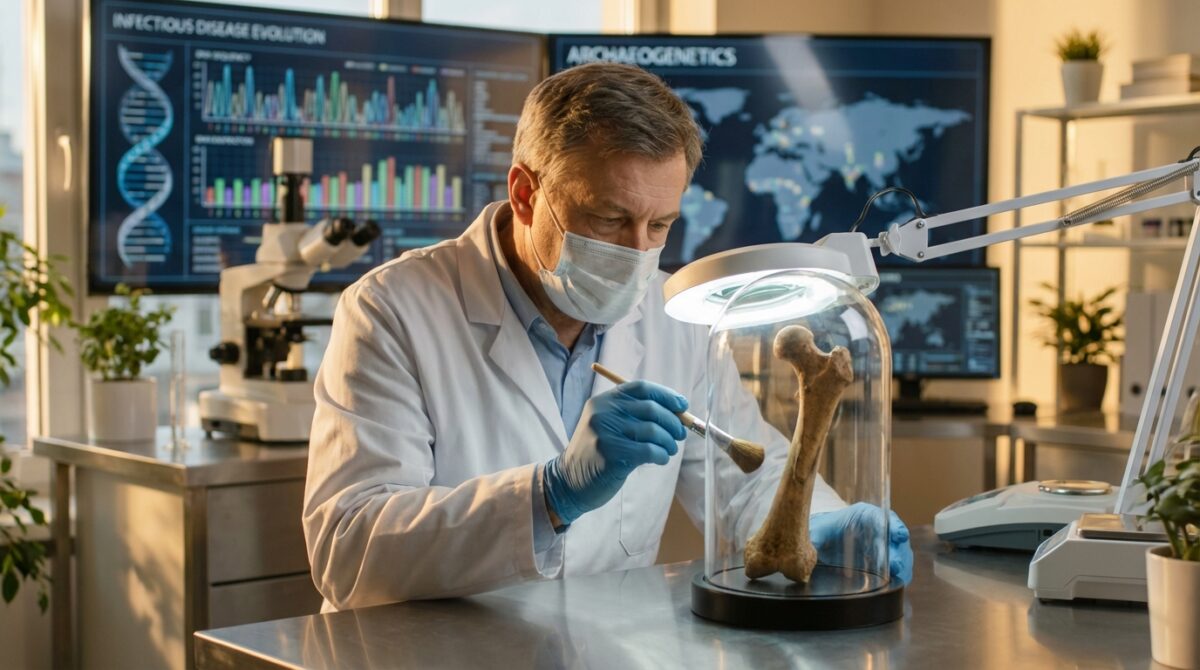
A single leg bone, buried for more than 5500 years in the Colombian Andes, has just forced scientists to rewrite the history of syphilis. Inside that bone, researchers uncovered DNA from an ancient bacterium related to syphilis, revealing that these infections shadowed humanity far earlier than anyone imagined.
This microbial discovery ripples far beyond one individual skeleton. It challenges long‑held assumptions about when complex infectious diseases emerged, how they evolved, and why they still shape human health in the twenty‑first century.
Ancient bacterium in Colombia reshapes syphilis origins
The bone comes from a hunter‑gatherer who lived on the Bogotá savannah over five millennia ago, long before cities, farms or empires. When researchers sequenced ancient DNA from the remains, expecting to study ancestry, they instead detected the full genome of Treponema pallidum, the spiral‑shaped bacterium family that today causes syphilis, yaws and bejel.
Assessing the Real Risks: How Concerned Should We Be About an AI Apocalypse?
Unexpected Fossil Finds Rewrite the Timeline of Complex Animal Evolution
No visible bone lesions hinted at infection. That absence makes the finding even more striking: the pathogen was present in the body but left no obvious skeletal scars, a reminder of how incomplete the archaeological record can be. Earlier work on pre‑Columbian Brazilian skeletons with syphilis-like disease had already unsettled the classic narrative that the ailment began with Columbus, as reported in sources like recent coverage of Brazilian remains.
From Columbus debate to deep pathogen history
For decades, historians and clinicians argued over whether syphilis arose in Europe or arrived from the Americas after 1492. Investigations of skeletons with treponemal lesions, such as those discussed in long‑term paleopathology reviews, could not fully resolve the controversy.
Ancient DNA has changed the picture. Genomes from American sites, summarized in outlets like The Detroit News on treponemal origins and recent Live Science reports, suggest that the pathogen history of Treponema stretches deep into the Americas. The Colombian genome pushes that timeline back thousands of years, showing a wide, ancient diversity within this bacterial family.
What the genome reveals about disease evolution
When the Colombian sequence was compared with modern strains, it did not match any known subspecies of Treponema pallidum. Instead, it formed a distinct branch, an extinct cousin that split from today’s lineages long ago. Despite that distance, it carried many of the same genes associated with virulence in modern syphilis strains.
This pattern supports a key idea in disease evolution: treponemal bacteria diversified early, then adapted to different modes of transmission and symptoms. Some lineages became sexually transmitted, like venereal syphilis, while others, such as yaws, spread mostly through skin contact in childhood.
Hunter‑gatherers, wildlife and hidden infections
The woman or man from the Bogotá highlands lived in a small, mobile band surrounded by rich Andean ecosystems. People moved often, hunted game, collected plants and likely encountered wild animals that carried similar microbes. Unlike densely packed farming villages, these groups had fewer permanent settlements and limited crowding.
Finding a treponemal genome in such a context undermines the simple idea that complex pathogens only flourished once intensive agriculture and big cities appeared. It suggests that bacteria capable of causing infectious diseases were already experimenting with human hosts in scattered forager communities, long before urbanization magnified their impact.
Paleopathology meets archaeological genetics and modern health
This discovery sits at the intersection of paleopathology and archaeological genetics. Bone lesions alone can mislead; some infections leave no trace on the skeleton, while others mimic multiple conditions. Ancient DNA fills those gaps, revealing “invisible” pathogens that never carved their signatures into bone.
Researchers now suspect that many treponemal lineages have vanished, leaving only genetic echoes. Articles such as recent Smithsonian reporting on treponemal studies and BBC explorations of ancient pathogens and modern cures highlight how each new genome helps reconstruct these lost branches, much like astronomers infer missing stars from their gravitational pull.
Why this microbial discovery matters for you
Understanding how Treponema pallidum adapted to humans over thousands of years can inform public health in several ways. When scientists see which genetic “tools” have remained stable and which have changed, they can identify promising targets for vaccines or more durable antibiotics.
Modern syphilis rates have climbed again in many countries, and antibiotic resistance is a growing concern. By tracing which genes helped ancient strains infect new hosts or evade immunity, researchers can anticipate how current bacteria might adapt in response to treatment pressures, rather than reacting only after resistance spreads.
From ancient skeletons to future diagnostics and treatments
Behind this work stand highly specialized laboratories, often funded through national research councils and university consortia rather than single agencies. Clean rooms filter out modern DNA; sequencing machines read billions of fragments; bioinformatic pipelines rebuild genomes from damaged molecules, as detailed in analyses like those in recent Nature coverage of ancient treponemal genomes and current genomic research on treponemal pathogens.
These projects can run into multimillion‑dollar budgets when fieldwork, conservation, sequencing and long‑term data storage are included. Yet the investment supports a wider ecosystem: students trained in ancient DNA methods contribute later to medical genomics, epidemiology and even environmental DNA monitoring of water and soil.
Key insights emerging from the history of syphilis
Taken together, recent findings about the history of syphilis point toward several important insights that reach far beyond one disease. For a reader trying to situate this new Colombian genome alongside other discoveries, a few themes stand out clearly.
- Syphilis and related treponemal infections likely have American origins, as reinforced by multiple ancient genomes and coverage such as recent CNN reporting on bacterial origins.
- Multiple extinct lineages once circulated among humans, leaving only genetic traces in bones across the Americas and possibly beyond.
- Pathogens adapted alongside shifts in social organisation, from mobile foragers to agricultural villages and colonial empires.
- Ancient DNA offers a powerful, independent line of evidence that complements, but sometimes overturns, classic skeletal diagnosis.
- Knowledge of long‑term evolution supports the design of future diagnostics and therapies that remain effective as bacteria continue to adapt.
Each of these points connects the deep past to present‑day medicine, showing how ancient genomes can guide modern responses to persistent infections.
What exactly did scientists find in the Colombian bone?
Researchers recovered ancient DNA from a leg bone dated to roughly 5500 years ago from the Bogotá savannah in Colombia. Genetic analysis revealed a complete genome from the Treponema pallidum group, an ancient bacterium related to the strains that cause modern syphilis, yaws and bejel. The skeleton itself showed no clear bone lesions, so only DNA sequencing exposed the hidden infection.
Does this discovery prove where syphilis first emerged?
The Colombian genome strengthens the view that treponemal bacteria, including ancestors of syphilis, diversified deeply in the Americas. Combined with other ancient genomes, it supports an American origin for these infections. However, scientists remain cautious about declaring an exact birthplace, because many regions and time periods still lack ancient DNA data.
How does ancient DNA help modern medicine?
Ancient DNA reveals which genes have remained stable in pathogens over thousands of years and which have changed. This helps researchers identify weak points in the bacteria that may make reliable vaccine or drug targets. By understanding long-term patterns of adaptation, public health teams can better anticipate how microbes might respond to antibiotics or shifts in human behaviour.
What is paleopathology and how is it used here?
Stanford Researchers Develop Shape-Shifting Material Mimicking Octopus Color and Texture Changes
Groundbreaking Fiber Optic Breakthrough Enables Simultaneous Streaming of 50 Million Movies
Paleopathology is the study of disease in ancient human and animal remains, often through skeletal changes such as lesions, deformities or healed fractures. In the case of ancient treponemal infections, paleopathologists first identified candidate skeletons with suspicious bone damage. Archaeological genetics then provided DNA-based confirmation or correction, revealing infections that left no visible marks.
Could similar methods reveal hidden histories of other diseases?
Yes. The same approaches are already transforming knowledge about plague, tuberculosis and leprosy, among others. As more sites and time periods are sampled, scientists expect to uncover lost lineages of many pathogens. That expanding dataset will refine evolutionary timelines, clarify how infections spread with human migrations and inform strategies to control emerging diseases in the future.