
Show summary Hide summary
- Stonehenge mystery: What we now know with more confidence
- Inside the Curtin study: From zircon fingerprints to human hands
- What this means for Stonehenge builders and their world
- How this study fits with other Stonehenge research
- From scientific debate to public understanding
- Practical takeaways for readers and educators
- Did this study finally prove humans moved the Stonehenge stones?
- How exactly did prehistoric people move such massive stones?
- Why are zircon minerals so useful for understanding Stonehenge?
- What role did the Altar Stone play in this new research?
- Will future research completely solve the Stonehenge transport mystery?
What if one of the longest running debates in archaeology has just shifted decisively, thanks to minerals smaller than a grain of sand? The century-long Stonehenge enigma over whether ice or people moved its ancient stones now has its clearest scientific test yet.
New research from Curtin University in Australia indicates that glaciers almost certainly did not drag the famous bluestones and the massive Altar Stone to Salisbury Plain. Instead, the evidence makes deliberate human transport during the prehistoric period far more likely, pushing this famous mystery toward a genuine breakthrough resolution.
Stonehenge mystery: What we now know with more confidence
The study, published in the journal Communications Earth and Environment, does not “prove” human hauling in an absolute sense. It does, however, strongly challenge the rival hypothesis that glaciers delivered the megalithic blocks for free.
Assessing the Real Risks: How Concerned Should We Be About an AI Apocalypse?
Unexpected Fossil Finds Rewrite the Timeline of Complex Animal Evolution
Led by geologist Dr. Anthony Clarke from Curtin’s School of Earth and Planetary Sciences, the team found no mineral trace that ancient ice sheets ever reached the Stonehenge area. This result adds weight to earlier work that linked the six tonne Altar Stone to Scotland, rather than to Wales as previously believed, suggesting purposeful long distance sourcing by Neolithic communities.
How tiny minerals help answer a century-long enigma
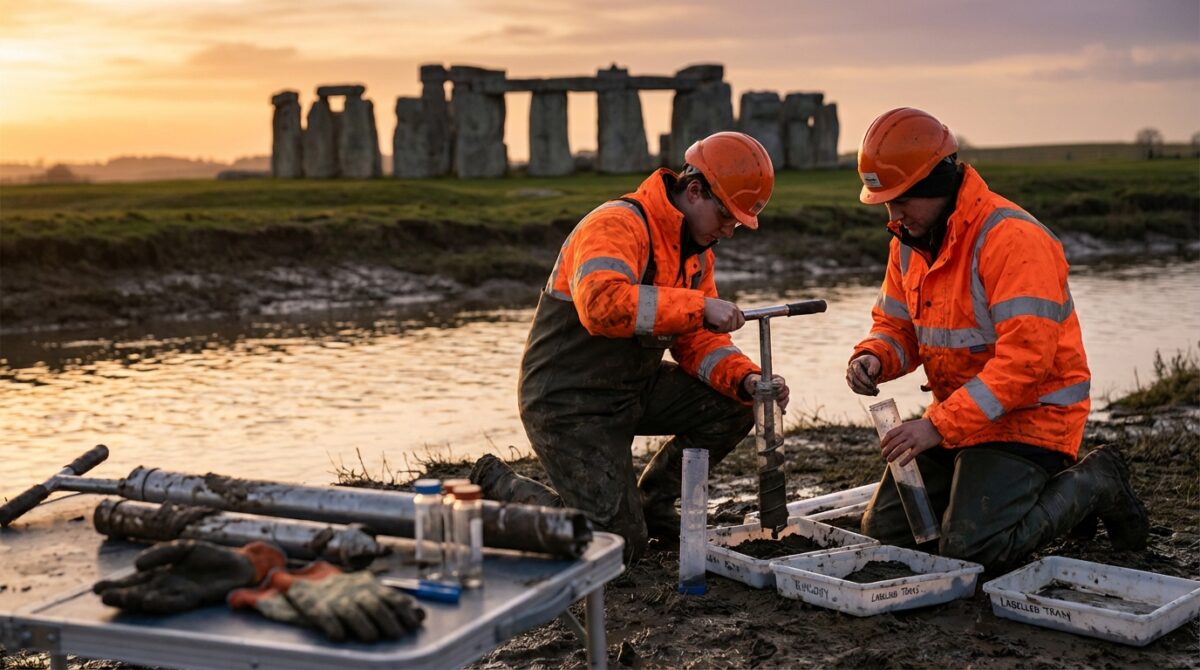
The method is deceptively simple to state: researchers matched the “fingerprints” of microscopic minerals in nearby river sands to the journeys that rocks would have taken if they had been moved by ice. In practice, this involved sophisticated geochemical tools, years of technique development and more than 500 individual mineral analyses.
Using world leading instruments at Curtin’s John de Laeter Centre, the team examined zircon crystals in sediments from rivers around Salisbury Plain. Zircon is extremely durable and records the age and origin of bedrock. If glaciers had once dragged stones south from Scotland or Wales, their erosion should have left distinctive zircon age patterns in these local sediments.
Inside the Curtin study: From zircon fingerprints to human hands
Over 500 zircon grains were dated and chemically characterized. The statistical distribution of ages was then compared with known geological provinces in Britain. According to Dr. Clarke, the pattern simply did not match what would be expected if large amounts of glacially transported rock from the north or west had ever covered Salisbury Plain.
This absence of a “glacial signature” is the central finding. As Dr. Clarke explains in the study, if ice had delivered the stones, erosion over thousands of years would have fed recognisable zircons into the river system. The fact that these expected grains are missing strongly suggests that natural ice transport did not occur in this landscape.
Key numbers and scientific confidence
While the paper focuses on geological evidence rather than headline statistics, several quantitative elements matter for interpreting confidence levels. First, analysing over 500 zircon crystals provides a robust sample for detecting rare age populations if they were present.
Second, the researchers compared their data with established zircon age distributions from Scottish and Welsh rock units. Within standard geochronological uncertainty ranges, the Stonehenge area sands showed no signal consistent with extensive glacial input from those distant regions. The authors present this as strong but not absolute evidence, carefully separating “highly plausible” from “proven fact”.
What this means for Stonehenge builders and their world
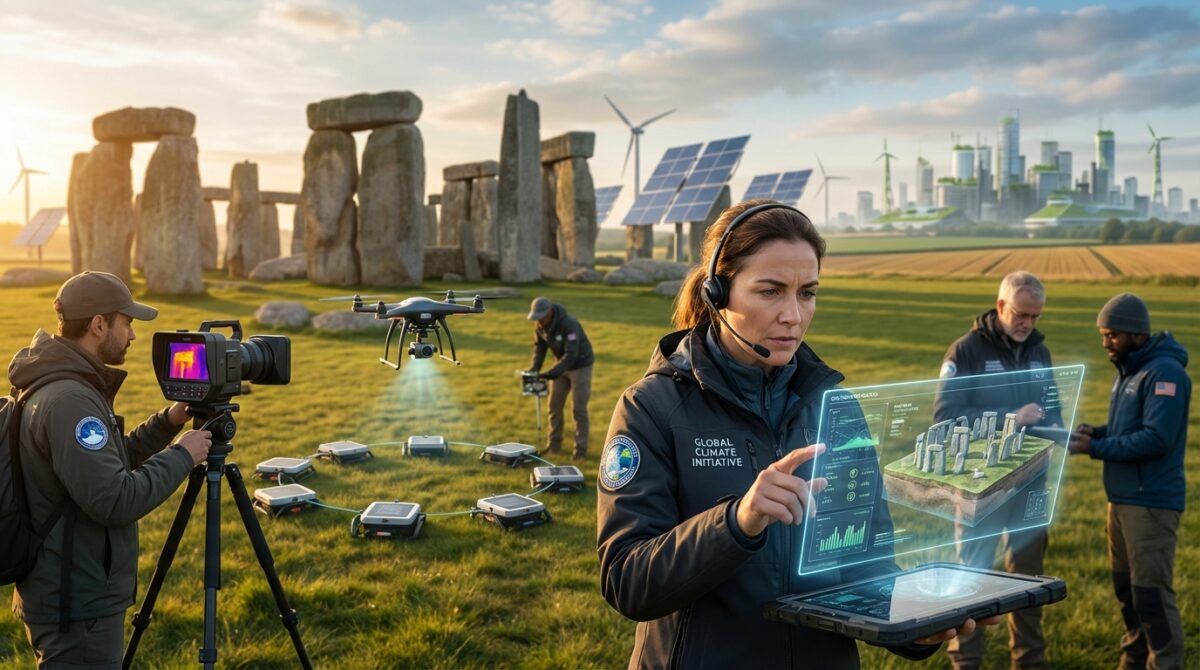
If ice did not do the heavy lifting, the implication is striking: Neolithic communities orchestrated the movement of multi tonne stones over hundreds of kilometres. This aligns with other recent work, such as coverage in UCL reports on Stonehenge mysteries and summaries in science media including Science Focus.
For a reader imagining the logistics, think of a cooperative project spanning multiple settlements, probably over years. Transport might have combined river journeys with overland hauling using wooden sleds and rollers, as discussed in reconstructions shared by outlets like the Mirror’s coverage of Stonehenge transport theories.
Why this prehistoric effort might have been worthwhile
Archaeologists increasingly see Stonehenge as more than a single purpose monument. As Professor Chris Kirkland, co author of the Curtin study, notes, it may have functioned at different times as a seasonal calendar, a ceremonial focus and a gathering place for feasting.
Bringing rare stones from afar could have reinforced alliances between distant communities or signalled shared beliefs. Interpretations discussed in overviews such as analyses of Stonehenge’s meaning and origin highlight this social dimension: the journey of the stones may have been as significant as their final arrangement.
How this study fits with other Stonehenge research
The new zircon work does not appear in isolation. It builds on a 2024 Curtin led study that first linked the Altar Stone to Scottish geology. Combined with other investigations into bluestone origins in Wales, and public facing summaries such as recent syntheses of Stonehenge’s ancient mystery, a more coherent picture is emerging.
Media stories often headline that the mystery is “solved after 5,000 years”. The scientific reality is more measured. What has shifted is the balance of probability: glacial transport now looks very unlikely, while human agency becomes the leading explanation, supported by independent lines of evidence.
Limits of the evidence and what remains unknown
Several uncertainties remain. Zircon fingerprinting speaks to where sediments came from, not directly to how specific megaliths were moved. The method cannot reconstruct sled designs, rope technologies, or the exact routes taken through the prehistoric landscape.
There are also geological caveats. If glacial deposits were once present but later removed by erosion without leaving detectable zircon traces, the signal might be weaker than expected. The authors consider this scenario but judge it improbable given regional geology and current models of British ice sheet extent.
From scientific debate to public understanding
For visitors standing among the stones, these findings reshape the story they imagine. Instead of picturing slow moving ice sheets dropping boulders by chance, the focus shifts to human decision making, planning and shared effort. This human centred view echoes narratives presented in recent news pieces such as reports on new evidence for Stonehenge stone movement.
Museums, heritage educators and tour guides can draw on this work to emphasise technological ingenuity and social organisation in late Neolithic Britain. For a school group or a curious traveller, this framing turns Stonehenge from a passive geological oddity into an active expression of community power and identity.
Practical takeaways for readers and educators
Teachers, science communicators and curious readers can use the Curtin study as a clear example of how modern methods revisit long contested hypotheses. It provides an accessible case study linking climate history, geology and archaeology.
For anyone designing educational content around Stonehenge, it helps to highlight three core messages: minerals record journeys, absence of expected evidence matters and ancient people were capable of complex engineering when motivated.
- Mineral fingerprints show where sediments, and by extension rocks, have travelled across landscapes.
- Missing signals can be as informative as positive matches when testing glacial versus human transport.
- Neolithic societies likely coordinated large scale projects, challenging stereotypes about prehistoric technology.
Did this study finally prove humans moved the Stonehenge stones?
The Curtin University research does not prove human transport in an absolute sense, but it strongly challenges the idea that glaciers delivered the stones. By finding no mineral evidence that ice sheets reached Salisbury Plain, the study makes deliberate human movement of the megaliths the most plausible explanation based on current data.
How exactly did prehistoric people move such massive stones?
The study does not identify a single confirmed method. Archaeologists suggest a mix of river transport on rafts and overland hauling using sleds, ropes and wooden rollers. These scenarios fit with what is known about Neolithic woodworking and coordination, but no direct physical remains of the transport systems have been found.
Why are zircon minerals so useful for understanding Stonehenge?
Zircon is incredibly hard and can survive for billions of years, preserving information about the rock it formed in. By dating zircon grains in river sands near Stonehenge and comparing their ages with known rocks in Scotland and Wales, scientists can test whether glaciers once brought northern material into the area.
What role did the Altar Stone play in this new research?
Stanford Researchers Develop Shape-Shifting Material Mimicking Octopus Color and Texture Changes
Groundbreaking Fiber Optic Breakthrough Enables Simultaneous Streaming of 50 Million Movies
A previous Curtin led study traced the Altar Stone to Scottish geology, suggesting a long distance human transport route. The new zircon work complements that finding by showing that glaciers probably did not reach Stonehenge, so the Scottish origin is best explained by deliberate sourcing and movement by people rather than by ice.
Will future research completely solve the Stonehenge transport mystery?
Future work may refine our understanding, for example by locating ancient quarry sites more precisely or modelling possible routes in detail. However, some aspects, such as the exact tools or ceremonies involved in moving the stones, may never be known with certainty because organic materials and direct records have not survived.