Show summary Hide summary
- How a failed control sparked a new chemical transformation
- From anti-Friedel-Crafts idea to LED-driven reaction
- Late-stage tuning of drug molecules with less waste
- Serendipity, AI and the new way discoveries are made
- Lessons this Cambridge discovery offers to future scientists
- Three habits to turn mistakes into innovation
- What makes the Cambridge anti-Friedel-Crafts reaction different from classic methods?
- How does this technique help pharmaceutical research move faster?
- Why is using LEDs and mild conditions environmentally beneficial?
- What role did artificial intelligence play in this discovery?
- Is this technique already ready for large-scale drug production?
A routine control test, one missing ingredient, and suddenly the reaction behaved “wrong.” That lab error at Cambridge has now become a groundbreaking green chemistry tool that could rewrite how your future medicines are designed and manufactured.
How a failed control sparked a new chemical transformation
In the Reisner laboratory at the University of Cambridge, PhD researcher David Vahey was checking a photocatalyst experiment. During a control run, he removed the catalyst that should have been driving the reaction. Strangely, the mixture still produced an unexpected product, sometimes even more efficiently.
On many benches, that anomaly would have gone straight into the “failed” folder. Vahey paused instead. That decision turned pure serendipity into a new technique for late stage drug functionalization of complex drug molecules, reminiscent of classic stories like accidental scientific discoveries that changed medicine. To understand how this fits with other breakthroughs in cellular chemistry, see Uncovering the Secret Metabolic Processes Functioning Within the Cell Nucleus.
AI-Powered Toys Are Here to Stay, But Their Safety Remains Uncertain
Unveiling the Unexpected Tactics Bacteria Use to Move Without Propellers
From anti-Friedel-Crafts idea to LED-driven reaction
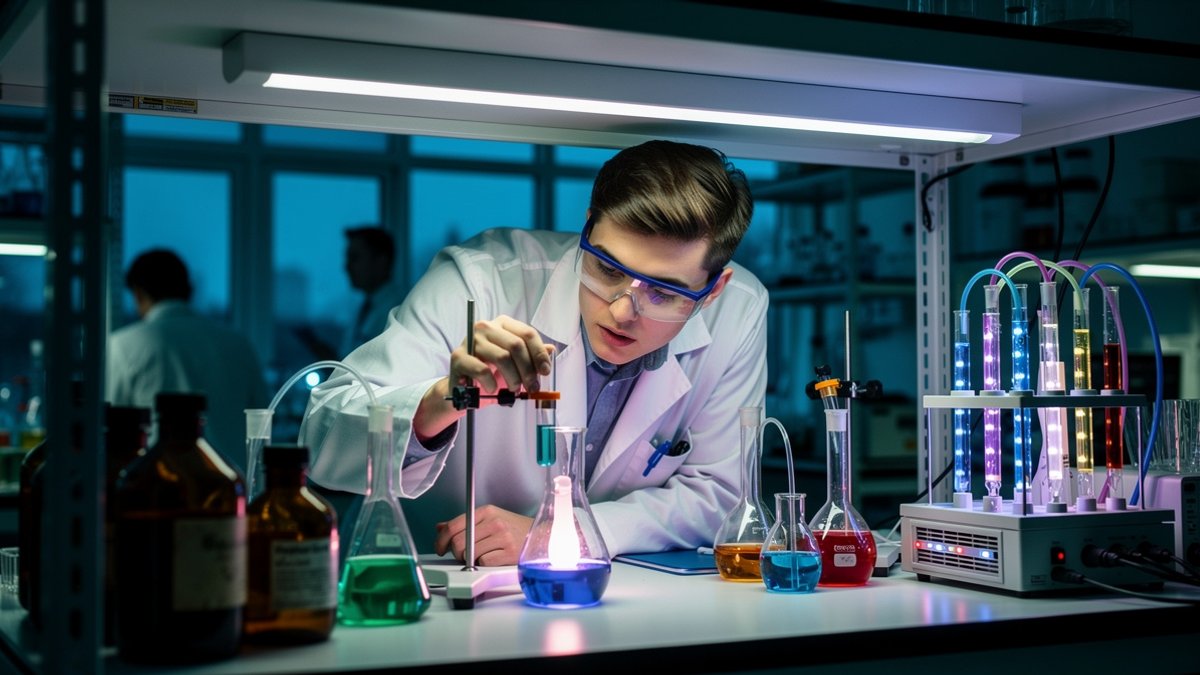
The team soon realized they were seeing an “anti-Friedel-Crafts mechanism” style process. Classic Friedel-Crafts reactions rely on corrosive acids or heavy-metal catalysts, under high temperatures and strictly controlled conditions, usually at the very start of pharmaceutical synthesis.
Here, an ordinary LED lamp at room temperature kicked off a self-sustaining chain reaction. Light alone initiated formation of new carbon–carbon bonds without toxic additives. For pharmaceutical research, that flips the script: you can now modify finished or nearly finished molecules instead of rebuilding them from scratch.
This shift matters because the backbone between carbon atoms defines how a medicine fits into its biological target. Creating those bonds gently, with light, gives chemists a nimble way to explore structure–activity relationships late in the game, when most of the molecule is already optimized. For more on how fundamental cellular processes relate to drug development, see AI Reveals the Hidden Genetic Switchboards Steering Alzheimer’s Disease.
Late-stage tuning of drug molecules with less waste
Medicinal chemists often spend months resynthesizing large chunks of a candidate drug just to tweak one substituent. With the Cambridge chemical transformation, they can start from their best “hit” and make small, precise edits on the aromatic ring system near the end of development.
This late-stage functionalization reduces the number of synthetic steps, solvents, and purification cycles. Less energy, fewer hazardous reagents, and a thinner waste stream all line up with the broader push toward greener pharmaceutical research and cleaner manufacturing pipelines. For related strategies in targeting cancer cells, read Revolutionary Iron-Based Nanomaterial Targets Cancer Cells While Preserving Healthy Tissue.
What this green technique changes in practice
For a team optimizing an anti-cancer agent, the reaction could allow rapid testing of multiple analogues that differ only at a single position. The high functional-group tolerance means delicate motifs—amides, esters, heterocycles—survive intact while one specific region gets edited.
That selectivity is vital because small variations control not just potency, but how a drug distributes in the body or triggers side effects. By combining this reaction with insights from work on inflammation control or organ health, such as studies on the body’s key mechanisms for inflammation, teams can systematically sculpt both efficacy and safety.
Industrial partners tested the method in continuous-flow setups, the workhorse systems of large-scale production. The reaction handled these conditions, hinting that it could translate beyond the academic fume hood into real manufacturing lines.
Serendipity, AI and the new way discoveries are made
This story sits in a long lineage that includes penicillin, X-rays, and even modern GLP‑1 weight-loss drugs. Resources like collections of famous lab accidents or detailed analyses of serendipity in research show the same pattern: chance observation plus a researcher who refuses to ignore an odd result.
In the Cambridge project, enormous datasets from photochemical trials were sifted using machine learning. An algorithm trained with collaborators at Trinity College Dublin learned where the new reaction was likely to occur on untested molecules, cutting down on blind experimentation.
Why human curiosity still beats pure algorithms
AI predicted reactivity patterns, but it did not “decide” that a failed control might hide something new. That leap came from Vahey, choosing to interrogate an outlier rather than discard it. Algorithms follow encoded rules; curiosity rewrites them.
After the mechanism was mapped, the same AI tools began suggesting fresh substrates, combining human insight with computational power. The balance between data-driven prediction and non-linear human thinking echoes broader conversations about serendipity in scientific research across disciplines.
Lessons this Cambridge discovery offers to future scientists
For young chemists, Vahey’s experience reads like a practical playbook for turning lab noise into breakthroughs. Every “wrong” spectrum or odd yield might signal a new pathway, not just contamination or mismeasurement.
Consider how many transformative findings—from vulcanized rubber to Viagra—appeared as side effects or failed objectives. In each case, someone cared enough to ask: “What if this is telling us something different?” That mindset now underpins this LED-driven tool for remodeling drug molecules.
Three habits to turn mistakes into innovation
Chemists and other scientists looking to emulate this approach can focus on a few concrete practices.
- Keep clean, detailed records so unexpected outcomes can be traced and reproduced instead of dismissed.
- Run thoughtful controls that genuinely test assumptions; the Cambridge reaction surfaced during a control, not the main experiment.
- Question every anomaly before labelling it as error, asking whether it might signal a new mechanism or reactivity pattern.
Together, those habits turn routine bench work into fertile ground for the next “accidental” advance in sustainable chemistry and medicine.
What makes the Cambridge anti-Friedel-Crafts reaction different from classic methods?
Traditional Friedel-Crafts chemistry typically uses strong acids or metal catalysts at high temperature, early in a synthetic route. The Cambridge approach uses visible light from an LED at room temperature to create carbon–carbon bonds on already complex drug molecules. This late stage drug functionalization, metal-free reactivity gives medicinal chemists a cleaner and more flexible way to adjust structures.
How does this technique help pharmaceutical research move faster?
By allowing precise modifications near the end of a synthesis, teams can start from a promising lead compound and generate multiple analogues without rebuilding the entire molecule. That reduces the number of steps, saves months of work, and lets researchers explore structure–activity relationships with far less trial and error. For more on innovative pharmaceutical strategies, read Innovative Medication Resets the Clock, Eases Jet Lag.
Why is using LEDs and mild conditions environmentally beneficial?
LED-driven reactions at ambient temperature avoid the energy costs of heating and cooling, and they can run without heavy metals or strongly corrosive reagents. That combination cuts chemical waste, lowers energy demand, and fits better with the goals of sustainable pharmaceutical manufacturing.
What role did artificial intelligence play in this discovery?
Depression Could Begin with Cellular Energy Deficits in the Brain
Unexpected Blood Protein Signature Could Unlock Early Detection of Alzheimer’s
AI did not find the reaction, but it helped once the team recognized the new chemistry. Machine learning models, trained on known reactions, were used to predict where the transformation would likely occur on new molecules. This guided experimental design and reduced the number of physical tests needed.
Is this technique already ready for large-scale drug production?
The reaction has been demonstrated on a broad set of drug-like molecules and adapted to continuous flow, which is the format used in many industrial plants. Further optimization and validation will be needed for each specific drug candidate, but the early results indicate strong potential for scale-up in real manufacturing environments.