Show summary Hide summary
- North Sea wind power network reshapes Europe’s energy map
- How 100GW offshore wind can power 143 million homes
- Climate impact and the pushback against wind energy
- Policies, protections and the Hamburg declaration’s bigger picture
- From political promise to steel in the water
- What individuals, cities and businesses can do now
- How much electricity will the 100GW North Sea wind plan provide?
- Which countries are part of the Nine Nations collaboration?
- Why focus on the North Sea for renewable energy?
- How will this project affect energy prices for consumers?
- What are the main challenges for the 100GW North Sea wind network?
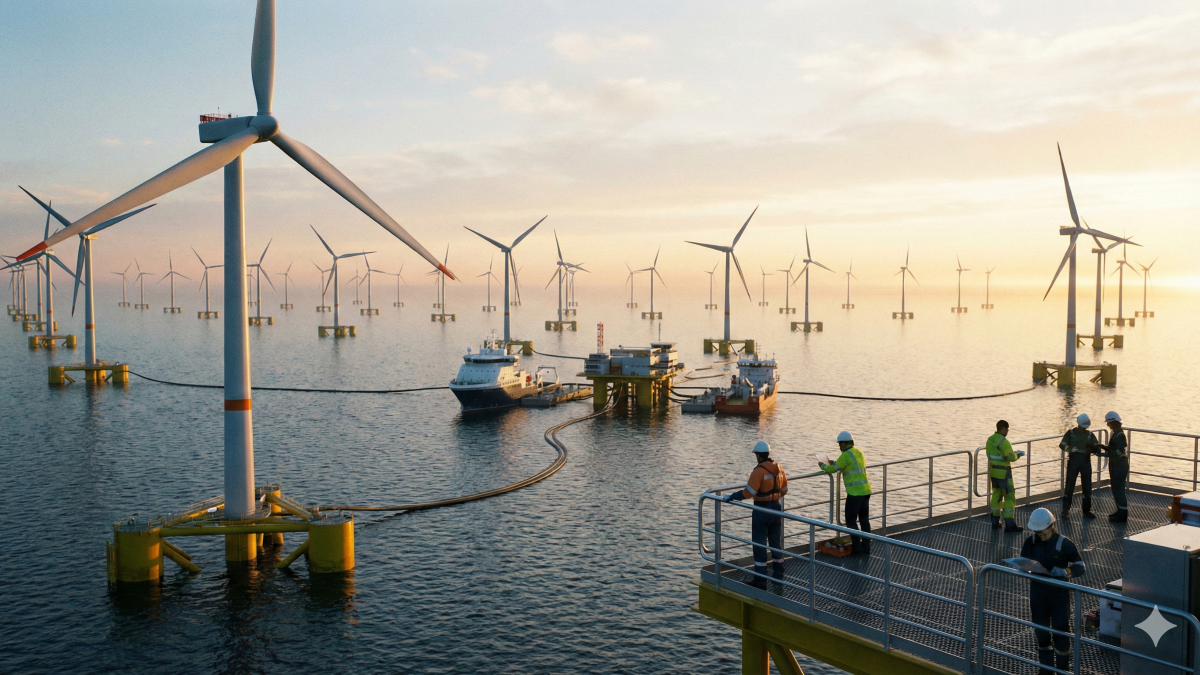
Imagine standing on a North Sea beach in winter and knowing that the storm above your head is quietly powering 143 million homes across Europe. That is the scale of the new plan to turn an ageing oil basin into a shared clean energy reservoir.
The UK and Nine Nations have now agreed to build a 100GW Offshore Wind Power network in the North Sea, wiring turbines directly into multiple countries. This is not only a climate story; it is a story about bills, jobs, and what keeps your lights on when fossil markets wobble.
North Sea wind power network reshapes Europe’s energy map
Under a landmark agreement, the UK, Belgium, Denmark, France, Germany, Iceland, Ireland, Luxembourg, the Netherlands and Norway will co-develop a 100GW Wind Power Network by 2050. New wind farms will be linked through high-voltage subsea cables, forming a shared grid rather than isolated projects.
Revolutionary Carbon Material Poised to Slash Carbon Capture Costs
Scientists Transform CO2 into Clean Fuel with Innovative Single-Atom Catalyst Breakthrough
The plan, detailed in the Hamburg declaration, builds on earlier pledges to reach 300GW of offshore capacity in the wider North Seas region by mid-century. Reports such as recent policy analyses describe this as a pivot from a fossil fuel basin to a coordinated Renewable Energy hub at continental scale.
From oil province to clean energy reservoir
For decades, the North Sea symbolised oil and gas, with platforms dotting the horizon. Today, those silhouettes are increasingly joined by turbine blades. According to WindEurope’s assessment, the new agreement could unlock about €1 trillion in offshore investment by 2040.
The UK energy secretary Ed Miliband frames this shift as getting “off the fossil fuel rollercoaster” and onto more predictable, homegrown power. That political language is backed by data: in the EU, wind and solar already generated about 30% of electricity last year, overtaking fossil fuels.
How 100GW offshore wind can power 143 million homes
One hundred gigawatts sounds abstract until it is broken down. Energy analysts translate this figure into enough capacity to supply about 143 million European households, assuming typical yearly consumption. The network will not be one giant wind farm, but a mesh of projects connected across several national grids.
High-voltage direct current (HVDC) cables will move electricity efficiently over hundreds of kilometres with relatively low losses. Shared interconnectors mean that when the wind is strong off the UK coast but weaker near Denmark, electrons can flow where demand is highest, stabilising prices and reducing waste.
Shared grids, shared risks and shared rewards
The agreement goes beyond turbines and cables. A separate statement between the UK, Germany, Belgium, Denmark and the Netherlands promotes joint planning, cost sharing and standardised technology. Analyses such as the one reported by Electrek highlight how shared infrastructure lowers project risk and accelerates construction.
Energy UK’s chief executive, Dhara Vyas, argues that this deeper International Collaboration on supply chains and common standards is the fastest route to lower household bills. A more interconnected grid also improves security: if one cable or plant fails, electricity can be rerouted across borders instead of triggering blackouts.
Climate impact and the pushback against wind energy
Climate scientists working with the IPCC have repeatedly shown that the power sector must decarbonise rapidly for global warming to stay near 1.5–2°C. Replacing gas-fired plants with Sustainable Energy sources such as offshore wind is one of the fastest available levers in Europe’s toolkit.
Yet this expansion faces headwinds. Former US president Donald Trump recently mocked European turbines, claiming that “the more windmills a country has, the more money that country loses”. That assertion clashes with empirical evidence from grid operators and recent coverage like reports in UK media, which show falling wholesale prices whenever abundant wind is available.
What this means for households and coastal communities
For families, the immediate benefit of this Offshore Wind Power build-out is more stable pricing. When gas markets spike, as seen after geopolitical tensions, wind farms in the North Sea keep generating without needing imported fuel. A larger shared grid helps dampen those shocks.
For coastal communities from Aberdeen to Esbjerg, the transition is more personal. Ports that once serviced oil rigs are retooling to assemble blades, towers and substations. Studies referenced by EnergyMagz suggest tens of thousands of high-skill jobs in installation, maintenance and marine engineering across the region.
Policies, protections and the Hamburg declaration’s bigger picture
The Hamburg declaration also addresses security. After incidents involving undersea infrastructure in European waters, governments are pledging tighter monitoring of turbines, cables and offshore substations. Shared surveillance and data will help spot anomalies early, limiting the risk of large-scale outages.
Institutionally, this pact reinforces a longer-term European climate narrative. Earlier North Sea summits committed to 300GW of offshore wind by 2050. The new 100GW grid, detailed by outlets such as 4C Offshore, is a significant slice of that promise and places the UK firmly at the core of Europe’s Clean Energy system.
Who gains and who worries in this transition
Not every stakeholder is enthusiastic. Some North Sea oil and gas operators fear stranded assets and declining revenues. Fishermen raise concerns about access to traditional grounds and navigation around dense turbine clusters.
Policy responses now focus on inclusive planning. Spatial mapping tools help designate routes for shipping and fishing, while some projects trial artificial reefs around turbine bases to enhance marine biodiversity. Case studies in outlets like The Guardian show early examples where consultation reduces conflict and even creates shared benefits.
From political promise to steel in the water
Turning declarations into spinning blades requires factories, ships, and trained workers. The UK’s recent record allocation of offshore wind subsidy contracts, reported by sources such as The Global Herald, signals that investors still see long-term value in the sector despite rising construction costs.
WindEurope estimates that meeting the 100GW goal will demand sustained build rates through the 2030s, with regulatory clarity and predictable auction schedules. For households, this level of deployment is a key piece in the UK’s plan to run a largely clean power system by 2030, reducing exposure to fossil volatility.
What individuals, cities and businesses can do now
The North Sea grid may feel distant from daily life, but choices on land determine whether this Renewable Energy system delivers its promise. Cities, companies and households all have leverage points that make the offshore build-out more effective.
Concrete steps include aligning local demand with new clean supply, investing in flexibility, and supporting policies that keep the grid modern and resilient.
- Households can switch to green tariffs, improve insulation, and shift some use (for example EV charging) to off-peak hours.
- Businesses can sign long-term power purchase agreements with offshore projects, giving developers financial certainty.
- Cities and regions can plan heat pumps, public transport electrification and charging hubs around access to North Sea power.
- Universities and training centres can expand courses in offshore engineering, marine ecology and HVDC systems.
- Civic groups can engage in consultation to ensure that new infrastructure respects ecosystems and local livelihoods.
Treating the North Sea as a shared clean reservoir works only if demand becomes smarter and more flexible on shore. That is where personal choices and local policy intersect with international cables and turbines.
How much electricity will the 100GW North Sea wind plan provide?
The planned 100GW Offshore Wind Power network in the North Sea is expected to deliver enough capacity to supply around 143 million homes. Actual output will vary with wind conditions, but the scale is comparable to the current electricity demand of several large European countries combined.
Which countries are part of the Nine Nations collaboration?
The initiative involves the UK and nine other European countries: Belgium, Denmark, France, Germany, Iceland, Ireland, Luxembourg, the Netherlands and Norway. Together they will co-develop offshore wind farms and a shared Wind Power Network linked by high-voltage subsea cables.
Why focus on the North Sea for renewable energy?
The North Sea offers strong, steady winds, relatively shallow waters and existing offshore expertise from decades of oil and gas activity. This combination makes it one of the most cost-effective places in the world to expand large-scale Renewable Energy, while reusing port, shipyard and grid infrastructure.
How will this project affect energy prices for consumers?
Researchers Discover Innovative Method to Convert Sunlight into Sustainable Fuel
Researchers Develop Slippery Nanopores to Boost Blue Energy Harvesting
A larger, interconnected offshore grid increases the share of low-cost Sustainable Energy on the system and reduces reliance on imported gas. Over time, this tends to lower wholesale prices and smooth out price spikes. Consumers benefit most when governments also support efficiency and fair retail tariffs.
What are the main challenges for the 100GW North Sea wind network?
Key challenges include building enough manufacturing capacity, securing skilled workers, protecting marine ecosystems, and coordinating regulations across multiple countries. The Hamburg declaration addresses some of these through International Collaboration on planning, standards, security and shared infrastructure investment.