
Show summary Hide summary
- What we now know about twisted nanocrystal diodes
- Methodology summary and why geometry matters
- Implications for future electronics and energy-efficient devices
- Limitations, open questions, and what comes next
- Why this matters for readers and policy makers
- What is nonreciprocal electrical transport in helical nanocrystals?
- How do researchers sculpt three dimensional devices from a single crystal?
- Why choose the magnetic crystal Co₃Sn₂S₂ for this study?
- Can this nanosculpting approach be scaled up for industry?
- How does this research relate to other crystal-based nanotechnologies?
What if the shape of a wire could decide which way electricity prefers to flow? That is what researchers now show by sculpting minuscule crystals into helical devices that behave like switchable electronic diodes, controlled not by chemical composition alone but by geometry itself.
This new perspective on geometry as an active design tool in nanotechnology comes from a team at the RIKEN Center for Emergent Matter Science in Japan, working with international collaborators. Their study, published in Nature Nanotechnology, indicates that twisting a single crystalline material at the nanoscale can generate and tune nonreciprocal electrical transport, where current flows more easily in one direction than the other.
What we now know about twisted nanocrystal diodes
The team used a topological magnetic crystal made of cobalt, tin, and sulfur (chemical formula Co₃Sn₂S₂) and carved it into three dimensional helical nanodevices. Tests showed a clear diode-like behavior: electrical current preferred one direction of flow, and this preference could be reversed by flipping the magnetization or the handedness of the helix.
Powergen 2026’s second keynote highlights potential challenges for the grid
Report Reveals Wind and Solar Surpass Fossil Fuels in EU Electricity Production for the First Time
This work extends a broader movement in materials science that treats shape as a design parameter, alongside chemical composition and atomic structure. Related explorations include the “almost magical” control of light in photonic crystals at MIT and organic crystals that conduct electricity at Purdue, reported in chemical engineering research. Together, these studies indicate a growing toolkit for harnessing electrical properties by designing both matter and geometry.

How the researchers manipulate minuscule crystals
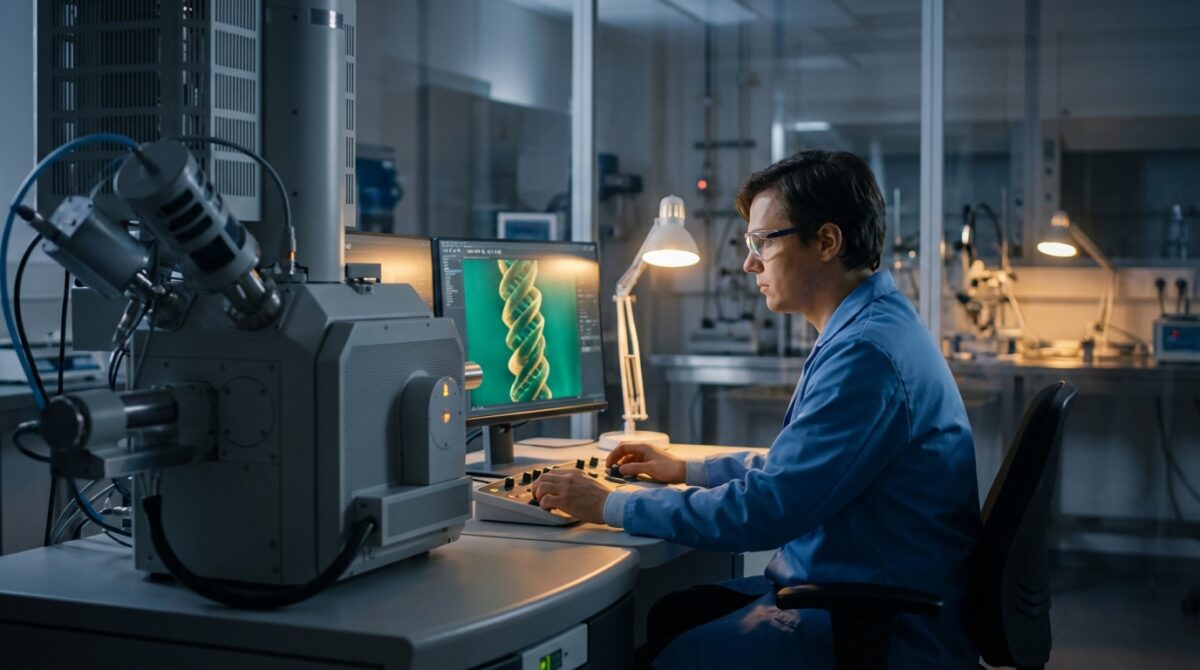
To build their devices, the RIKEN-led team relied on a focused ion beam, a tool that fires a narrow stream of ions to cut and mill material with sub-micron precision. In one sentence, their methodology can be summarized as: carve complex three dimensional structures directly from a single crystal, then wire them up and measure how electrons move under magnetic and electric fields.
This approach resembles sculpting more than conventional chip fabrication. Instead of stacking or etching thin films, the team started from a pristine single crystal and removed material voxel by voxel until only a microscopic helix remained. Similar “nanosculpting” ideas have been discussed in work on twisting crystals to control current, as highlighted in analyses of nanoscale twisting and electricity flow.
Methodology summary and why geometry matters
According to the study, the researchers fabricated multiple helices with different diameters and pitches from the same Co₃Sn₂S₂ crystal, then cooled them and applied magnetic fields while sweeping an electrical current. By comparing current–voltage curves across samples and temperatures, they isolated the role of chiral geometry from the underlying material properties.
The key observation was that nonreciprocal electrical transport strengthened as the curvature and twist of the helix increased. This trend supports the idea that electron scattering against the curved walls of the crystal wire becomes direction-dependent. Some theoretical background for such asymmetries in quantum effects and transport in molecular and crystalline systems has been explored in journals like Chemical Letters, which discuss optical and structural control of electronic states.
Detailed results: from diode effect to magnetization switching
In quantitative terms, the helical nano-devices displayed a clear diode-like asymmetry in their current–voltage response. The magnitude of this electrical nonreciprocity depended on temperature, device size, and the direction of the magnetic field. While the exact percentages vary across samples, the authors report statistically significant differences in conductance between forward and reverse directions, backed by repeated measurements over multiple devices.
Crucially, the effect was switchable. Reversing the magnetization of the magnetic crystal flipped the preferred current direction, and constructing helices with the opposite handedness had a similar impact. Beyond that, strong electrical pulses could themselves trigger changes in magnetization, indicating a feedback loop where current flow not only responds to magnetic configuration but can also modify it.
How this fits into the wider nanotechnology landscape
The RIKEN work sits alongside global efforts to control electric and optical behavior by reconfiguring tiny structures. For example, scientists at Argonne National Laboratory have used light to induce symmetry changes in nanocrystals. Rice University researchers have used electron beams to pattern light emitters and wiring directly in crystals, described in a report on electron-patterned crystal devices.
Other teams have identified entirely new classes of crystal-like materials, such as the “intercrystals” described by Rutgers scientists in recent materials discovery work. When seen together with the RIKEN study and analyses on twisted nanostructures and novel transport, a pattern emerges: shape, symmetry, and microstructure are becoming design knobs for electronic and optical devices, rather than fixed background details.
Implications for future electronics and energy-efficient devices
For a fictional startup engineer like Amina, trying to build ultra-efficient sensors for smart infrastructure, the message is clear. Device performance in the coming decade may depend as much on 3D nanoscale architecture as on which element appears in the periodic table. Nonreciprocal transport achieved through geometry could lead to diodes and rectifiers that operate with lower power loss and reduced material complexity.
Potential applications mentioned by the authors include memory, logic, and sensing technologies that exploit topological and strongly correlated electronic states in curved devices. If manufacturing challenges can be overcome, one could imagine integrated circuits where tiny twisted interconnects perform directional current steering or built-in signal protection, helping manage power flows in compact devices used in energy, communications, or environmental monitoring.
Key design ideas emerging from this research
For readers thinking about how to translate these findings into design principles, several themes stand out:
- Treat geometry as a design parameter: Curvature and chirality can break symmetries and influence electron paths, not just decorative choices.
- Leverage single-crystal quality: Sculpting from a single crystal preserves coherent transport, enabling sensitive quantum effects.
- Integrate magnetism and shape: Combining magnetic order with chiral geometry creates tunable, switchable nonreciprocal devices.
- Consider dynamic control: Light, electrons, or strong current pulses may reconfigure internal states, as in light-induced symmetry changes or electrically driven magnetization flips.
- Connect across disciplines: Insights from photonic crystals, organic conductors, and molecular systems enrich how engineers harness electrical properties at the nanoscale.
Together, these ideas suggest a design philosophy where materials science, geometry, and device engineering are deeply intertwined, especially for applications that demand efficiency and compactness.
Limitations, open questions, and what comes next
The authors themselves emphasize several limitations. Focused ion beam sculpting, while powerful, is slow and not yet suitable for high-volume manufacturing. The samples studied represent a small set of helices carved from one particular topological magnet; their results, although reproducible, come from a modest number of devices rather than industrial-scale statistics.
There is also caution about correlation versus causation. While the experiments strongly support a link between helical geometry and nonreciprocal transport, other microscopic factors—such as local defects introduced during milling—could contribute. The study does not claim that geometry alone determines current flow, but rather that geometry appears as a major symmetry-breaking factor alongside magnetism and crystal structure.
Why this matters for readers and policy makers
For readers following the evolution of electronics and sustainable technology, such work reshapes expectations about what miniaturization may offer. Instead of only cramming more transistors onto flat chips, engineers may soon design curved, three dimensional nano-architectures to steer electrons with higher efficiency, reducing waste heat and enabling lower operating voltages.
Policy makers and funding agencies interested in energy-efficient computing and advanced manufacturing may see in this study a case for supporting platforms that combine nanofabrication, quantum transport, and materials discovery. The convergence highlighted by the RIKEN team echoes other studies on symmetry control in tiny crystals and recent syntheses on crystal-based innovation, pointing toward a research ecosystem where manipulating minuscule crystals becomes a practical route to new device functions.
What is nonreciprocal electrical transport in helical nanocrystals?
Nonreciprocal electrical transport means that current flows more easily in one direction than in the opposite direction under the same conditions. In the helical Co₃Sn₂S₂ nanodevices, this asymmetry arises from the combination of magnetic order and chiral geometry, which breaks spatial symmetries and makes electron scattering direction-dependent. The result is a diode-like behavior emerging from shape and magnetism rather than from a conventional p–n junction.
How do researchers sculpt three dimensional devices from a single crystal?
The team uses a focused ion beam instrument, which directs a narrow beam of ions onto the sample. By scanning the beam according to a programmed pattern, they remove material layer by layer with sub-micron precision. This process allows them to carve complex three dimensional shapes, such as helices, directly from a single crystal without assembling multiple pieces or using lithographic masks.
Why choose the magnetic crystal Co₃Sn₂S₂ for this study?
Co₃Sn₂S₂ is a topological magnetic material with interesting electronic states that already exhibit unusual transport phenomena in bulk form. Its combination of magnetism and strong spin–orbit coupling makes it a good candidate for exploring how geometry and topology interact. By sculpting this specific crystal into helical forms, the researchers could test predictions that chiral shapes would enhance or modify its intrinsic electronic asymmetries.
Can this nanosculpting approach be scaled up for industry?
At present, focused ion beam sculpting is relatively slow and suited mainly for prototyping, fundamental studies, and small-batch devices. Scaling to industrial production would likely require new parallel processing techniques or alternative 3D fabrication methods that replicate the key geometric features. The study therefore points to design possibilities rather than offering a ready-made manufacturing solution.
How does this research relate to other crystal-based nanotechnologies?
Enhancing utility distribution planning: strategies for boosting resiliency and accelerating restoration
UK’s Warm Homes Plan Backs Heat Pumps with £2.7bn Investment, No Gas Boiler Ban Enforced
This work complements several directions in nanotechnology where crystals are engineered to control light and charge. Photonic crystals guide photons, organic crystals can conduct electricity, and light-induced symmetry changes tune electronic behavior in quantum dots. The RIKEN study adds shape-driven nonreciprocal transport in magnetic crystals, enriching a broader landscape where electrical properties, nanostructure, and quantum effects are co-designed.