Show summary Hide summary
- New manganese catalyst rewrites CO2 conversion rules
- Detailed results: formate as a clean hydrogen carrier
- How this innovative catalyst compares to other CO2-to-fuel breakthroughs
- From lab to real-world sustainable fuel applications
- Where manganese catalysis could go next
- Key takeaways for readers tracking clean fuel innovation
- How does the manganese catalyst turn CO2 into sustainable fuel storage?
- Why is manganese considered better than precious metals for CO2 conversion?
- Does this research mean CO2 emissions will soon become a major fuel source?
- How is this work different from other CO2-to-fuel technologies?
- What are the main limitations of the current manganese catalyst system?
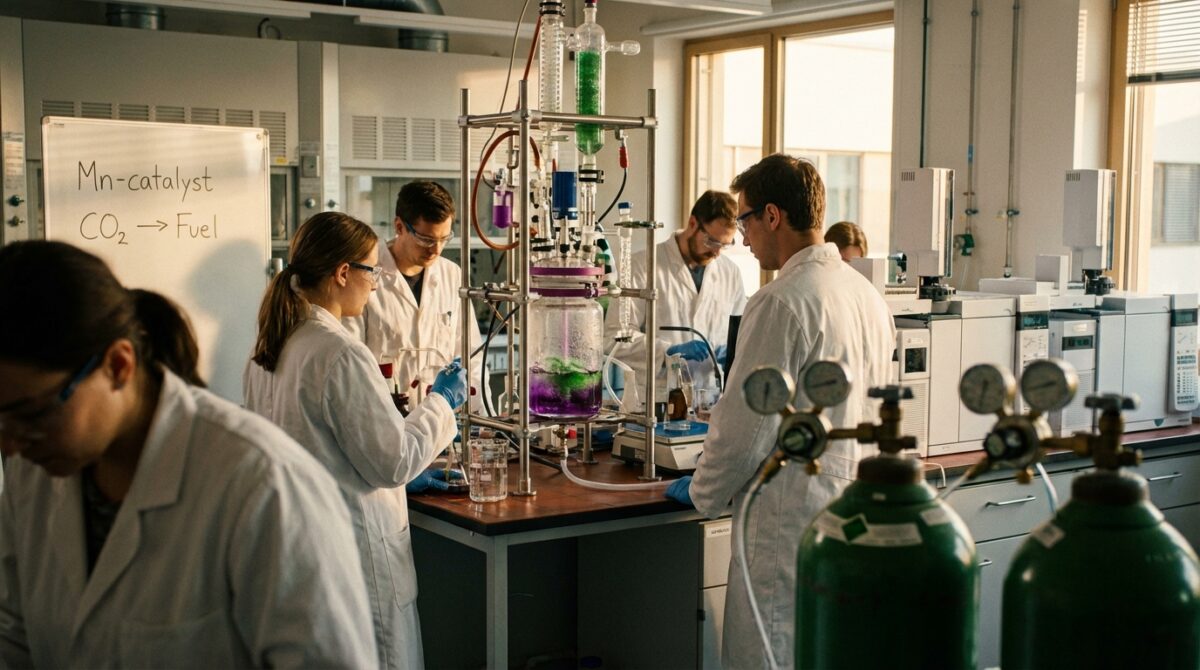
What if the same carbon dioxide you are trying to cut from your commute could one day store the hydrogen that powers your car? That is what a new study from Yale University and the University of Missouri now makes technically plausible, with an innovative catalyst built from one of the world’s most common metals.
Researchers have shown that a manganese-based system can convert CO2 into formate efficiently, offering a fresh route to sustainable fuel and clean energy storage that breaks away from rare and expensive metals.
New manganese catalyst rewrites CO2 conversion rules
The work, published in Chem, demonstrates that manganese complexes can rival or outperform catalysts based on precious metals for CO2 conversion to formate. The team, led by Yale chemist Nilay Hazari and University of Missouri professor Wesley Bernskoetter, reports high stability and turnover numbers that were previously out of reach for such an abundant element.
Revolutionary Carbon Material Poised to Slash Carbon Capture Costs
Scientists Transform CO2 into Clean Fuel with Innovative Single-Atom Catalyst Breakthrough
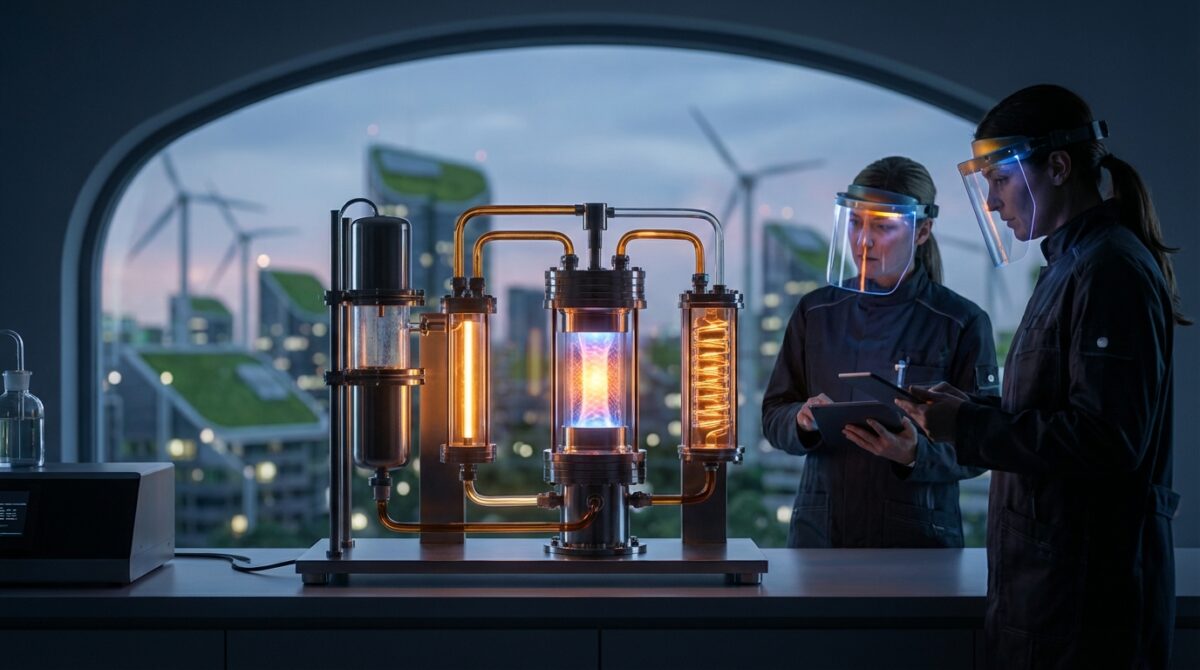
The study’s lead authors, Yale postdoctoral researcher Justin Wedal and Missouri graduate assistant Kyler Virtue, focused on a single design idea: tweaking the ligand, the molecular “frame” that holds manganese in place. By adding one extra donor atom, they dramatically extended the catalyst’s working life, pushing low-cost green technology a step closer to industrial relevance.
Method in one sentence: stabilising manganese to tame CO2
The team reacted pressurised carbon dioxide with a hydrogen source in the presence of newly designed manganese complexes, then monitored how efficiently the catalyst produced formate and how long it survived before degrading. This seemingly minimalist setup allowed them to isolate how small shifts in ligand structure changed performance over many cycles.
In parallel, spectroscopic analysis and kinetic measurements mapped out how the catalyst evolved during reaction. That combination of durability tests and mechanistic tracking is what supports the claim that ligand design, rather than just metal choice, is doing most of the work.
Detailed results: formate as a clean hydrogen carrier
The central outcome is clear: manganese, a metal mined at scale around the world, can now drive reliable CO2 conversion to formate under realistic conditions. Formate and its protonated cousin, formic acid, already appear in industrial supply chains as preservatives and tanning agents, which simplifies the path toward broader deployment as hydrogen carriers.
Compared with earlier manganese systems that deactivated quickly, the new complexes stayed active for far longer reaction times, with turnovers competitive with noble-metal catalysts described in resources such as recent manganese hydrogen-storage reports. While the Chem paper’s exact numbers vary by test, the trend is consistent: adding that extra donor atom stabilises the active species and slows down decomposition pathways.
Why this matters for hydrogen fuel cells and clean energy
Hydrogen fuel cells convert chemical energy into electricity with only water as a by-product, but safe storage and transport of hydrogen remain obstacles. Liquid formate or formic acid can store hydrogen in a compact, environmentally friendly form and release it on demand in a fuel-cell system, avoiding high-pressure tanks.
Today, most industrial formate production still depends on fossil-based feedstocks, which blunts the climate benefit. A route that starts from captured carbon dioxide unlocks a double gain: it supports carbon capture efforts and provides a recyclable, renewable reservoir for hydrogen. In this sense, the manganese catalyst operates as a link between waste emissions and practical sustainable fuel logistics.
How this innovative catalyst compares to other CO2-to-fuel breakthroughs
The manganese study sits in a rapidly evolving landscape of innovative catalyst research. Copper-based systems highlighted in outlets like reports on copper catalysts for clean fuel target methanol or multi-carbon products, while other teams focus on one-step routes from waste CO2 and green hydrogen to jet fuel, as summarised in coverage of aviation fuel innovations.
Compared with those multi-step syntheses, the manganese route deliberately narrows its scope to formate, trading product complexity for efficiency and stability. Instead of trying to replace every fossil-derived molecule at once, it offers a specialized tool for hydrogen storage that can plug into future mobility and grid-balancing systems.
The ligand tweak that changed the catalyst’s behaviour
At the molecular level, the key innovation lies in the ligand architecture surrounding manganese. By adding an extra donor atom, researchers created a more electron-rich environment that better supports the metal during redox swings, reducing its tendency to fall apart under operating conditions.
Wedal described satisfaction at seeing this design principle translate from theory to practice, turning a once-fragile system into a robust workhorse. That success also resonates with broader work in homogeneous catalysis, where small changes in ligand geometry often unlock large jumps in performance.
From lab to real-world sustainable fuel applications
To picture the impact, imagine a regional bus fleet run by a company like the fictional “MetroGreen Transit.” Instead of trucking compressed hydrogen into depots, MetroGreen could receive liquid formate produced using captured industrial CO2 and renewably sourced hydrogen.
On-site units would reconvert formate to hydrogen for fuel cells, cutting local emissions and easing storage concerns. While this scenario still sits ahead of present deployment, it illustrates how a targeted advance in green technology can translate into everyday transport decisions.
Where manganese catalysis could go next
The authors point out that their design strategy is not limited to CO2 conversion. Similar ligand frameworks may improve catalysts that upgrade other small molecules, from nitrogen to oxygenates, and may intersect with emerging fields like the molecular control strategies described in forward-looking pieces such as explorations of quantum-inspired chemistry.
Funding from the U.S. Department of Energy’s Office of Science underscores policy interest in routes that merge carbon capture, hydrogen management and renewable feedstocks. As governments weigh investments in infrastructure, the availability of low-cost metals such as manganese could become a deciding factor in which pathways scale.
Key takeaways for readers tracking clean fuel innovation
For anyone following the shift to clean energy, several practical signals emerge from this work:
- Abundant metals matter: relying on manganese instead of precious metals improves cost and long-term supply security.
- Formate is more than a niche chemical: its role as a hydrogen carrier connects industrial chemistry to everyday mobility.
- Design details pay off: a single extra donor atom in the ligand changed stability enough to challenge established catalysts.
- Integration is the next hurdle: moving from flasks to pilot plants will test how this system performs under real operating constraints.
These points highlight a broader trend: climate solutions will likely combine specialised tools—such as this manganese system—with complementary advances, from fast CO2-to-CO processes described in sources like rapid conversion technologies to changes in land use and legal frameworks, occasionally illustrated by local stories like campaigns to protect urban trees.
How does the manganese catalyst turn CO2 into sustainable fuel storage?
The manganese catalyst promotes a chemical reaction where captured carbon dioxide reacts with a hydrogen source to form formate. This formate, or its protonated form formic acid, stores hydrogen in a stable liquid that can later release it inside a fuel-cell system. The process does not create a fuel you burn directly but a carrier that supports clean hydrogen-based energy cycles.
Why is manganese considered better than precious metals for CO2 conversion?
Manganese is abundant, relatively inexpensive and less toxic than many noble metals typically used in catalysts. This makes scale-up more realistic for large energy or industrial applications. The new study shows that, with a carefully engineered ligand, manganese can reach performance levels that begin to challenge those of precious-metal systems, while offering better long-term availability and lower cost.
Does this research mean CO2 emissions will soon become a major fuel source?
The findings show that CO2 can serve as a carbon input for useful chemicals such as formate, but they do not mean emissions automatically turn into fuel at large scale. Converting CO2 still requires energy and hydrogen, ideally from renewable sources. The manganese catalyst improves one step in this chain, yet full deployment will depend on infrastructure, policy support and the economics of competing technologies.
How is this work different from other CO2-to-fuel technologies?
Researchers Discover Innovative Method to Convert Sunlight into Sustainable Fuel
Researchers Develop Slippery Nanopores to Boost Blue Energy Harvesting
Many other projects aim to turn carbon dioxide into methanol, hydrocarbons or even jet fuel, sometimes through multi-step routes or solid-state catalysts. This study focuses on a homogeneous manganese system that converts CO2 into formate specifically for hydrogen storage. Rather than replacing all fossil fuels, it concentrates on making hydrogen logistics cleaner and more efficient within a broader clean energy system.
What are the main limitations of the current manganese catalyst system?
The research was performed under controlled laboratory conditions with defined pressures, temperatures and reagent purity. Real industrial gases and large reactors may introduce impurities and stresses that shorten catalyst life or reduce efficiency. Energy input and hydrogen sourcing also need to remain low-carbon for the system to deliver genuine climate benefits, which means results should be viewed as a promising step, not a finished commercial solution.