
Show summary Hide summary
- Large Tortoiseshell rediscovery: why this matters now
- How a “lost” UK species came back from extinction
- How to identify a Large Tortoiseshell in the field
- Climate, habitat and the future of this butterfly
- How your records can support conservation actions
- Where can I see the Large Tortoiseshell butterfly in the UK?
- How is the Large Tortoiseshell different from the small tortoiseshell?
- Is the Large Tortoiseshell still at risk in the UK?
- How can I help conserve this rediscovered species?
- Why did scientists once think the Large Tortoiseshell was extinct in Britain?
A butterfly thought lost from British wildlife for generations is suddenly gliding back through spring woodlands. The Large Tortoiseshell butterfly UK, once written off as extinct in the UK, is now officially classed as a resident species again.
Large Tortoiseshell rediscovery: why this matters now
The return of the Large Tortoiseshell is more than a pretty story about orange wings. It signals a shift in UK biodiversity, climate and woodland health. Recent early spring sightings across Kent, Sussex, Hampshire, Dorset, Cornwall and the Isle of Wight have convinced Butterfly Conservation that this is no longer just a wandering visitor.
Individuals emerging from hibernation in multiple counties show a stable presence rather than random one-off records. For the first time in the charity’s 58-year history, the butterfly is recognised as a true UK resident, pushing Britain’s native list to about 60 butterfly species. This change brings a new responsibility for long-term conservation.
Ocean alkalinity enhancement: Boosting carbon storage in the sea
Evaluating the Environmental Footprint: Dairy Milk vs. Plant-Based Alternatives
From Victorian abundance to apparent extinction
To understand the excitement, picture Edward, a keen naturalist from Kent who has dreamt of seeing this insect since childhood. In Victorian times, collectors like him would have found the Large Tortoiseshell common in southern and central England. By the late 20th century, though, it had vanished as a breeding species and was widely regarded as extinct in Britain.
Many people blamed the devastation of elm trees by Dutch elm disease in the 1960s and 70s. With one key habitat tree gone from the countryside, the butterfly’s decline accelerated. For decades, only rare stray individuals reached the south coast, leaving enthusiasts convinced the old populations were gone for good.
How a “lost” UK species came back from extinction
The turning point came with a run of warmer decades. The Large Tortoiseshell did well in parts of mainland Europe, especially the Netherlands and France. Rising temperatures allowed more individuals to cross the Channel and North Sea, echoing the pattern seen with other continental moths such as the Clifden nonpareil.
On the English south coast, numbers built up around 2006–2007, with clusters of sightings along key migration corridors. Some records were clouded by suspected unofficial releases from private breeders, making it harder to separate natural recolonisation from human intervention. The picture changed completely once wild caterpillars were discovered.
Breeding confirmed: caterpillars in British woodlands
Since 2020, larvae have been found feeding freely on trees in Dorset and later in other southern counties. This proved the butterfly was not just dropping in, but completing its whole life cycle in British woods. That evidence underpins the decision reported by outlets like The Guardian’s environment coverage.
The adults hibernate through winter, then emerge in early spring to mate. Eggs are laid on food trees, and the next generation takes flight in midsummer. Each warm, dry season now raises hopes that the rediscovery phase will evolve into a robust, self-sustaining population.
How to identify a Large Tortoiseshell in the field
For observers like Edward, the real thrill comes when a big orange butterfly bursts out from a sunny ride, and you only have seconds to decide what you are seeing. Distinguishing Large Tortoiseshell from the familiar small tortoiseshell matters for accurate recording and future conservation work.
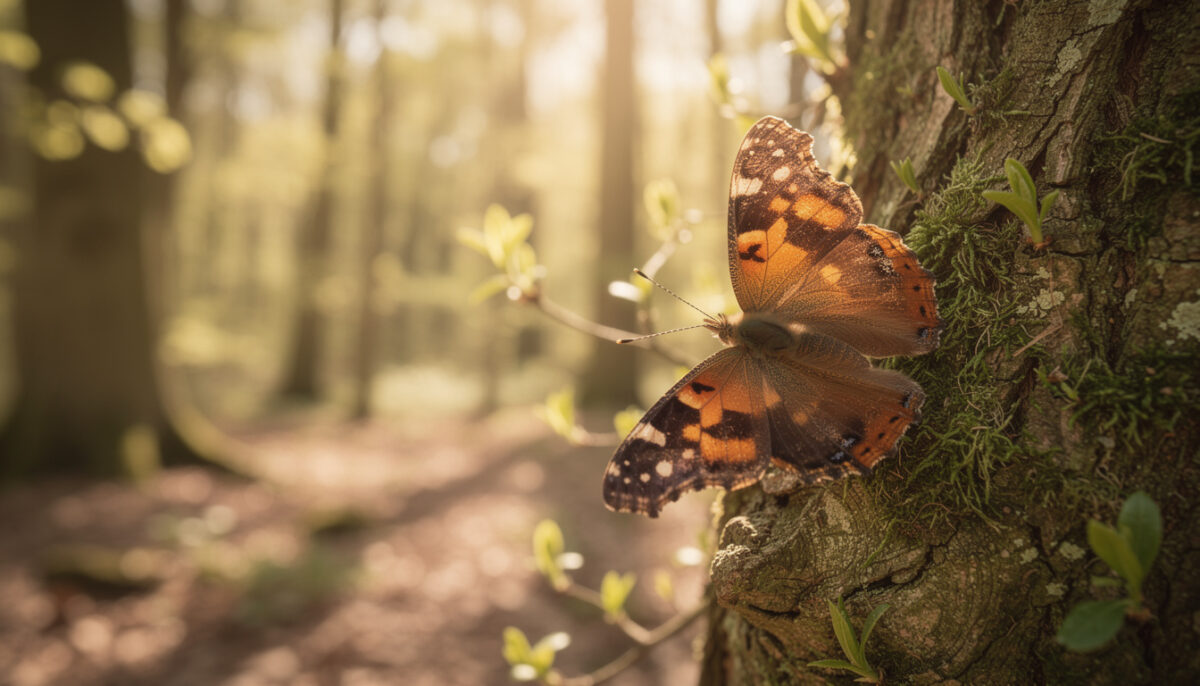
The Large Tortoiseshell is noticeably bigger, with a heavier, more powerful flight. The upperwings are deep orange with black blotches but lack the clean white patches near the wingtips that mark the smaller species. Undersides are mottled and bark-like, making a resting insect vanish against tree trunks or fence posts.
Habitat preferences and behaviour differences
Unlike small tortoiseshells, which you encounter in gardens and parks feeding on nettles, the Large Tortoiseshell is strongly tied to trees. Caterpillars use elm, willow, aspen and poplar, often in mixed or edge woodland. Adults bask high in the canopy, then drop to sunlit clearings or path edges.
This canopy-focused lifestyle explains why some records come from seasoned woodland watchers rather than casual garden observers. Local groups such as Dorset and Sussex branches of Butterfly Conservation share detailed field tips on sites like Dorset Butterflies and regional species pages, helping you refine identification skills.
- Size: larger, broader wings than small tortoiseshell.
- Wing tips: no bright white blocks; pattern more diffuse.
- Habitat: mature woodland edges, rides, tree-lined slopes.
- Season: adults in early spring and again mid-summer.
- Behaviour: often basks on trunks, logs or sunny banks.
Climate, habitat and the future of this butterfly
The Large Tortoiseshell’s comeback sits at the intersection of climate change, woodland management and citizen science. Warmer conditions have opened a window for recolonisation, yet the same global heating threatens many other wildlife species. Its story is both hopeful and uneasy.
To secure this new UK resident, suitable habitat must be protected and expanded. Mixed native woodland, wet areas with willows, and recovering elm stands all matter. Thoughtful coppicing, ride widening and tree planting can create the warm, sheltered pockets where this butterfly thrives, while also helping a range of woodland insects and birds.
How your records can support conservation actions
For Edward and thousands of other observers, every sighting is now data. Butterfly Conservation encourages you to log observations through iRecord and local schemes. Media outlets like the BBC’s wildlife reports have highlighted how citizen science has tracked this rediscovery from isolated individuals to clear breeding evidence.
Each verified record sharpens distribution maps and informs decisions on woodland planning. When planners, landowners and charities see real numbers on the ground, they can justify targeted habitat work. The Large Tortoiseshell’s return shows how attentive monitoring can turn a story of extinction into a powerful case for active conservation.
Where can I see the Large Tortoiseshell butterfly in the UK?
Current records concentrate in southern England, especially Kent, Sussex, Hampshire, Dorset, Cornwall and the Isle of Wight. Look in sunny woodland edges, rides and tree-lined valleys during early spring and again in midsummer. Checking local Butterfly Conservation branch updates will help you find the latest hotspots.
How is the Large Tortoiseshell different from the small tortoiseshell?
The Large Tortoiseshell is bigger, with broader wings and a heavier flight. It lacks the bright white patches near the wingtips that characterise the small tortoiseshell. It also prefers woodland habitats and tree-feeding caterpillars, rather than gardens and nettle patches.
Is the Large Tortoiseshell still at risk in the UK?
Yes. Although it is now recognised as a resident species, its populations are still developing and localised. Climate, habitat quality and potential loss of host trees all influence its future. Continued monitoring, woodland management and protection of key sites are needed to keep numbers growing.
How can I help conserve this rediscovered species?
Love and Survival Beneath the Waves: How a Daring Marine Lab Rescued a Sea Snail from Extinction
Study Reveals Humanity is Accelerating Earth’s Warming at Unprecedented Rates
You can support the butterfly by recording sightings through iRecord or local schemes, volunteering with woodland projects, and backing organisations such as Butterfly Conservation. If you manage land, maintaining mixed woodland, rides and stands of elm, willow, aspen or poplar will benefit the species.
Why did scientists once think the Large Tortoiseshell was extinct in Britain?
By the late 20th century, there were no confirmed breeding populations, and sightings were extremely rare. The loss of elms to Dutch elm disease and the UK’s position near the northern edge of the species’ natural range contributed to the collapse. Only recent breeding records have shown that it has re-established itself.