
Show summary Hide summary
- Did this Utah cloud seeding startup really boost snowfall?
- The science behind ionized cloud seeding and snowfall claims
- From Utah’s snowpack to global water stress and Earth impacts
- Environmental impact, ethics, and what it means for Earth
- Did the Utah startup really increase snowfall by 20 percent?
- How is this cloud seeding method different from silver iodide programs?
- Is ionization-based weather modification proven to work?
- What are the main environmental concerns of artificial snow technologies?
- Why does Utah invest so much in snowpack enhancement?
Imagine a winter storm surging over the La Sal mountains in Utah and dropping noticeably more snowfall on one side than on the other, not by chance but because a cloud seeding startup flipped a switch. This scenario feeds a heated debate today on the reality of weather modification.
At the heart of this controversy, a young climate technology company, Rain Enhancement Technologies, claims to have increased snow by 20% in a Utah mountain range using a chemical-free cloud seeding method. The stakes go far beyond skiing: it touches on water management, the water security of the American West, and how societies rely on artificial snow to adapt to a warmer climate.
Did this Utah cloud seeding startup really boost snowfall?
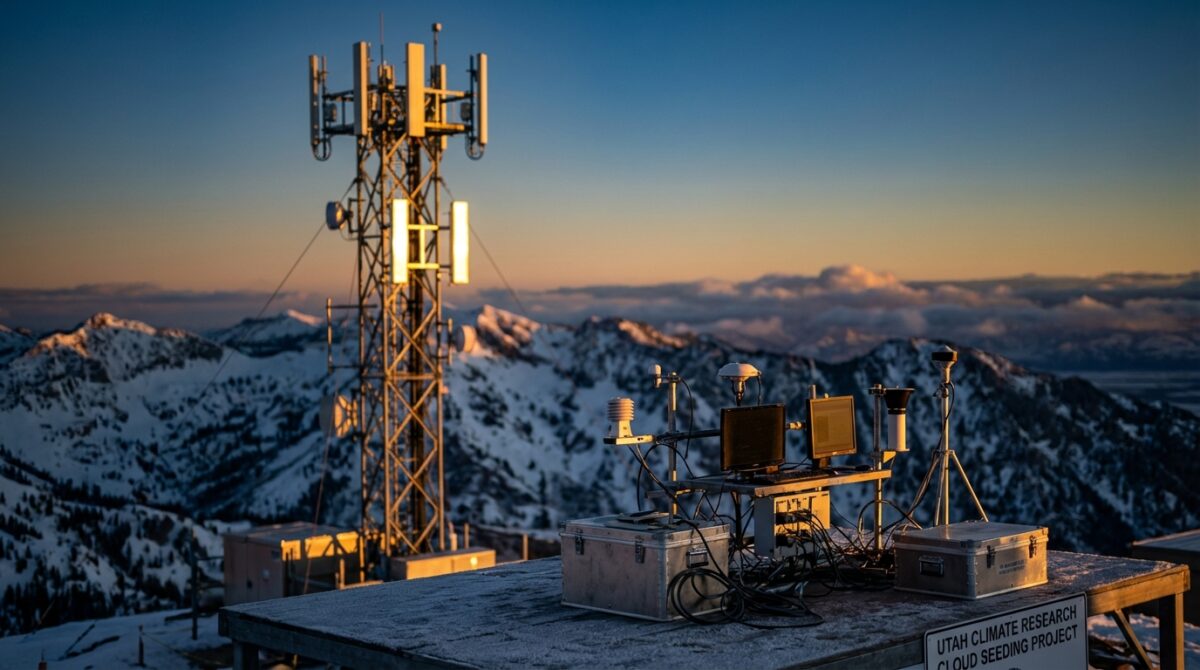
In an American West marked by a record “snow drought,” Utah authorities are monitoring every inch of snowpack, this natural reservoir that feeds the Colorado and conditions the following summer. It is in this setting that Rain Enhancement Technologies has installed a network of precipitation enhancement equipment near the La Sal mountains.
Exposing Truth Battling Big Oil’s Plastic Expansion
‘It Sounds Apocalyptic’: UK Floods Endanger Wildlife
The company compared five recent dry winters between the La Sal and Abajo mountains, located 70 kilometers further south. When its high-voltage device was operating in the wind of the La Sal in January, the range reportedly received about 9 centimeters more snow than what the comparison with the Abajo would suggest. A modest gain on the scale of a ski resort, but potentially decisive for a thirsty watershed.
How Utah became a test bed for weather modification
Utah is not new to cloud seeding. The state already runs the world’s largest remote-controlled program, with nearly 200 ground generators dispersing silver iodide into winter clouds. This system, described by the Department of Natural Resources and reported by media like Great Salt Lake News, aims primarily to thicken the snow cover over major watersheds.
Against this already sophisticated backdrop, the arrival of a startup betting on electrical ionization introduces a sharp contrast: no chemicals, no plane, only electricity and wind. Utah thus becomes an open-air lab where classical methods and electrostatic approaches coexist, offering a rare observation field for hydrologists.
The science behind ionized cloud seeding and snowfall claims
Unlike silver iodide, Rain Enhancement Technologies’ technology relies on a large antenna formed by a wire wound between two 8-meter poles. The company circulates up to 10,000 volts in this wire, which negatively charges tiny particles like dust, soot, or salt grains suspended in the air.
Carried by the wind, some of these ionized particles are driven towards the clouds. Water droplets naturally condense around aerosols, but here, the electrical charge adds a layer of complexity: even two droplets with the same charge create a local polarity, with a more positive side attracted to a more negative side of a neighbor. This attraction would encourage more frequent collisions and faster coalescence, accelerating the formation of droplets or ice crystals large enough to fall to the ground.
What scientists say about precipitation enhancement evidence
Historical experiments support this hypothesis. During the Cold War, high levels of ionization linked to atmospheric nuclear tests seemed to coincide with increased rainfall. A 2020 analysis, for example, highlighted nearly 24% more rain over the Shetlands during the most radioactive days.
Rain Enhancement Technologies also highlights a five-year trial in Oman, where data suggests a 10 to 14% increase in precipitation, and a similar experiment in China reporting a gain close to 20%. However, the scientific community remains cautious. Climatologists interviewed by specialized media, including New Scientist, remind that precipitation varies greatly from season to season and that about five dry winters are not enough to establish solid evidence.
From Utah’s snowpack to global water stress and Earth impacts
Behind the numbers of snowfall increase, the underlying issue is water security. The UN now mentions entering an era of “water bankruptcy,” where up to three-quarters of the global population could face chronic shortages or contamination. In this context, each gain of a few percent in snowpack in Utah resonates well beyond the Rockies.
For someone like Emily, a water management engineer in Salt Lake City, an extra layer of snow means slightly fuller reservoirs in the summer, some crops saved, and perhaps less pressure on the fragile ecosystem of the Great Salt Lake. Resources like the Utah State University Extension article detail how these techniques are accompanied by conservation efforts, from reducing home watering to reusing wastewater.
Environmental impact, ethics, and what it means for Earth
Traditional weather modification programs relying on silver iodide regularly raise toxicological questions, even though measured concentrations remain very low. The electrical option put forward by this startup bypasses some of these concerns but opens another debate: how far to modify interdependent atmospheric systems without mastering all the side effects?
Authorities in several US states have already considered, or even adopted, partial bans on cloud seeding, also fueled by conspiracy theories about “chemtrails.” For scientists, the way forward is clear: multiply measurement campaigns, document long-term effects, and keep these projects under public review. As cities worldwide seek solutions to water shortages, Utah’s experience will serve as a reference, whether it confirms or not the promise of a controllable precipitation enhancement.
- Public cloud seeding programs with silver iodide tested for decades.
- Emerging electric technologies betting on air ionization.
- International trials in Oman, China, and now in Utah.
- Debates on environmental impact and potential health risks.
- Urgent needs for reliable data to guide water management.
Did the Utah startup really increase snowfall by 20 percent?
Rain Enhancement Technologies observed about 20% more snow on the La Sal mountains during certain operations, with an estimated surplus of 9 centimeters compared to a neighboring range. However, climatologists point out that this difference could be due to natural variability and call for longer series to confirm the effect.
How is this cloud seeding method different from silver iodide programs?
Traditional cloud seeding programs in Utah disperse silver iodide from ground generators or aircraft, targeting cold clouds to form more ice crystals. The startup’s method relies on the electrical ionization of particles already present in the air, without adding chemicals, and is remotely controlled by activating a high-voltage antenna.
Is ionization-based weather modification proven to work?
The available evidence, from Oman to China to Utah, suggests a possible increase in rain or snow on the order of 10 to 20%. However, the World Meteorological Organization considers that the demonstration remains insufficient and calls for better-controlled experiments, with longer statistical series and independent measurements.
What are the main environmental concerns of artificial snow technologies?
For silver iodide, the key issue is long-term accumulation in soils and waters, even though current doses remain very low. For electrical systems, the focus is more on regional changes in precipitation distribution and the risks of shifting water from one watershed to another. In both cases, scientists request close monitoring of ecosystem impacts.
Why does Utah invest so much in snowpack enhancement?
England’s Red Squirrels on the Brink: Is There Hope?
Destabilized Ice Shelf Spurs Fast Movement of Antarctic Glacier
Utah relies heavily on its winter snowpack to supply the Colorado River and secure drinking water, agriculture, and industry. Facing warmer and drier winters, the state has developed the world’s largest remote-controlled cloud seeding program and is now testing innovative approaches, hoping to extract a bit more water from each storm while monitoring environmental impacts.