
Show summary Hide summary
- Why a national AV bill challenges city and state control
- Limits on local regulation of self-driving cars
- Competing visions: safety, innovation and local voice
- How this federal bill compares with past AV regulation
- What this federal AV debate means for city life
- Key takeaways for residents watching the AV rollout
- What does the new federal AV bill change for cities?
- How does the safety case requirement work for autonomous vehicles?
- Will self-driving cars still be legal without this legislation?
- How could this bill affect public transport users?
- Who are the main supporters and critics of the proposal?
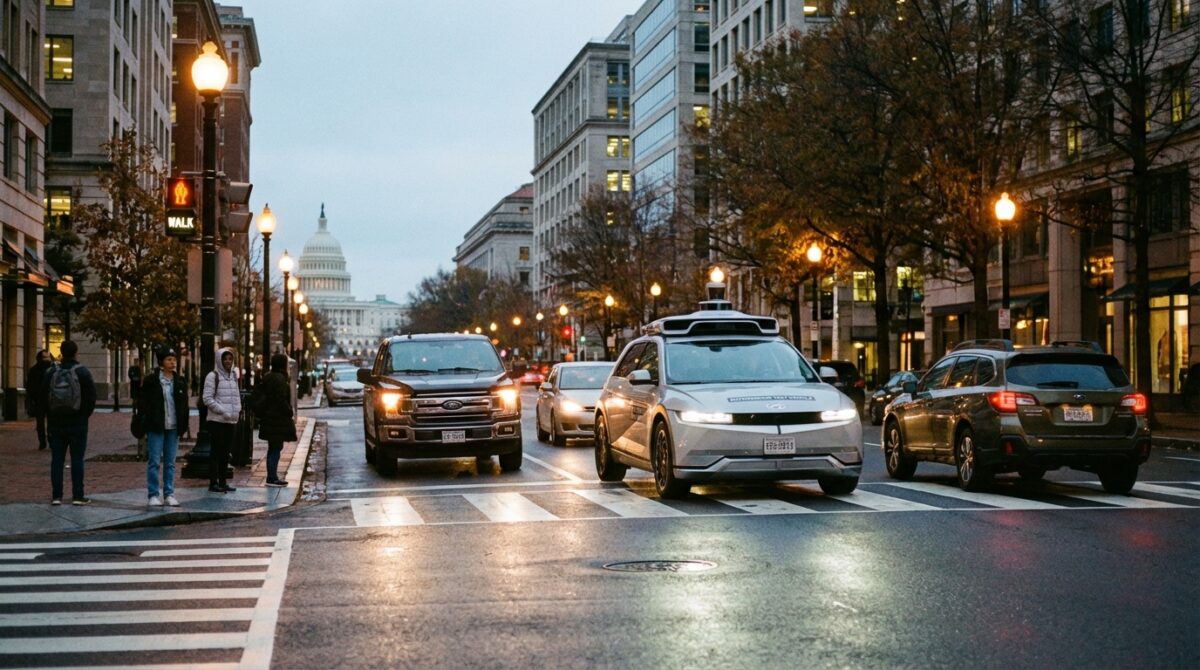
When a self-driving taxi blocks an ambulance, the abstract debate about Autonomous Vehicles becomes painfully real. In San Francisco, robotaxis stopping in darkened intersections during a blackout showed how software decisions can decide whether an entire street moves or freezes.
That kind of incident now sits at the heart of a new Federal Bill in Washington, one that could sharply limit how cities and states manage these machines on their streets. The proposal promises national rules for Self-Driving Cars, but it also raises a pointed question: who really gets to shape daily life on urban roads?
Why a national AV bill challenges city and state control
U.S. Representatives Debbie Dingell of Michigan and Bob Latta of Ohio have introduced draft legislation that could reset Transportation Policy for automated driving nationwide. The bill aims to create the first comprehensive federal statute focused on Autonomous Vehicles safety, after several failed attempts in 2017, 2020 and 2021.
Our cities are choked by cars—but the real solutions experts propose will shock most drivers
How Paris Revolutionized Urban Life by Replacing Cars with Bikes and Revamping Its Streets
At its core, the proposal would curb City Control and State Control over vehicles equipped with an automated driving system once those vehicles meet new federal requirements. For residents in dense neighbourhoods already reshaped by ride-hailing and delivery vans, this marks another shift of power from local planners to distant regulators in Washington.
How the proposed safety case system would work
The draft legislation would require every manufacturer deploying an automated driving system to prepare a detailed “safety case”. This document would explain how the technology manages core driving tasks, handles failures and responds to emergencies. According to legal analysis from Sidley, companies would be allowed to self-certify these safety cases before submitting them to the National Highway Traffic Safety Administration (NHTSA).
Unlike earlier voluntary guidance from NHTSA, described by experts in sources such as Associated Press coverage of safety guidelines, the new framework would carry statutory weight. Yet safety advocates warn that self-certification, without regular public reporting, could leave residents relying heavily on company assurances rather than transparent data.
Limits on local regulation of self-driving cars
The most contested feature of the Legislation is its language restricting subnational authority. Once an AV has a safety case on file with NHTSA, states and cities would be barred from regulating that vehicle directly, beyond certain rules that already apply to conventional cars in use.
For fast-growing regions experimenting with local rules on testing zones, fleet caps or emergency response plans, this could be transformative. Reporting from outlets like the Houston Chronicle on House AV debates illustrates how sprawling metros worry about congestion, while compact cities worry about curb space and sidewalks. A single federal standard may not reflect those sharply different realities.
What this means on a busy urban street
Imagine Leila, a nurse finishing a night shift in a large Midwestern city. Today, her route home mixes buses, occasional ride-hail trips and a short walk. Under a future governed by this bill, a national fleet of robotaxis might serve her neighbourhood, regardless of whether her city council favoured aggressive AV deployment or preferred a slower rollout.
Local officials could still manage issues like parking rules or general traffic laws, but not the specific operation of AVs with certified safety cases. For residents, this means the character of traffic—how many empty vehicles circle, where they stop, how they behave around bike lanes—would depend far more on federal Government Oversight and corporate strategy than on city hall debates.
Competing visions: safety, innovation and local voice
The bill’s supporters argue that the United States needs a unified framework to stay competitive. Industry representatives, including leaders from the Alliance for Automotive Innovation, claim that strong national standards will enable AVs to reduce crashes, ease congestion and connect seniors and people with disabilities to jobs and services. Analyses like those at Newsweek on proposed federal rules for self-driving cars highlight that argument.
Yet the same hearing that celebrated “significant progress” also revealed deep unease. Michael Brooks from the Center for Auto Safety criticised the draft’s safety case language, pointing to the absence of routine submissions or mandatory reports to the Transportation Secretary or NHTSA. For him and other advocates, the risk is a legal structure that moves faster than the public evidence base.
Data gaps and incidents that shape public trust
Representative Lori Trahan stressed that policymakers still lack reliable information on sudden stops, traffic blockages and impacts on first responders. Her concerns followed events like Waymo vehicles halting in San Francisco during a citywide blackout, leaving roads partially obstructed when traffic lights failed.
Researchers tracking these issues through tools such as the National Conference of State Legislatures AV database and legal reviews in the Law and Mobility Journal on smart mobility regulation underscore how fragmented reporting remains. For people walking or cycling alongside AVs, that fragmentation translates into uncertainty about who is accountable when things go wrong.
How this federal bill compares with past AV regulation
For nearly a decade, the United States has relied on a patchwork of state rules layered over federal auto safety law. States like Arizona and Texas opened doors wide to AV testing, while others imposed stricter oversight. Analyses from institutions such as Stanford, for example in overviews of automated driving law near the end of the Biden administration, describe how this patchwork complicated nationwide deployment.
Earlier efforts at federal coordination, including voluntary guidance documents and proposed rules discussed in outlets like Scientific American’s coverage of new U.S. AV rules, stopped short of sweeping preemption. The current bill goes further by tying limits on local power to the presence of a certified safety case, a structure described in detail in legal briefings such as recent analyses of the federal SELF DRIVE proposal.
Who stands to gain, and who worries most
Automakers and technology firms see advantages in a single national standard: simplified deployment, consistent compliance obligations and the ability to scale fleets rapidly across regions. Earlier commentary on federal frameworks, such as coverage of Department of Transportation initiatives in Business Insider’s reporting on AV frameworks, already highlighted these industry priorities.
City leaders, transit agencies and some community groups express a different concern. They fear that limits on City Control and State Control could weaken local experiments that integrate AVs with buses, bike networks and pedestrian zones. For them, the street is more than a test bed; it is a shared public space where residents negotiate safety, climate goals and social life.
What this federal AV debate means for city life
The hearing room discussion in Washington may feel distant from a crowded crosswalk or a bus stop bench, yet its consequences will be visible at eye level. When this Federal Bill shapes how Regulation works, it will influence whether AVs support or undermine daily routines in neighbourhoods of every size.
For people living in cities, several questions loom large. Who decides when robotaxis may operate during severe weather or grid failures? How are emergency services prioritised when software controls traffic flow? Will dense, transit-rich districts be allowed to prioritise buses and bikes over fleets of automated cars circling empty, searching for passengers?
Key takeaways for residents watching the AV rollout
As debate continues, urban residents and local advocates can watch for several signals:
- Transparency of safety cases: Are summaries shared publicly, and can independent experts review them?
- Role of local emergency services: Do fire, police and ambulance departments help shape operational rules?
- Integration with public transport: Are AVs planned as complements to buses and trains, or as competitors?
- Data on street-level impacts: Are stoppages, near misses and accessibility outcomes measured and reported?
- Meaningful local input: Do residents have formal channels to influence how AV fleets operate in their neighbourhoods?
The answers will determine whether self-driving technology feels like a distant federal initiative or a shared project in which city dwellers, planners and companies all have a hand.
What does the new federal AV bill change for cities?
The bill would limit how cities and states regulate vehicles equipped with automated driving systems once those vehicles have a certified safety case on file with NHTSA. Local governments could still enforce general traffic and safety rules, but they would have less authority over the specific deployment and operation of autonomous vehicles compared with today’s patchwork of state-level regulations.
How does the safety case requirement work for autonomous vehicles?
Manufacturers deploying automated driving systems would have to prepare a detailed safety case explaining how their technology manages driving tasks, failures and emergencies. They would self-certify these documents and submit them to NHTSA. Critics argue that without regular reporting requirements or independent verification, residents and local officials may not see enough concrete data behind those safety claims.
Will self-driving cars still be legal without this legislation?
Yes. Autonomous vehicles can already operate under existing federal vehicle safety rules and diverse state laws. The proposed legislation does not create legality from scratch; instead, it seeks to harmonise rules and clarify federal authority. Its main impact would be to establish a national framework for safety cases and to preempt certain types of state and city regulation.
How could this bill affect public transport users?
Massive Food Waste as Automated Systems Deny Truckload Approvals
Satellites Reveal Hidden Flaws in Bridges Across America and Beyond
The impact will depend on how fleets are deployed. If AVs are used as feeders to bus or rail networks, they could shorten first- and last-mile trips. If they mainly replace transit trips, they could increase congestion and weaken bus ridership. Because the bill limits some local regulatory levers, cities might find it harder to steer autonomous vehicle services toward supporting existing public transport priorities.
Who are the main supporters and critics of the proposal?
Support tends to come from automakers, technology companies and some federal policymakers who emphasise national competitiveness and uniform standards. Concerned voices include safety advocacy groups, some city leaders and members of Congress focused on data transparency and emergency response. Their central worry is that national rules could move ahead of independent evidence and reduce local capacity to adapt deployment to on-the-ground conditions.